Beta Testers: Where to Find Them as a Startup
Where startups find beta testers, how many to recruit, how to keep them engaged, and how to turn beta testers into your first paying users.
Beta testers are real people who use your product in their own environment, over time, before the full launch, and tell you what breaks, what confuses them and what they love. For a startup they are more than QA:
- They are your first users. Good testers are early adopters with the problem you solve.
- They are your first proof. Their feedback and quotes become testimonials on launch day.
- They are a channel. Where you recruit them is often where your first customers come from.
The fastest place to find them is where early adopters already look for new products: launch platforms like Microlaunch, beta directories like BetaList, and communities your audience reads. This page covers where to recruit, how many testers you need, and how to turn a beta into a user base. If you are still deciding when a product is ready for outside users, start with our beta testing vs alpha testing guide. For a full list of places to recruit, see our beta testing websites guide.
What beta testers actually do
Beta testers answer the question that kills most startups. In CB Insights' analysis of 101 startup post-mortems, no market need was the No. 1 reason for failure, cited in 42% of cases. Centercode, which builds beta test software, describes the job well: beta testers use real products in real environments, follow test activities, and give feedback as issues, ideas and praise. Their job isn't only to report bugs, it's to show how the product behaves in the wild.
The testers worth recruiting share three traits, again per Centercode:
| Trait | What it means for you |
|---|---|
| They are in your target market | Their feedback reflects what paying customers will hit |
| They have the problem you solve | They stay engaged because they want the product to work |
| They put in the time | They give insights you can act on, not one-line "looks good" replies |
Where to find beta testers
Pick channels where your future customers already are, not where testers are cheapest. A tester paid to click through screens rarely becomes a user. Expect to recruit the first ones by hand: in Do Things that Don't Scale, Paul Graham calls recruiting users manually the most common unscalable thing founders have to do at the start.
| Channel | Who you reach | Best for | Trade-off |
|---|---|---|---|
| Launch platforms (Microlaunch) | Founders, makers and early adopters browsing new products | Web apps, SaaS and AI tools that want testers who can become users | You need a working product page, not just an idea, but testers stay visible for 30 days and can leave reviews |
| Beta directories (BetaList) | People looking for early access to upcoming startups | Pre-launch products collecting a waitlist | Listing review can take time |
| Communities and forums | Niche audiences on Reddit, Slack and Discord groups | Products with a clear niche | Self-promotion rules vary, so read each group's rules |
| Your own network and waitlist | People who already know you | The first 10 to 20 testers | Friends are polite, so feedback is softer |
| Managed testing services (BetaTesting) | Recruited panels matching criteria you set | Hardware, regulated or hard-to-reach audiences | Paid, and testers are less likely to stay as customers |
Launch platforms: testers who can become users
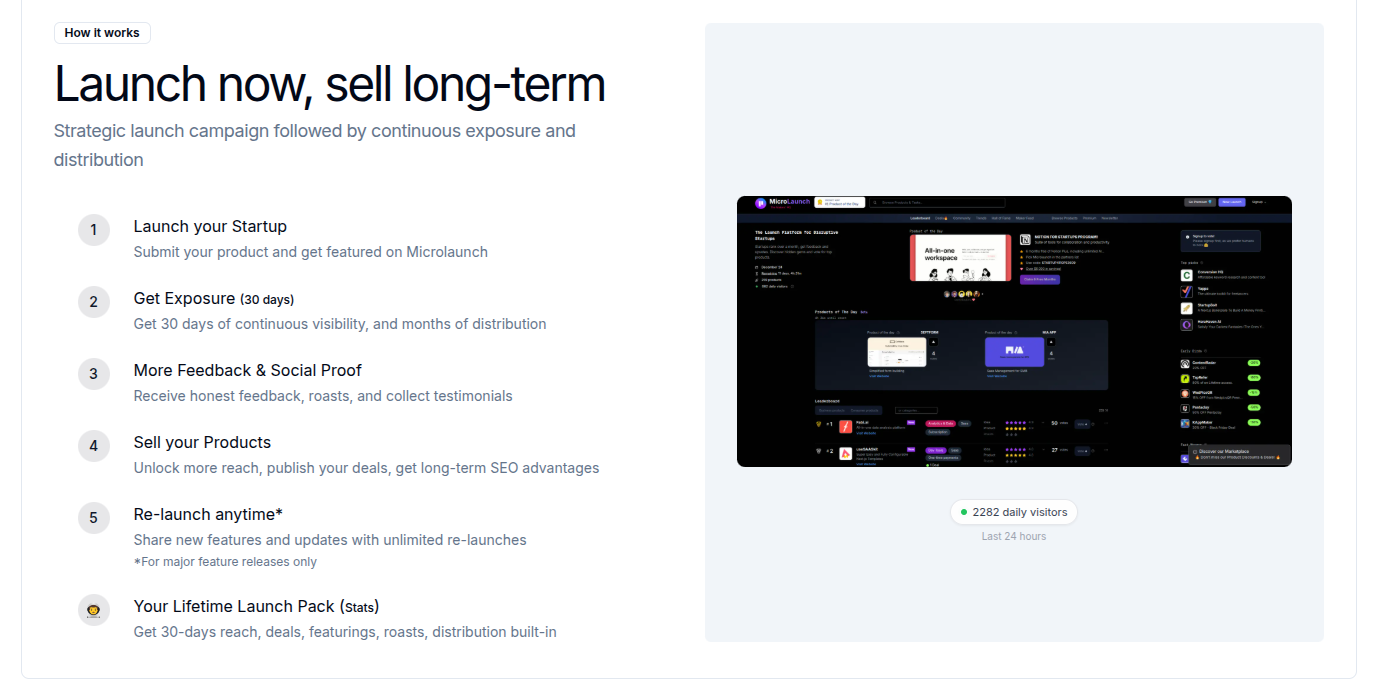
A launch puts your product in front of people who browse new products on purpose. On Microlaunch, a launch runs as a 30-day campaign instead of a single day:
- You launch your startup and get featured.
- You get 30 days of continuous visibility and months of distribution.
- Visitors leave honest feedback and roasts, and you collect testimonials.
- You can publish deals and re-launch when you ship a major feature.
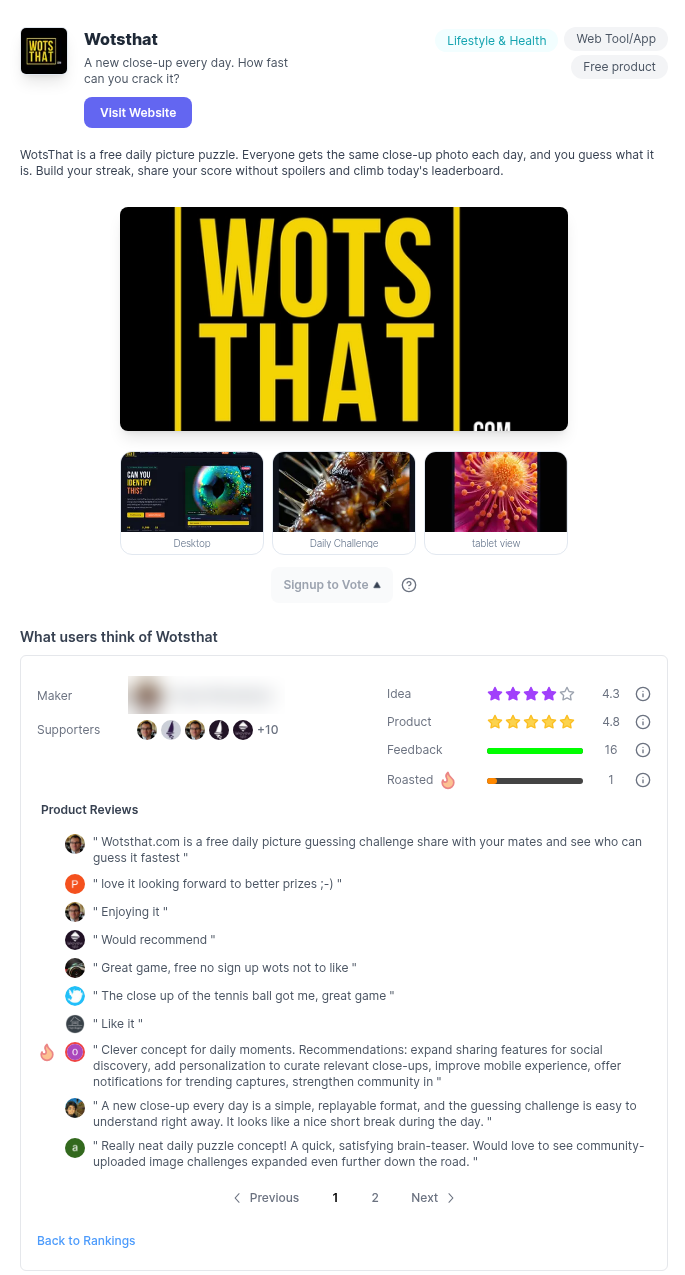
That is a beta test with an audience attached: the people who try your product and comment are early adopters by definition. Microlaunch reports 650,000+ unique visitors in total and 30k+ a month, and its Launch Pro pack adds verified reviews, featured spots, a marketplace spot for deals and DR65+ do-follow backlinks. You can browse current launches to see the kind of products and feedback there. Each product page collects an Idea score, a Product score, written reviews and roasts (critical feedback) from the people who tried it:
To reach more early adopters at once, Launch Everywhere adds submissions to 50 launch and SaaS directories with a live status for each. Our Product Hunt alternatives guide compares the other launch platforms worth a listing.
Beta directories: early access seekers
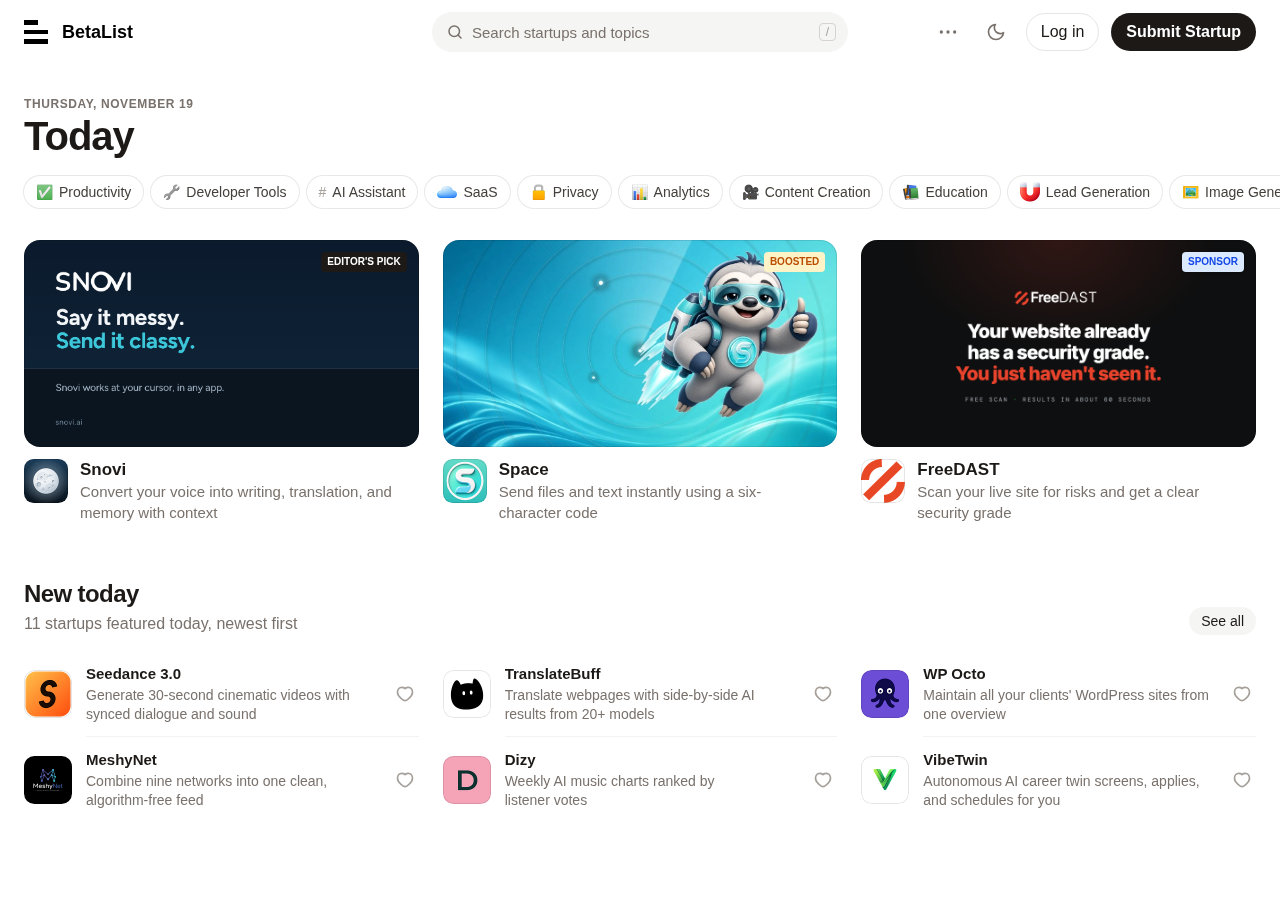
BetaList lists upcoming internet startups and invites visitors to "discover and get early access" to them. Founders can also boost a listing. It suits products that are still pre-launch and want a waitlist of people who chose to try new things.
Managed services: when you need a specific panel
When you need testers with specific hardware, in specific countries or at the same time, a managed service recruits them for you. BetaTesting, for example, offers custom audience recruiting, test design consulting, shipping and logistics for hardware, and feedback analysis, priced per test or as one yearly price. It describes recruiting testers in the U.S., Brazil, Italy and Germany for a wearable test. This is the right tool for a hardware or enterprise product; for an early SaaS it costs more and gives you fewer future customers than a launch.
Closed or open beta?
Testlio splits beta tests into several types. The two that matter most for a startup:
| Type | How it works | Use it when |
|---|---|---|
| Closed beta | Invite-only, testers picked on criteria like expertise or profile | You need focused feedback and want to fix critical issues before a wider release |
| Open beta | Available to a larger, often public audience | The core works and you want broad feedback and your first public users |
A common path: run a closed beta with your network and a waitlist, then open it up with a public launch.
How many beta testers do you need?
The number of beta testers you need depends on what you want to learn, not on a fixed rule. Size the group by the question:
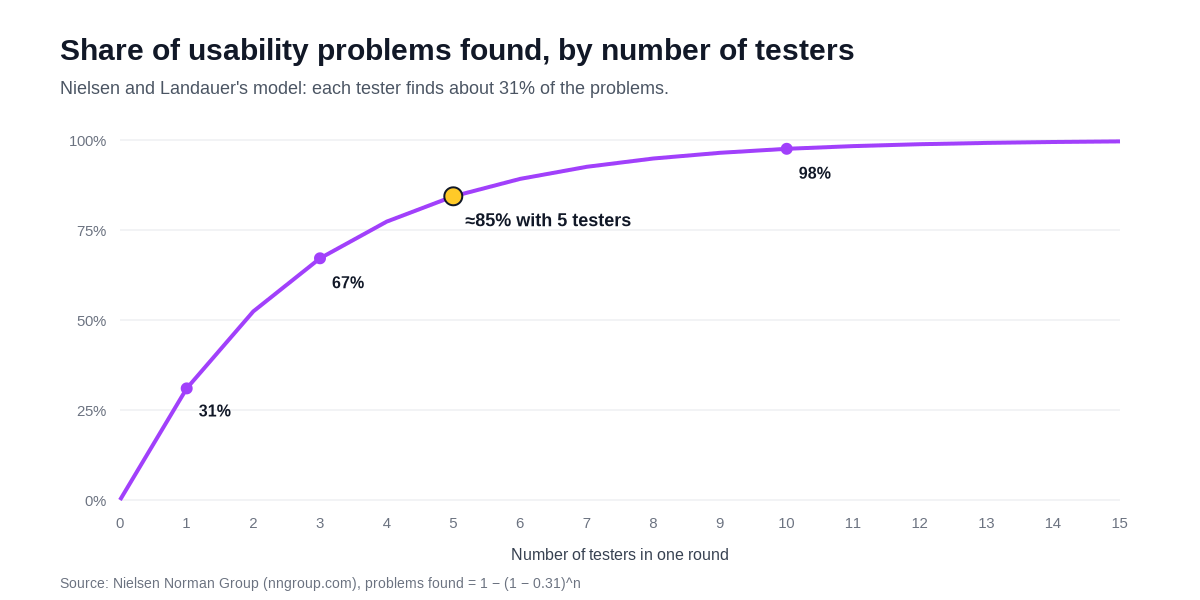
- Usability and onboarding: 5 testers who match your target user find about 85% of the usability problems, according to Nielsen Norman Group's model. Fix them, then test again with another 5 rather than inviting 30 at once.
- Bugs across devices and browsers: more testers on more setups. Testlio notes testers try software on as many combinations of devices, operating systems and browsers as possible.
- Demand and retention: enough people that you can see who comes back after week one. For numbers you can trust, such as success rates, NN/g recommends at least 20 users.
Recruit more than you need. Not everyone who signs up will test, so plan for a share of silent testers.
How to keep beta testers engaged
Testers drop off when they don't know what to do or never hear back. A few habits keep them active:
- Give them tasks. A short list of things to try works better than "let us know what you think". Testlio cites an 80/20 rule: most users use a small share of the features, so point testers at the core ones.
- Make feedback one click away. An in-app widget, a short form or a shared channel.
- Close the loop. Tell testers what you fixed because of them. It is the cheapest reward you have.
- Thank them publicly. Credit in the changelog, a founding-member badge or an early-adopter discount.
Our guide to product feedback covers how to collect, tag and act on what testers tell you.
Do beta testers get paid? Usually not for a startup beta: early access, a discount or lifetime pricing motivates the right people. Paying testers makes sense for managed panels, not for finding customers.
How to turn beta testers into your first users
Beta testers become your first users when you treat the beta as user acquisition, not only as testing. These steps get you there:
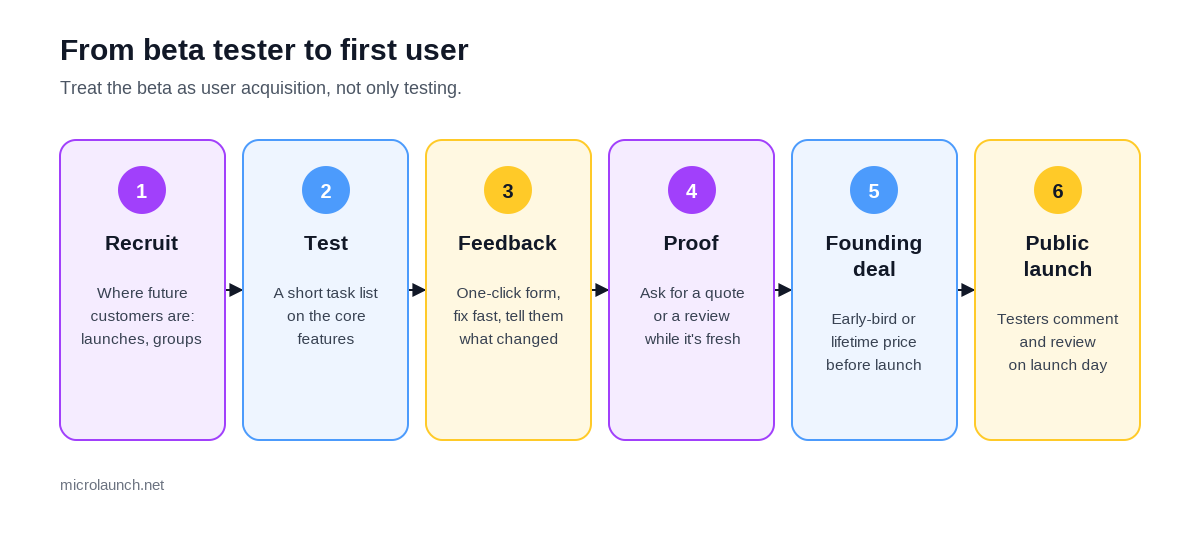
- Ask for a quote while the excitement is fresh, and use it on your landing page and launch.
- Offer a founding deal before the public price. A lifetime or early-bird deal on your site or a deals marketplace rewards testers and brings new buyers. Our AppSumo alternatives guide lists where founders publish deals.
- Invite them to your public launch. Early comments and reviews from real users make a launch page convincing. Our product launch guide covers how to plan launch day, and the user acquisition guide covers the channels to add after it.
- Keep the links your launch earns. Listings on launch platforms and directories keep sending visitors after the beta ends; see our link building guide for what those links are worth.
Looking for your first testers? Launch on Microlaunch to get 30 days in front of founders and early adopters, with reviews and roasts on your product page.
Frequently asked questions
What is a beta tester?
A beta tester is someone outside your team who uses a near-final version of your product in real conditions and reports issues, ideas and what works, before the full launch.
Where can I find beta testers for free?
Your own network and waitlist, communities where your audience gathers, and beta and launch listings. BetaList lists upcoming startups for early access, and a Microlaunch launch puts your product in front of early adopters for 30 days.
What is the difference between beta testers and QA testers?
QA testers check the product against requirements, usually inside the company. Beta testers are outside users who show how the product fits real workflows. Our beta testing vs alpha testing guide explains where each stage fits.
Should beta testers be my target customers?
Yes, as far as possible. Testers with the problem you solve give feedback that matters, and they are the ones most likely to pay once you launch.