Product Launch: A Founder's Step-by-Step Guide (2026)
How to plan and run a new product launch as a startup: pre-launch, launch day, where to launch and what to do in the 30 days after.
A product launch, or new product launch, is the planned push that introduces a new product to the market so people actually start using it, not just hear about it. For a startup, it comes down to three things:
- Before: know who it's for, build a small audience and get your page and assets ready.
- Launch day: post on the right platforms, rally your network and answer every comment.
- After: keep the product visible for weeks, collect feedback and turn visitors into customers.
The usual mistake is treating launch day as the whole launch. A single day on Product Hunt can bring a spike and then silence. A launch on Microlaunch runs for 30 days instead, so the traffic, roasts and reviews keep coming after day one.
This guide is published by the Microlaunch team. It draws on the launch guides that rank for this search (Appcues, Planio, Centercode, ProdPad) and on each launch platform's own site, read on 2026-11-19.
Product launch vs product release
The two words get mixed up, and the difference changes what you plan.
- A product release is the technical moment the product reaches users, sometimes only a small group. ProdPad describes it as inward-facing: making sure the product works, is stable and is secure, often through a beta, internal use ("dogfooding") or feature flags. A release to a small cohort is also called a soft launch.
- A product launch faces the market: messaging, PR, promotion and the channels that bring in customers.
You can release quietly to beta users first, fix what breaks, and launch publicly later. Most startups should. A buggy product on launch day wastes the attention you worked to get.
The 5 stages of a product launch
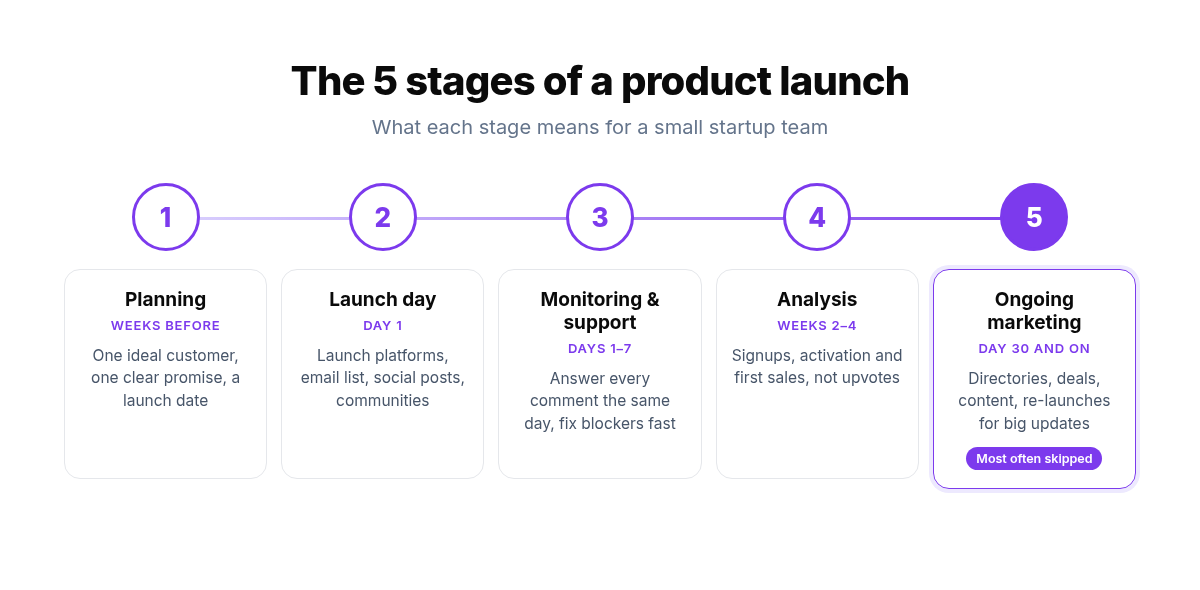
Centercode splits a launch into five stages. Here is what each one means for a small startup team:
| Stage | What you do | Startup version |
|---|---|---|
| Planning | Audience, positioning, pricing, channels | One ideal customer, one clear promise, a launch date |
| Launch day | Coordinated announcement across channels | Launch platforms, email list, social posts, communities |
| Monitoring and support | Watch feedback, reviews and bugs | Answer every comment the same day, fix blockers fast |
| Analysis and optimization | Compare results to your goals | Signups, activation and first sales, not upvotes |
| Ongoing marketing | Keep the product visible | Directories, deals, content and re-launches for big updates |
The last stage is the one most founders skip, and the one where a launch turns into steady traffic.
Before launch: what to prepare
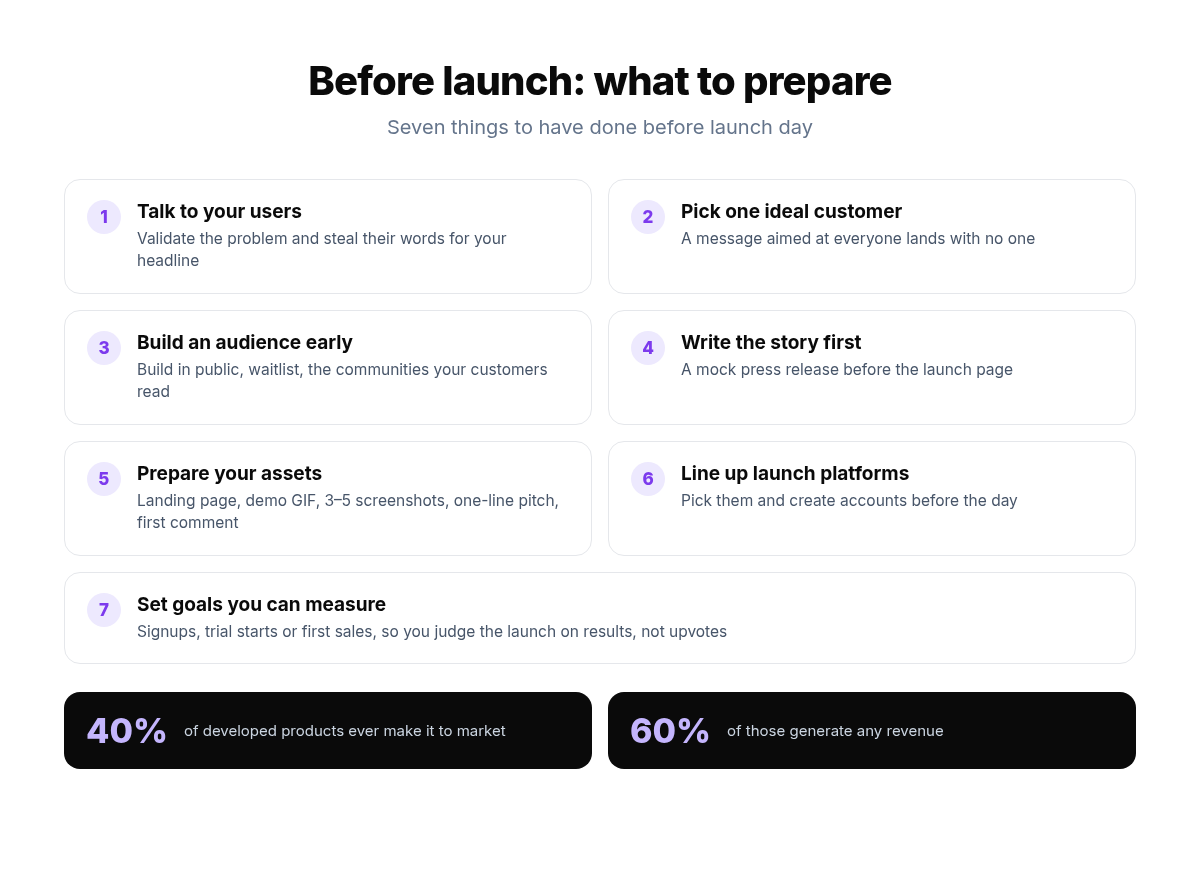
Planio's playbook makes the point bluntly: your launch starts long before launch day. It cites Marketing Research Association figures that only 40% of developed products ever make it to market, and only 60% of those generate any revenue. The prep is what moves you into that 60%.
- Talk to the people you built it for. Validate the problem and the wording they use for it. Their words become your headline.
- Pick one ideal customer per product. A launch message aimed at everyone lands with no one.
- Start building an audience early. Share progress in public, collect emails on a waitlist and join the communities your customers read.
- Write the story first. Planio suggests a mock press release in Amazon's style before you build the launch page: if the announcement is dull, the launch will be too.
- Prepare your assets. A clear landing page, a short demo video or GIF, 3 to 5 screenshots, a one-line pitch and a first comment explaining why you built it.
- Line up your launch platforms. Choose them and create accounts before the day, so you aren't filling forms while comments wait. Our Product Hunt alternatives guide compares the main options.
- Set goals you can measure. Signups, trial starts or first sales, so you can judge the launch on results.
Want honest feedback before going public? A beta round with a few real users catches the problems a launch audience would otherwise point out in public.
Launch day: how to run it
On the day, your job is to be present and fast.
- Post your launch on the right platforms, all on the same day or staggered over the week.
- Tell your own people first: email list, waitlist, current users, friends and mentors. Ask them to try it and share it, not just to upvote.
- Share in communities where you already contribute. Dropping a link in a community you have never posted in rarely works.
- Answer every comment and question. Early replies make your launch page look alive and teach you how people read your product.
- Run something live if you can, such as a demo, an AMA or a webinar, as Planio suggests.
- Follow up with anyone you briefed before launch, like journalists, bloggers or partners.
A launch on Microlaunch can happen on any date you pick. You aren't racing a fixed daily leaderboard, so a launch day that clashes with a big competitor launch or a holiday is easy to avoid.
Where to launch your product
No single platform does everything. Each one suits a different kind of product and stage:
| Platform | What it is | Best for |
|---|---|---|
| Microlaunch | Launch platform with 30 days of exposure, roasts, reviews and deals | Startups that want traffic and feedback for a month, not a day |
| Product Hunt | The best-known launch site, built around a single launch day | Products with an audience ready to show up on the day |
| Uneed | Daily launch platform where makers launch every day | Indie makers who want homepage visibility and a backlink |
| BetaList | Early-access listings for upcoming startups | Pre-launch products recruiting early users |
| PeerPush | Product discovery for people and AI assistants | Products that want sustained discovery beyond launch day |
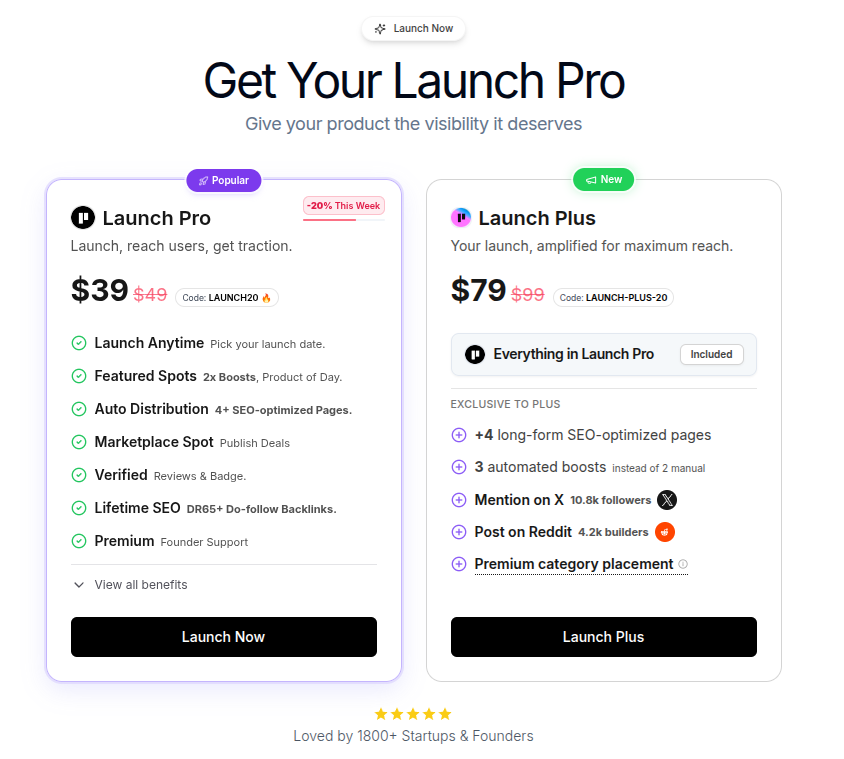
Microlaunch gives you a launch campaign followed by 30 days of continuous visibility. You collect honest feedback, roasts and testimonials, and can publish deals. Its site reports 650,000+ unique visitors in total and 30k+ unique visitors a month, and says it is used by 1800+ startups and founders. You can re-launch for major feature releases. The paid packs:
- Launch Pro: $49, or $39 with code LAUNCH20. Pick your launch date, featured spots with 2x boosts and Product of the Day, 4+ SEO-optimized pages, a Marketplace spot to publish deals, verified reviews and a badge, and DR65+ do-follow backlinks.
- Launch Plus: $99, or $79 with code LAUNCH-PLUS-20. Everything in Launch Pro plus 4 long-form SEO pages, 3 automated boosts, a mention on X and a post on Reddit.
- Launch Everywhere: $149 one-time ($199 list). Launch Pro plus submission to 50+ launch and SaaS directories, with a live status and URL for each one.
Honest limit: Microlaunch's audience is smaller than Product Hunt's, so it works best as part of a launch across several platforms, not as the only one.
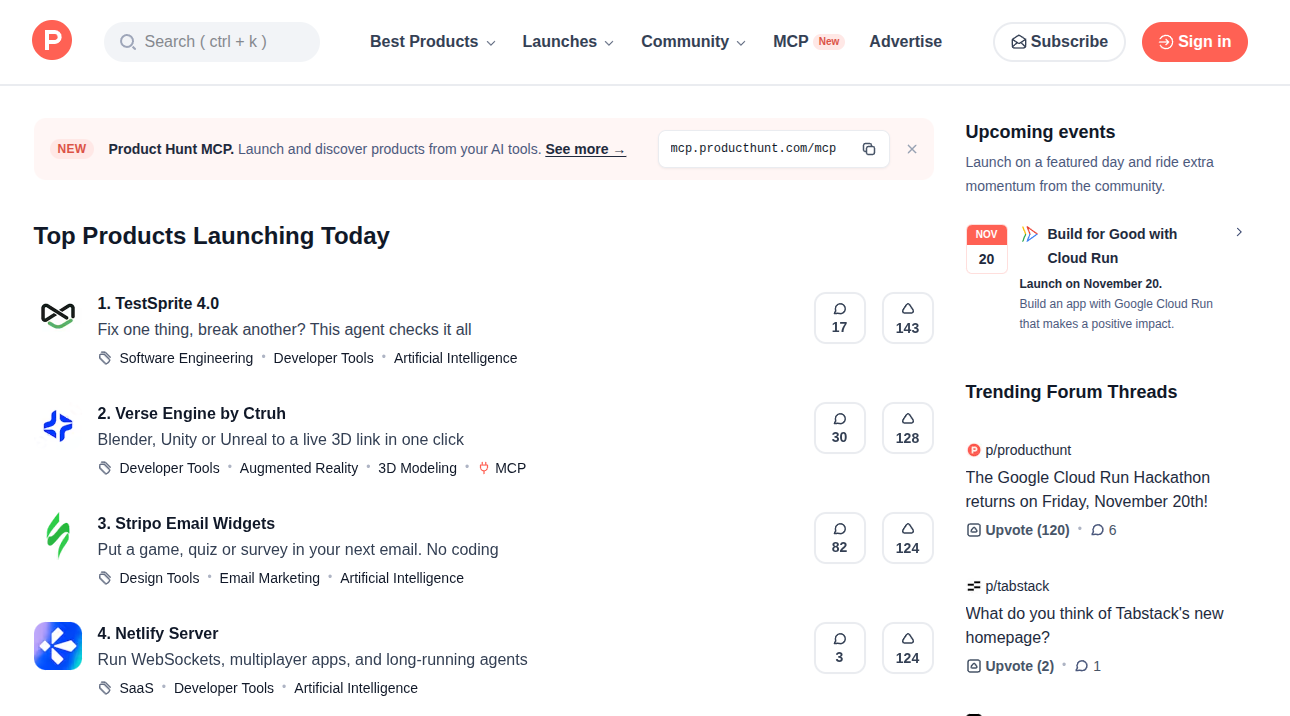
Product Hunt is where most founders think of launching first. PeerPush's own comparison describes it as focused on a single launch day. That day can bring a lot of attention, but the competition for the top spots is stiff, and visibility drops once the day ends.
Uneed describes itself as a launch platform where makers launch every day. It offers guaranteed homepage visibility and a DR 75 backlink, says it has 110,000 makers, and gives badges to the top 3 daily products, with weekly, monthly and yearly winners featured in its newsletter.
BetaList lists upcoming startups and gives early access to them, with a set of startups featured each day. It suits a product still in beta that needs its first testers.
PeerPush describes itself as a product discovery platform for people and AI: you add your product once and it is described in a structured way that AI assistants can read and recommend. It says 63,000+ builders have joined.
Directories add up too. Listing in dozens of launch and SaaS directories gives a new site its first backlinks. See our guide to link building companies for when directory links are enough and when outreach is worth paying for.
After launch: the 30 days that matter
The launch spike fades. What you do next decides whether it was worth it.
A one-day spike vs 30 days of exposure
A single launch day produces a traffic spike: a tall peak on day one, a smaller one on day two, then a drop back close to where you started. Everyone who was going to see your launch saw it in those 24 hours, and the next day's launches push yours off the homepage.
A 30-day launch spreads the same attention over a month. The first day is still the biggest, but the product stays listed, featured and reachable, so visitors keep arriving after the launch day traffic is gone. That matters more than the peak:
-
More chances to convert. People who see your product on day 12 or day 25 are often the ones with the problem right now.
-
Time to act on feedback. You can fix what early users flagged while new visitors are still coming in.
-
Search and AI visibility build up. Pages and backlinks that stay live get crawled and indexed; a page that fades after a day rarely does.
-
Compare results to your goals. Look at signups, activation and paying users. Appcues recommends measuring whether customers reached the outcome, not whether they saw the announcement.
-
Follow up with people who weren't ready. Visitors who signed up but didn't convert are your warmest leads.
-
Fix what launch feedback exposed. Have a system to log bugs and requests so nothing raised in the comments gets lost.
-
Stay visible. Launch updates as small re-launches, list your product in directories, and offer a deal. Lifetime and launch deals bring a second wave of buyers. Our AppSumo alternatives guide covers where to publish one, including Microlaunch Deals.
-
Debrief. Write down what worked, what didn't and what you would change, while it's fresh.
Appcues points to two examples of keeping momentum. Supabase turned one launch day into a launch week, and Linear made its changelog the launch. Both treat launching as a rhythm rather than a one-off event.
Launching faster than you can market
AI coding tools mean many teams now ship more than they can launch. In Appcues' State of Product Launches 2026 survey, 75% of marketers said they ship faster than a year ago, and only 7% said their launch process has kept up.
The fix it suggests is a tier framework. Give a full launch only to the releases that change what customers can do. Batch smaller updates into themed announcements. For a startup, that might mean one big launch for the product, then re-launches only for major features, and a changelog for everything else.
How to choose your launch approach
| If your product is… | Start with |
|---|---|
| In beta, looking for testers | BetaList, a waitlist and a soft launch to a small group |
| Live, with no audience yet | Microlaunch for 30 days of exposure, plus directories |
| Live, with a community ready to show up | Product Hunt on the day, Microlaunch and Uneed around it |
| A developer tool | Communities where developers already talk, plus launch platforms |
| Shipping updates every week | A changelog, and re-launches only for major features |
Browse recent startup launches to see how they wrote their pitch, first comment and screenshots.
Frequently asked questions
What is a product launch?
A product launch is the planned effort to introduce a new product or feature so people start using it. It covers pre-launch preparation, launch day and the follow-up that turns attention into customers.
What is a new product launch?
It is the same thing as a product launch: the first time a new product goes to market, as opposed to a feature update or a relaunch. For a startup, a new product launch usually means a first launch on platforms like Microlaunch or Product Hunt, followed by 30 days of follow-up to turn early visitors into users.
How far ahead should I plan a product launch?
Start building your audience and validating your message well before launch day. Your page, assets and platform accounts should be ready a week or two before the date, so launch day is spent answering people, not fixing forms.
Is Product Hunt still worth it for a startup launch?
It can be if you have an audience ready to show up on the day. If you don't, a single launch day often brings a short spike. Pair it with platforms that keep you visible longer, such as Microlaunch's 30-day launch.
What is the difference between a soft launch and a product launch?
A soft launch releases the product to a small group to test it and gather feedback. A product launch is the public, market-facing push with messaging and promotion.
How do I measure a product launch?
Set goals before launch day: signups, activation, trials or first sales. Compare them with the results after a few weeks. Upvotes and page views show reach, not whether the launch worked.