Product Hunt Alternatives for AI & SaaS Startups (2026)
25 Product Hunt alternatives for AI & SaaS startups, compared by cost, link type, launch cadence and audience, plus a 2–4 week launch plan to copy.
The best Product Hunt alternatives for an early-stage AI or SaaS launch are launch boards such as Microlaunch, Uneed, DevHunt, Fazier and OpenLaunch, communities such as Show HN, Indie Hackers and r/SideProject, and long-tail directories such as SaaSHub and AlternativeTo. Most founders get the best result from two to five of them, spread over two to four weeks, not from a single launch day.
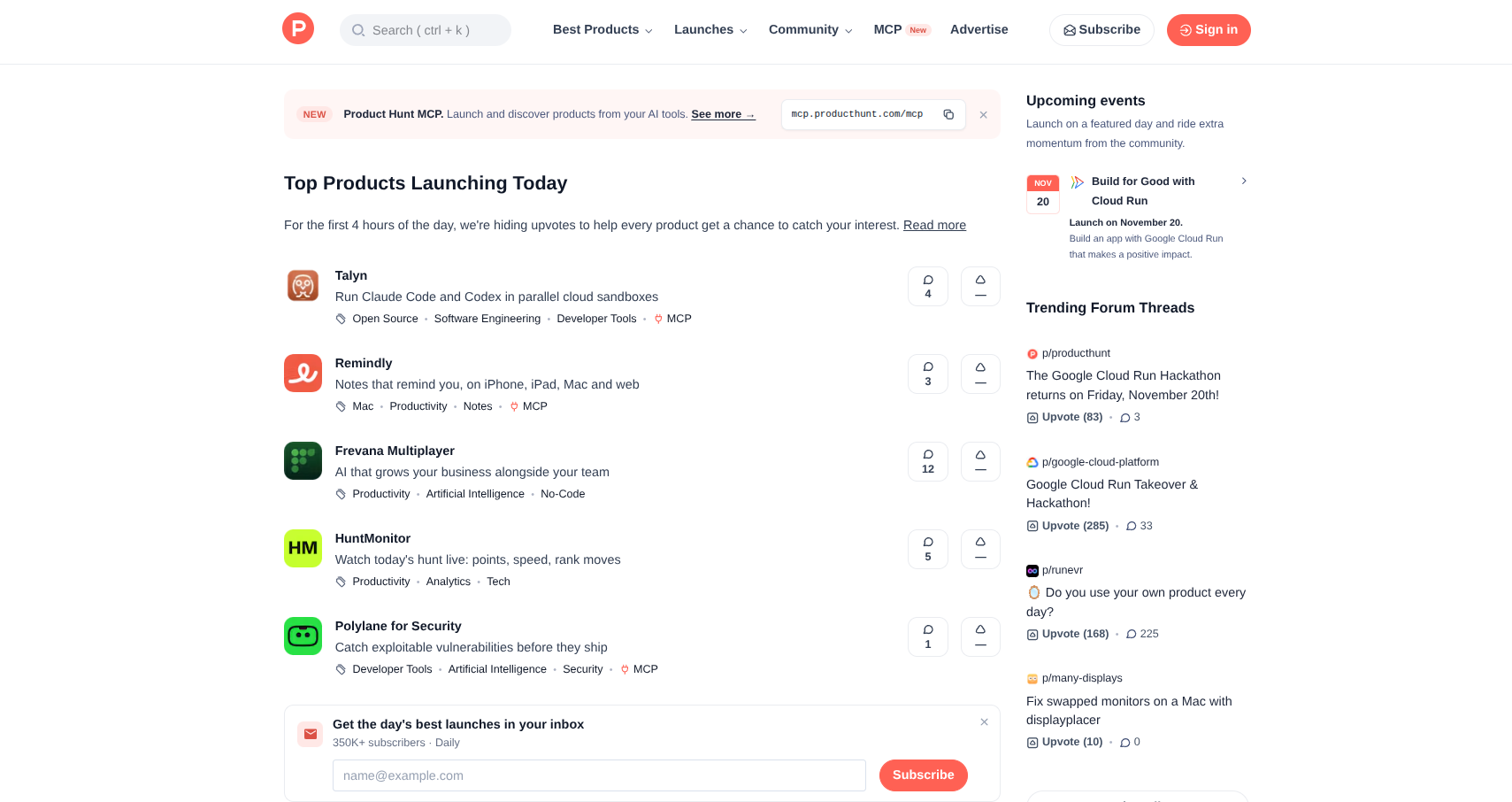
Product Hunt's daily leaderboard hides upvotes for the first 4 hours of each day.
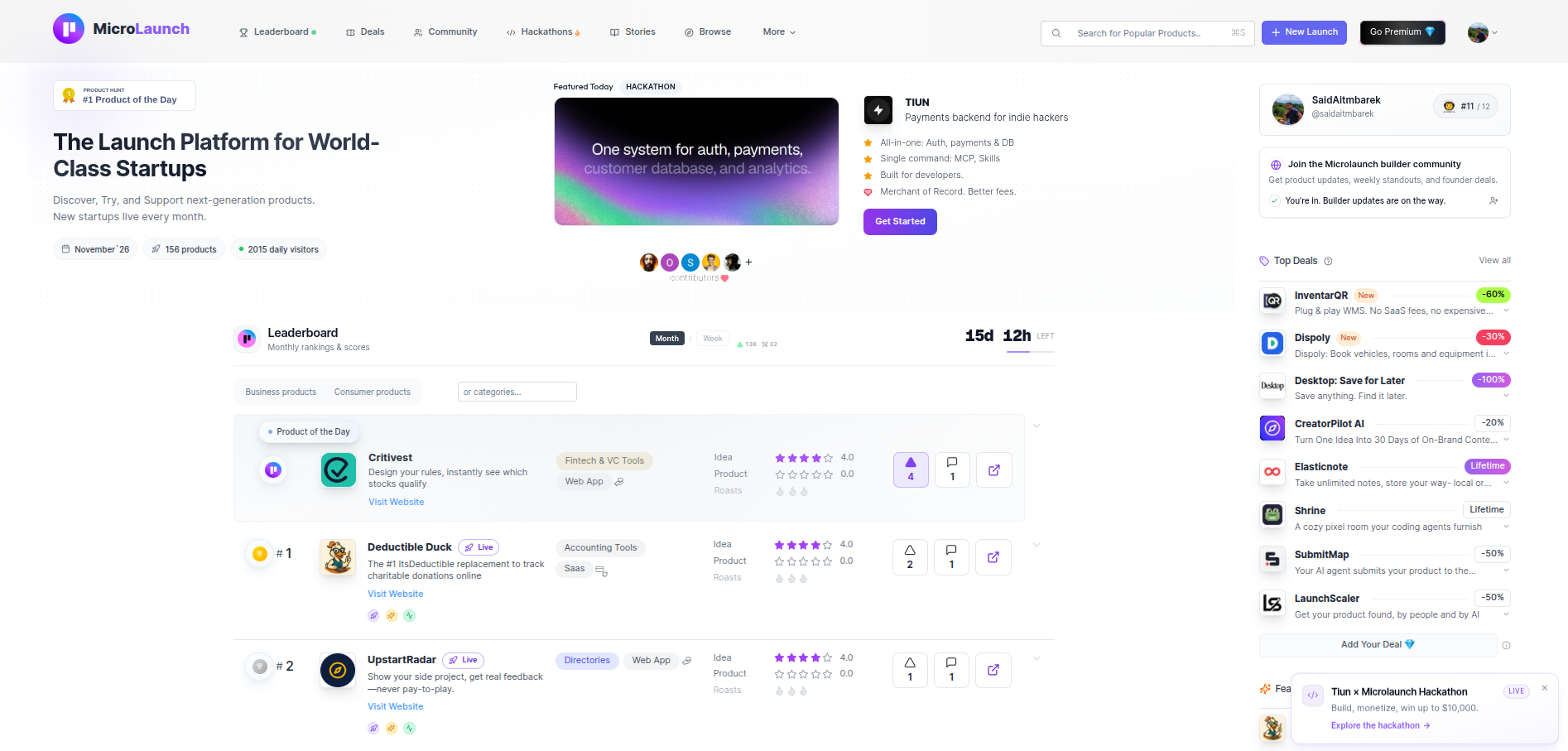
Microlaunch ranks products on a monthly leaderboard instead of a single launch day.
This page is published by the Microlaunch team. Every price, rule and number below was taken from each platform's own site on 13 November 2026; where a site could not be read, we used what published comparison pages (OpenHunts, Lifto) say about it, and the entry names that source.
Best Product Hunt alternatives by goal (quick picks)
| Your goal | Best for it | Why |
|---|---|---|
| 🔥 Traffic and users | Product Hunt, Microlaunch | Biggest day-one spike; Microlaunch adds ongoing distribution and a deals marketplace |
| 🤖 AI-native (MCP) | Microlaunch MCP | Launches discoverable by AI assistants: setup steps |
| Dofollow link, no votes | OpenLaunch Premium, Lifto, Launchtory, Microlaunch | Paid, badge or reciprocal links |
| Developer audience | DevHunt, Show HN, Dev.to | Built for developers |
| Fast go-live | Lifto, OpenLaunch Premium, Microlaunch | Instant or dated publishing; no approval step on Microlaunch |
| Free launch | Fazier, Lifto, Launching Next | Free, with a link |
| 📅 Weeks of exposure | Microlaunch, Lifto | Permanent pages or multi-day feeds |
| Pre-launch waitlist | BetaList | Early access to upcoming startups |
To see an indie launch board first, Browse trending indie launches.
Alternatives grouped by type
"Product Hunt alternative" covers four kinds of sites that do different jobs, so mix types.
- Launch boards run a daily or weekly competition with upvotes, badges and a homepage slot. Pros: a concentrated traffic spike and a badge. Cons: exposure fades once the day or week ends, and free links often depend on finishing top 3.
- Communities are discussion-first. Pros: honest feedback and, on a good day, large reach. Cons: high variance, strict self-promotion norms and usually nofollow links.
- Directories keep a permanent page. Pros: long-tail search and "X alternatives" traffic that compounds. Cons: little traffic on day one. Or use our launch-everywhere pack to handle submissions for you.
- AI tool directories are directories focused on AI products. Pros: buyers who are actively looking for an AI tool. Cons: crowded categories.
Launch boards
- Microlaunch — Launch platform with weekly and monthly leaderboards, idea and product ratings, and "roasts" (public feedback). Audience: 2638 daily on the homepage counter, 30k+ monthly, 650,000+ all time (August 2026). Best for AI & SaaS founders at early stage who want weeks of exposure. Price and full feature list: see the Microlaunch section below. Limit: a smaller audience than Product Hunt on any given day.
- Uneed — Daily launch board; the top 3 each day win badges and newsletter features. Best for indie makers and design-led products. Price: free; Skip the line $29.99 (OpenHunts). Limit: per OpenHunts, the free queue can run up to about five months.
- DevHunt — Open-source weekly launchpad for developer tools, voted on by developers. Best for dev tools only. Price: free listing; launch $19 (OpenHunts). Limit: the free listing is nofollow.
- Peerlist Launchpad — Weekly launches for the Peerlist professional community (Lifto). Best for developers and designers. Price: free (OpenHunts). Limit: nofollow link.
- BetaList — Daily feature of upcoming startups that offer early access. Best for pre-launch products building a waitlist. Price: paid submission (OpenHunts). Limit: a product that has already launched can look out of place.
- Fazier — Daily launch board with free and paid launches. Best for a less crowded launch day than Product Hunt. Price: free to submit; paid tiers add visibility. Limit: free launches require a badge.
- TinyLaunch — Daily launch board; the top 3 get a badge and a backlink. Best for small tools. Price: Premium $39 per launch (OpenHunts). Limit: the dofollow link requires embedding its badge.
- OpenHunts — Weekly launch slots for tiny startups. Best for MVPs and dev tools. Price: free queue; Premium $9.90. Limit: the free link is dofollow only if you finish top 3.
- Lifto — Video-first launch feed of demo reels. Best for products you can show in a short demo. Price: free, with a dofollow link; Launch $29. Limit: you need a demo reel.
- OpenLaunch — Daily launch board; launches go live at 8:00 AM UTC. Best for a cheap, dated launch. Price: free; Premium $9 per launch. Limit: the free link is dofollow only if you finish top 3.
- StartupBase — Daily launches at 12:00 AM PST with a backlink. Best for a dated launch. Limit: daily competition means a short spotlight.
- PeerPush — Discovery platform for people and AI, with an MCP server and a public API. Best for products that want AI assistants to recommend them. Price: free queue; paid plans publish instantly. Limit: visibility depends on community engagement.
- Tiny Startups — Pay-what-you-want launch board and directory; the more you pay, the higher you rank. Best for a backlink and a newsletter audience. Limit: a low payment means a low position.
- Nick Launches — Launch directory for indie makers (Lifto). Best for indie products that want a listing backlink after a launch post. Price: free to submit. Limit: a small audience compared with the larger boards.
Communities
-
Show HN (Hacker News) — Show-and-tell posts on Hacker News. Best for technical products and developer tools. Price: free. Limit: nofollow, blunt feedback and high-variance attention (OpenHunts).
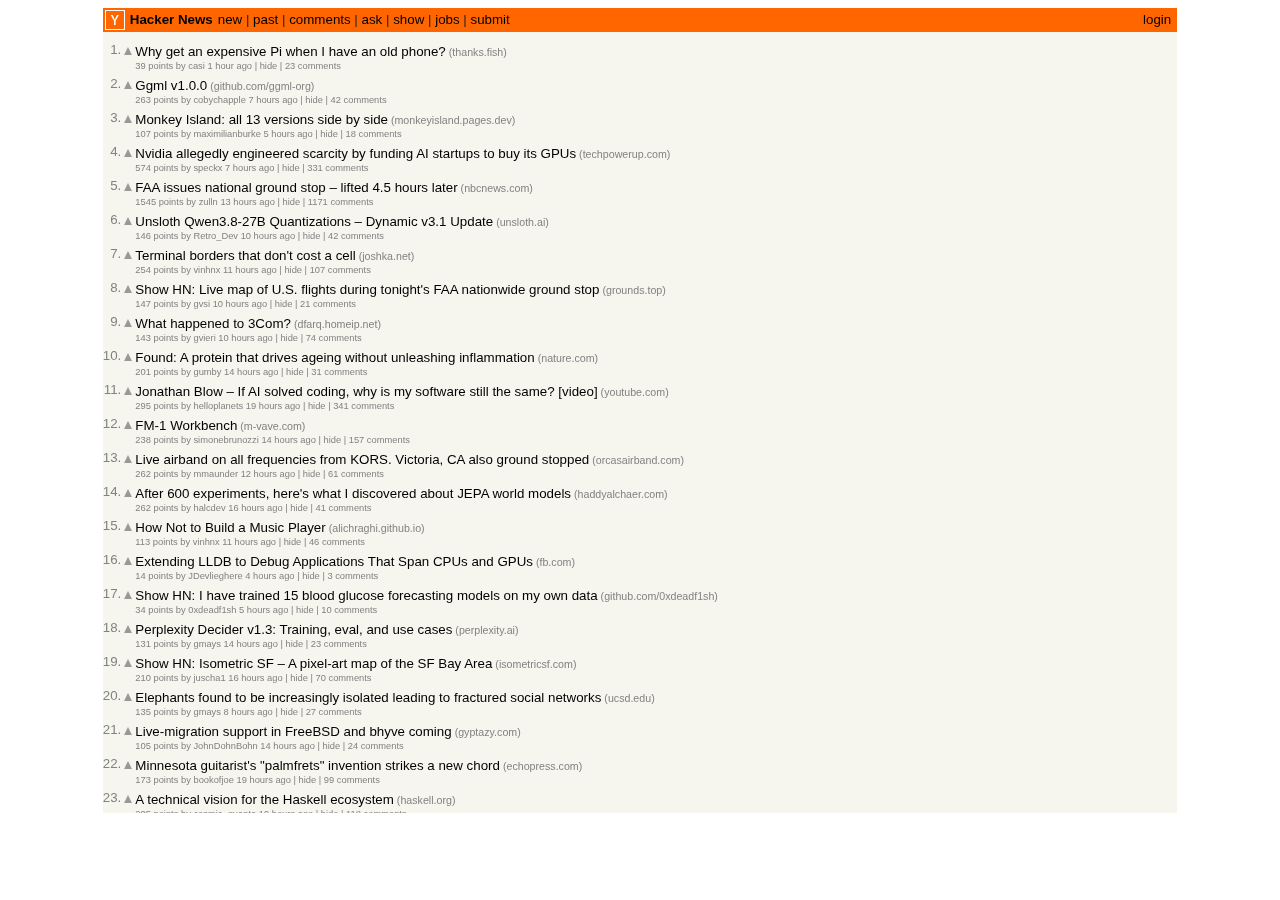
On Hacker News, Show HN posts compete with every other story for the front page.
-
Indie Hackers — Community of bootstrapped founders (Lifto). Best for build-in-public posts, milestones and revenue stories. Limit: the audience is founders, not always your buyers.
-
Reddit r/SideProject — Subreddit for side projects; r/SaaS works the same way (Lifto). Best for targeted feedback and direct conversation with users. Price: free. Limit: each subreddit has its own self-promotion rules.
-
Dev.to — Developer community and blog network. Best for dev tools that can share a technical launch post. Price: free. Limit: a bare announcement gets little traction.
Directories
- Launching Next — Daily startup directory (Lifto). Best for a lightweight listing with a backlink. Price: free submission. Limit: little day-one traffic.
- SaaSHub — Software alternatives directory with a daily "top 5" round. Best for SaaS tools that want comparison-page traffic. Price: free profile (Lifto). Limit: a crowded catalog.
- AlternativeTo — Crowdsourced software alternatives site (Lifto). Best for tools that compete with a well-known incumbent. Limit: links appear to be nofollow (Lifto).
- OpenAlternative — Directory of open-source alternatives (Lifto). Best for open-source projects. Price: free listing. Limit: closed-source products do not fit.
AI tool directories
- Launchtory — Weekly-updated directory of new AI tools and niche software. Best for AI tools. Price: free with a reciprocal link; paid from $29. Limit: no guaranteed review time for free submissions.
- Pitchwall — Daily feed of new AI products with a newsletter. Best for AI products. Limit: the homepage leans heavily on sponsored slots.
- Futurepedia — AI tools directory updated daily, with a newsletter. Best for AI tools aimed at people using AI at work. Limit: tool listings compete with its own AI workspace product.
Data-checked comparison table (checked November 2026)
Platforms whose cost, link type and cadence we could all confirm; the rest are in the lists above.
| Platform | Best for | Cost | Link type |
|---|---|---|---|
| Microlaunch | AI & SaaS founders (early-stage), weeks of exposure | Paid packs from $39 | Dofollow (DR 65+) |
| Product Hunt | Big, broad launch day | Free to submit | Nofollow |
| Uneed | Design-led indie products | Free; Skip the line $29.99 | Dofollow (guaranteed with Skip the line) |
| DevHunt | Developer tools | Free listing; launch $19 | Free: nofollow; paid: dofollow |
| Lifto | Demo-friendly products | Free; Launch $29 | Dofollow with badge |
| OpenLaunch | Cheap dated launch | Free; Premium $9 | Free: top 3 only; paid: dofollow |
| Launchtory | AI tools | Free with reciprocal link; from $29 | Dofollow |
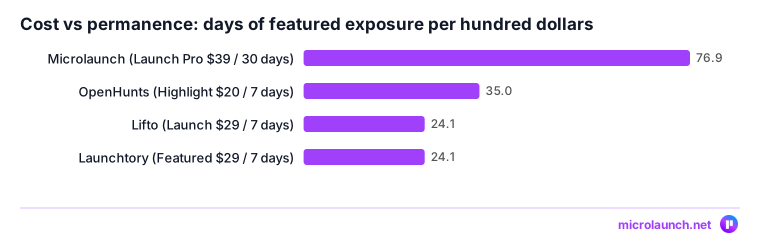
How to choose your launch stack (3-step decision path)
- Start from your buyer. Developers: DevHunt, Show HN, Dev.to. Founders and makers: Indie Hackers, Uneed, Tiny Startups and the other indie launch boards. AI tool buyers: Launchtory, Futurepedia, Pitchwall. Not live yet: BetaList.
- Check the calendar. If you launch in under two weeks, free queues on boards like Uneed or OpenLaunch may not reach you in time; either budget for a paid tier or choose platforms that publish quickly (Lifto, Fazier, communities). If you have two months, free queues are fine.
- Decide what you need from SEO. If you want links, keep the platforms with a dofollow link you can actually get: paid tiers, badge-embed programs, or directories with reciprocal links. Aim for one launch board, one community and one or two directories.
Running deals for launch week? List one in the Founder deals marketplace so launch visitors have a reason to buy now.
Launch sequencing that works in 2026 (2–4 week plan)
| When | What to do |
|---|---|
| Week −2 to −4 | Submit to directories with free queues (Uneed, OpenLaunch, OpenHunts, Launchtory, SaaSHub). If you are pre-launch, submit to BetaList. |
| Week −1 | Book a dated paid slot where you need a guaranteed date. Write your Show HN, Indie Hackers and Reddit posts. Record a short demo for Lifto. |
| Week 1, day 1 | Main launch on Microlaunch or one board. Be online all day to reply to every comment. |
| Week 1, days 2–4 | One community post a day (Show HN, then Indie Hackers, then r/SideProject), each written for that community. |
| Week 2 | Second launch board (Fazier, TinyLaunch, DevHunt or Peerlist, depending on your audience). |
| Weeks 3–4 | AI catalogs and alternatives directories (Futurepedia, Pitchwall, AlternativeTo, OpenAlternative). Write a short retro post with your numbers. |
Before you pick a date, check Microlaunch Trends: what's getting attention now.
Do launch directories help SEO? Link types and indexing explained
Yes, in a limited way. A launch listing helps SEO through three things:
- Link type. A dofollow link passes ranking signals; a nofollow link mostly does not. Many boards give a dofollow link only to paid launches or to the top 3 of the day (OpenLaunch, OpenHunts, TinyLaunch), or ask for a badge or reciprocal link in return (Lifto, Launchtory).
- Permanence. A link on a page that stays up keeps working; a link that disappears after launch week or is removed when you miss an upvote threshold (as OpenHunts reports for free Uneed launches) does not.
- Indexing. A listing only helps if search engines index it. Before you count a link, open the listing, check that it is not marked noindex, that its canonical points to itself, and search the listing's URL in Google a few weeks later.
Realistic impact: a handful of indexed, permanent, dofollow listings help a new domain get crawled and build early authority, but they will not rank you for competitive keywords on their own. Favor listings with real traffic and relevant categories over volume.
Microlaunch vs. Product Hunt
| Microlaunch | Product Hunt | |
|---|---|---|
| Audience | AI & SaaS founders and early adopters (traffic in its list entry above) 🚀 | Largest mainstream launch audience 🐱 |
| Exposure window | 30 days of continuous visibility, then months of distribution | Launch day |
| Link | DR 65+ dofollow backlinks for life | Nofollow |
| Launch date | You pick it | Daily competition |
| Price | Launch Pro $39 ($49 list); Launch Plus $79; Launch Pro + 50 directories submitted for you $149 one-time | Free to submit |
Details and current pricing: see Microlaunch Premium launch features.
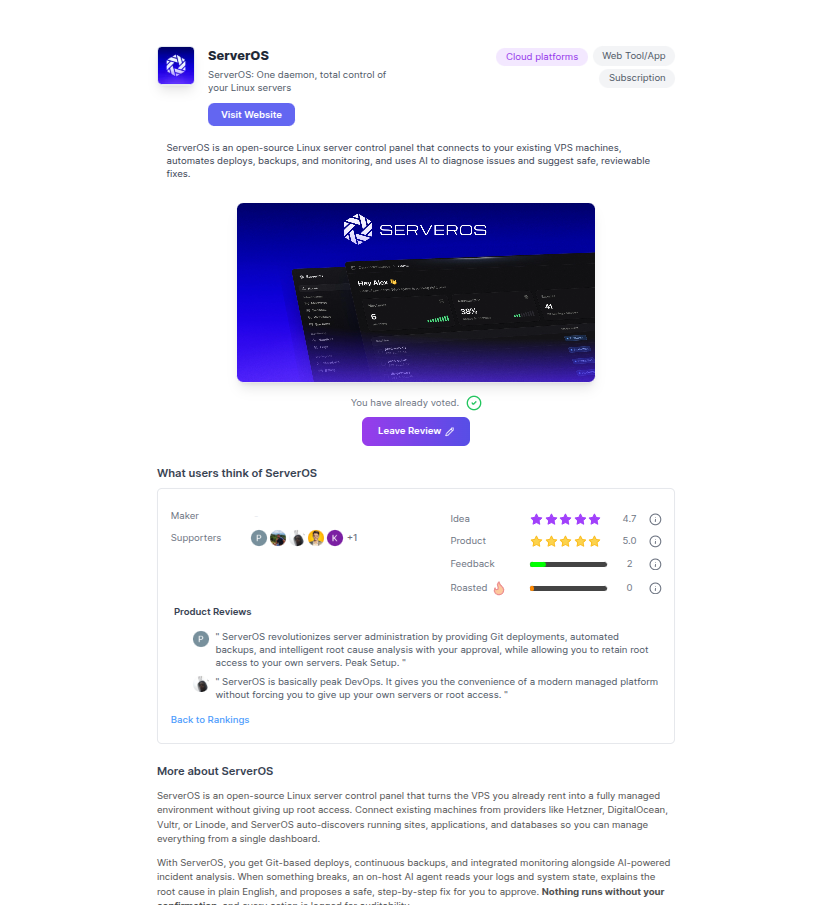
A Microlaunch product page: website link, user ratings and written reviews.
See how Microlaunch works or compare the packs on Microlaunch Premium launch features.
FAQs (founder questions answered fast)
What is the best free Product Hunt alternative?
For a free launch with a link, Lifto (dofollow with its badge) and Fazier are the simplest. For free reach, Show HN costs nothing but gives a nofollow link. OpenLaunch and OpenHunts are free too, but their free link is dofollow only if you finish top 3.
Which platforms give a dofollow backlink?
Guaranteed with a paid tier: OpenLaunch Premium, OpenHunts Premium, DevHunt paid launches, Uneed Skip the line and Microlaunch's packs. With a badge or reciprocal link: Lifto, TinyLaunch, Launchtory. By default: BetaList, Fazier, Tiny Startups. Product Hunt, Peerlist and Show HN are nofollow.
Can I launch on several platforms in one week?
Yes. Use one launch board as your main day, then post to a different community each following day. Just don't run two major launches on the same day.
What is the best day to launch?
No single day wins everywhere. Pick a day you can spend replying to comments, avoid clashing with your own Show HN post, and check each board's go-live time (OpenLaunch at 8:00 AM UTC, StartupBase at 12:00 AM PST) so you are online when it starts.
How far in advance should I submit?
For free queues, as early as you can: OpenLaunch's free scheduling window runs up to 180 days and OpenHunts reports Uneed's free queue at up to about five months. Paid tiers on Lifto, PeerPush and OpenLaunch let you launch within days.
Should I use directories or communities?
Both. Communities bring feedback and a spike of users; directories bring permanent pages and links.
Which metrics matter after a launch?
Signups and paid conversions by referrer, not upvotes, plus indexed backlinks a month later.
For more on launches and go-to-market, read More launch and GTM guides.
AI-native launch platforms: Microlaunch MCP
Public Microlaunch MCP (for users and agents)
This is a remote server over streamable HTTP. It needs no install and no API key.
-
Claude: go to Settings → Connectors → "Add custom connector" and paste
https://mcp.microlaunch.net/mcp?host=claude -
ChatGPT: go to chatgpt.com/plugins → Add → Create MCP App, paste
https://mcp.microlaunch.net/mcp?host=chatgptand pick "No authentication" -
Claude Code:
claude mcp add --transport http microlaunch https://mcp.microlaunch.net/mcp -
Any other MCP client: add a remote streamable-HTTP server with
https://mcp.microlaunch.net/mcp
How we verified this list
On 13 November 2026 we read each platform's homepage, and its pricing page where it has one, and took prices, link rules, cadence and traffic numbers from there. For platforms whose site we could not read (Peerlist, Launching Next, Indie Hackers, Hacker News, Reddit, AlternativeTo, Nick Launches, OpenAlternative), each fact comes from the OpenHunts or Lifto comparison pages and the entry says so. Traffic numbers are self-reported by each platform. We did not launch on every platform for this page; confirm prices before you pay.
Ready to launch on Microlaunch?
Pick your date and start your launch, or compare the launch packs.