Product Launch Software for Startup Founders
Product launch software comes in two kinds: tools that plan a launch and platforms that get it seen. Compare the options for founders, with honest limits.
Product launch software is any tool that helps you plan, run or promote the release of a new product. It comes in two kinds. Launch management tools (Asana, Notion, Productboard, Jira Product Discovery and similar) coordinate the work inside your team: timelines, tasks and assets. Launch platforms (Microlaunch, Product Hunt, PeerPush, Uneed, BetaList) put your finished product in front of people who try it, give feedback and buy. Large companies mostly need the first kind. An indie or SaaS founder with a small team usually needs the second, because the hard part of a startup launch isn't coordinating ten departments, it's getting anyone to notice.
The short answer for most founders: plan in a shared doc, then launch on Microlaunch and Product Hunt together. A launch there runs for 30 days on a date you pick, and the product page stays listed afterwards with do-follow backlinks and SEO pages. Product Hunt adds one big day in front of a large audience.
Launch management tools vs launch platforms
The two kinds of product launch software solve different problems, so the first question is which problem you have.
| Launch management tools | Launch platforms | |
|---|---|---|
| Job | Plan and coordinate the launch inside your company | Get the launched product seen, tried and bought |
| Who uses it | Product, marketing and sales teams | Founders and makers |
| What you get | Roadmaps, task boards, launch checklists, demos | Visitors, upvotes, badges, feedback, reviews, backlinks |
| Examples | Asana, Monday.com, Notion, Airtable, Coda, Productboard, Jira Product Discovery, Pendo, Guideflow | Microlaunch, Product Hunt, PeerPush, Uneed, BetaList |
| Best fit | Companies with several teams and a general availability (GA) date to hit | Startups that need first users |
Enterprise launch guides describe a launch as a coordinated effort across product, sales, marketing, PR, analyst relations and events teams. Salesforce, for example, runs a marketing ("soft") launch three to six months before general availability, then a GA launch aimed mainly at its own sales team. A two-person startup has no sales team to brief, which is why launch platforms matter more at that stage.
What a launch should achieve: set your goal first
A launch can bring five things: users, feedback, fame, sales and discovery. Pick the one that matters most before launch day, because it decides which software you need and how you judge the result.
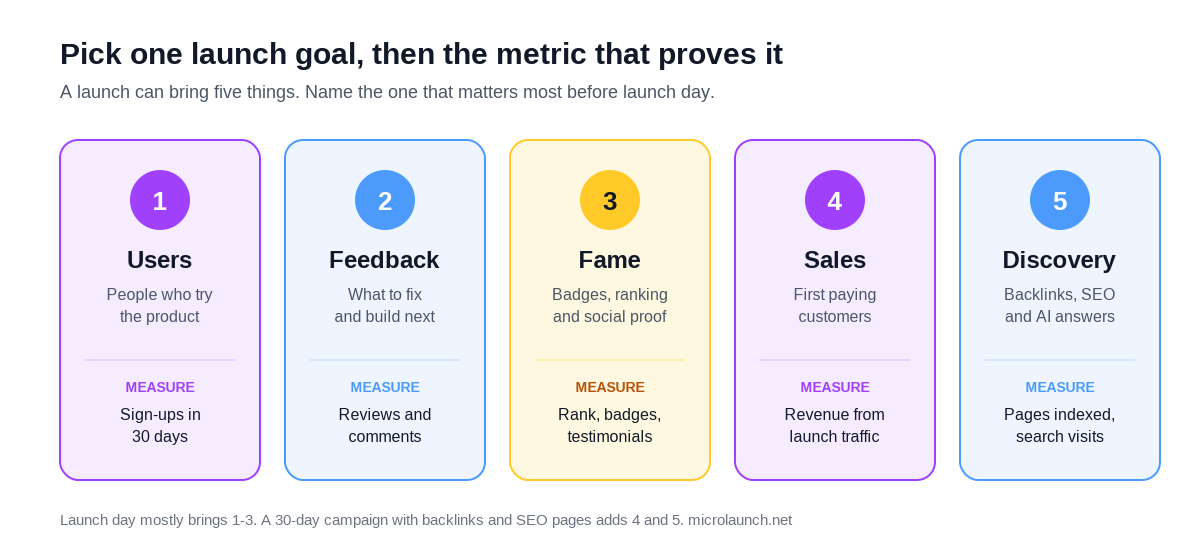
- Users: people who sign up and try the product. Measure sign-ups in the first 30 days.
- Feedback: reviews and comments that tell you what to fix. Measure how many you can act on.
- Fame: a high rank, a winner badge and testimonials you can show on your site.
- Sales: first paying customers from launch traffic.
- Discovery: backlinks, SEO pages and listings that keep people finding you on Google and in AI answers.
Launch day mostly delivers the first three. Sales and discovery need weeks, which is why the shape of your launch matters as much as the platform. Our guide to user acquisition shows how a launch feeds every other channel afterwards.
Launch day vs launch campaign
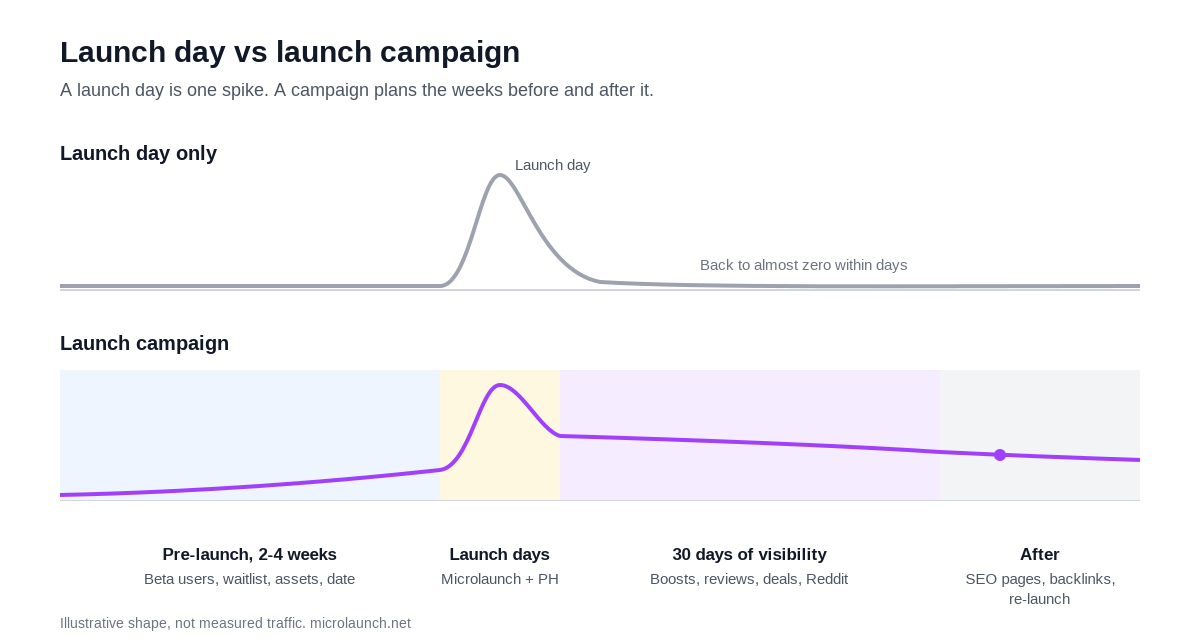
A launch day is a single 24-hour push on one platform. A launch campaign is the plan around it: two to four weeks of preparation, launch days on more than one platform, then a month of visibility and follow-up.
| Launch day | Launch campaign | |
|---|---|---|
| Length | 24 hours | About 6 to 8 weeks, start to finish |
| Platforms | One leaderboard | Microlaunch and Product Hunt, then directories and communities |
| What you get | A traffic spike, upvotes, maybe a badge | Users, reviews, a badge, backlinks and pages that keep ranking |
| Risk | A bad day means a lost launch | A slow day is one part of a longer plan |
| Best for | Products that already have an audience | First-time founders starting from zero |
Most first-time founders should run a campaign. You don't have an audience yet, so one day on one leaderboard is a big bet. Spreading the launch over 30 days gives each visitor, review and backlink time to bring the next one. The user acquisition guide covers the channels to add once the launch is live.
Launch platforms that get your product seen
A launch platform is a site where makers list a new product and an audience of early adopters discovers, upvotes and reviews it. These five are built for startups and indie founders.
1. Microlaunch
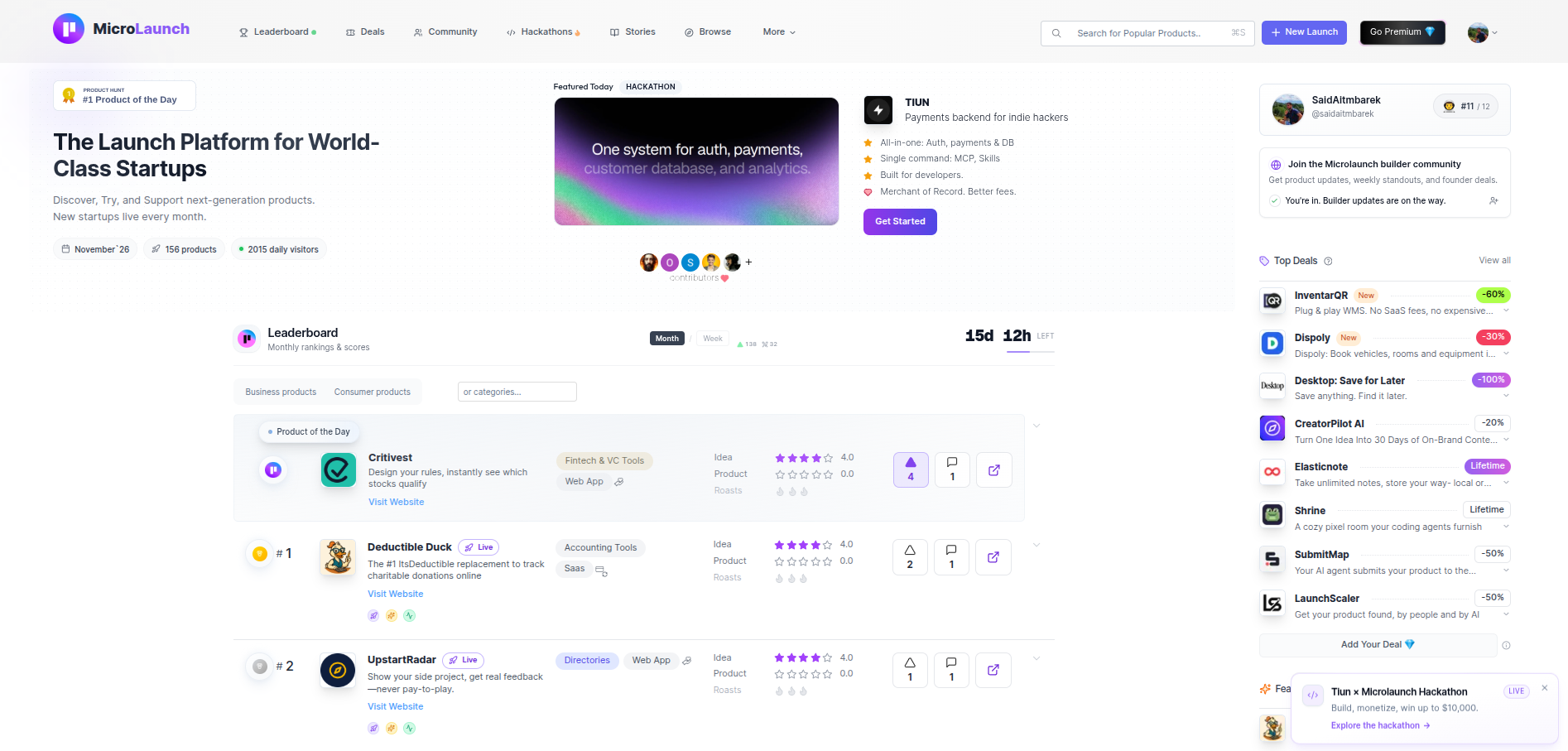
What it is: a launch platform where startups launch, get 30 days of continuous visibility and months of distribution, collect honest feedback, roasts and testimonials, and publish deals in a marketplace. Launches compete on weekly and monthly leaderboards, split into Business and Consumer products, and top products get Product of the Day, Week and Month. Microlaunch states 30k+ unique visitors and 70k page views a month, 650,000+ unique visitors, 7.2M+ product impressions and 140,000+ clicks to listed products in total (August 2026). Makers also share launches and ask for feedback in its subreddit, r/microlaunch, with 6,000+ founders.
Who it suits: indie and SaaS founders who want a launch to keep working after launch day, through featured spots, deals, SEO pages and re-launches.
Price: Launch Pro is $49, Launch Plus $99 and Launch Everywhere $199 (adds submission to 50 directories), all one-time. See the launch packs. Unlimited re-launches are included for major feature releases.
Honest limit: the paid packs carry most of the benefits, and its stated monthly audience is smaller than PeerPush's.
2. Product Hunt
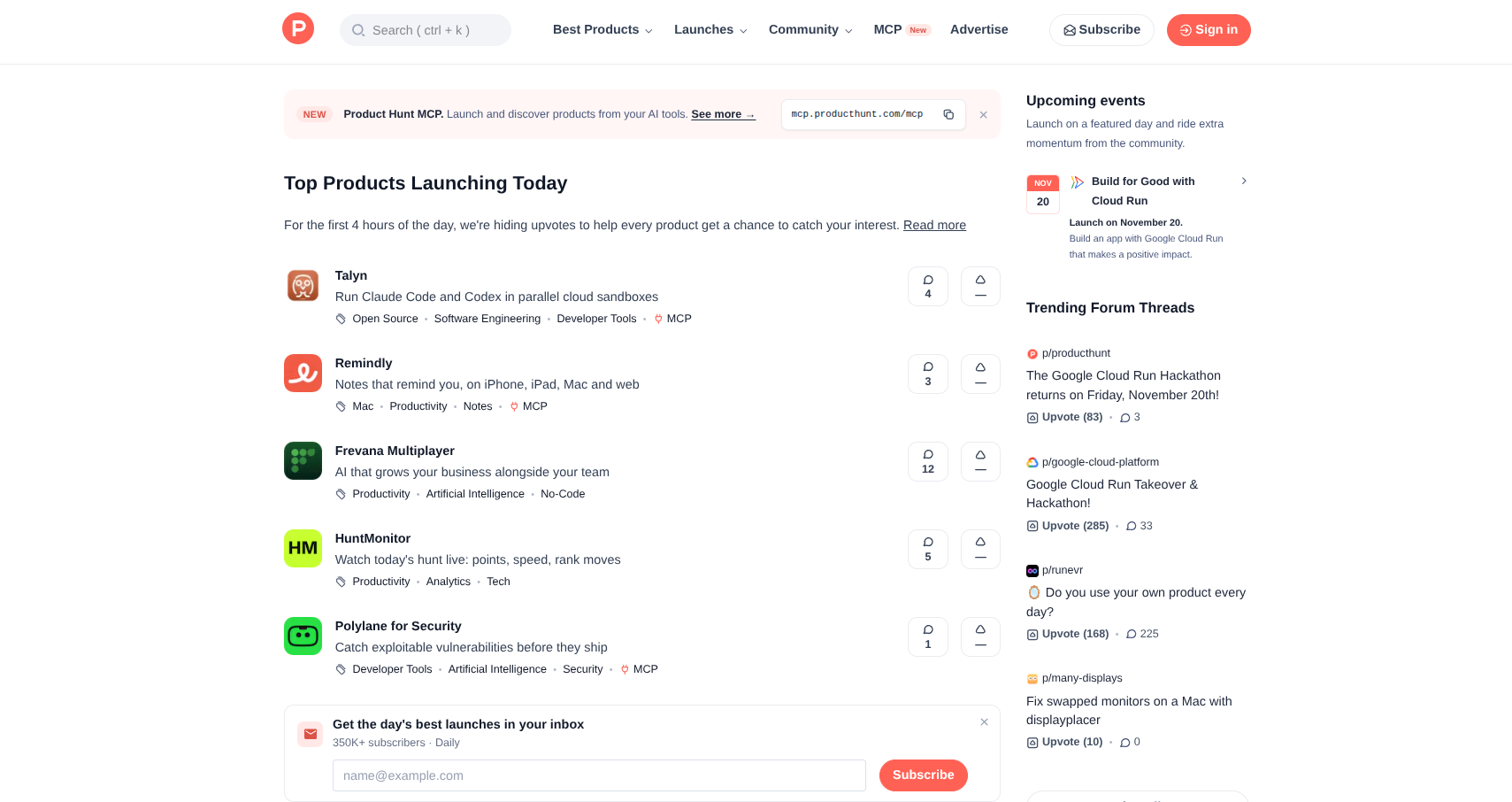
What it is: the best-known daily launch leaderboard. Product Hunt runs daily, weekly, monthly and yearly leaderboards on Pacific time, and for the first 4 hours of each day it hides upvotes so every product gets a chance to be seen. Its daily newsletter of the best launches has 350K+ subscribers.
Who it suits: founders who can bring their own supporters on launch day and want a recognizable badge afterwards.
Price: free to launch.
Honest limit: each launch lasts one day and competes with every other product on that day's leaderboard. Without supporters ready at the start, a product can sink fast. Our list of Product Hunt alternatives compares the options.
3. PeerPush
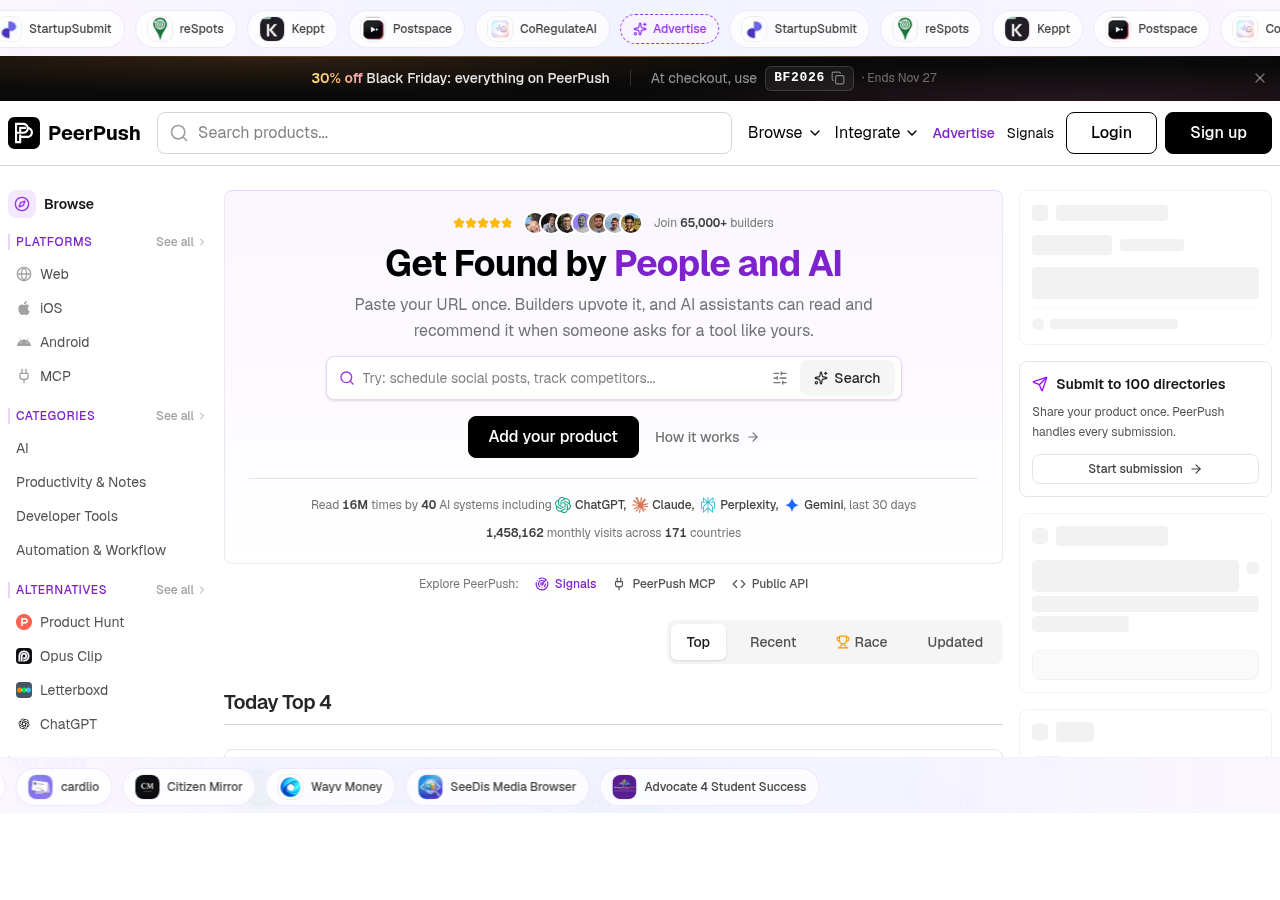
What it is: a product discovery platform that describes each product in structured, machine-readable data so both people and AI assistants (ChatGPT, Claude, Perplexity, Gemini) can find and recommend it. PeerPush states 1,458,162 monthly visits across 171 countries and a community of 65,000+ builders, and offers an MCP server and a public API.
Who it suits: founders who want to be found by AI assistants as well as by people, and who prefer steady discovery over a single launch day.
Price: submission is free; paid plans publish instantly.
Honest limit: free submissions wait in a publishing queue.
4. Uneed
What it is: a daily launch platform where makers launch products and the community discovers, upvotes and reviews them. Uneed promises guaranteed homepage visibility, a DR 75 backlink and feedback from a community of 110,000 makers. The top 3 products each day win badges, and weekly, monthly and yearly winners are featured in its newsletter.
Who it suits: makers who want a launch-day push with badges to show afterwards.
Honest limit: every launch competes with that day's other products for the top 3 spots.
5. BetaList
What it is: a directory of upcoming internet startups, where visitors discover and get early access to new products. It features a set of new startups each day (15 on the day we looked), plus an editor's pick and founder-boosted listings.
Who it suits: founders before or around launch who want early adopters to sign up for access.
Honest limit: it's built around upcoming startups, so it fits a pre-launch or beta product better than one that has been live for a while.
Winner badges: fame, users and sales after launch day
A winner badge is the most lasting thing a launch day gives you. Microlaunch awards Product of the Day, Week and Month and lists past top products in its Hall of Fame. Product Hunt offers embeddable badges for products that rank on its leaderboard. Uneed gives badges to its top 3 products each day and features weekly, monthly and yearly winners in its newsletter.
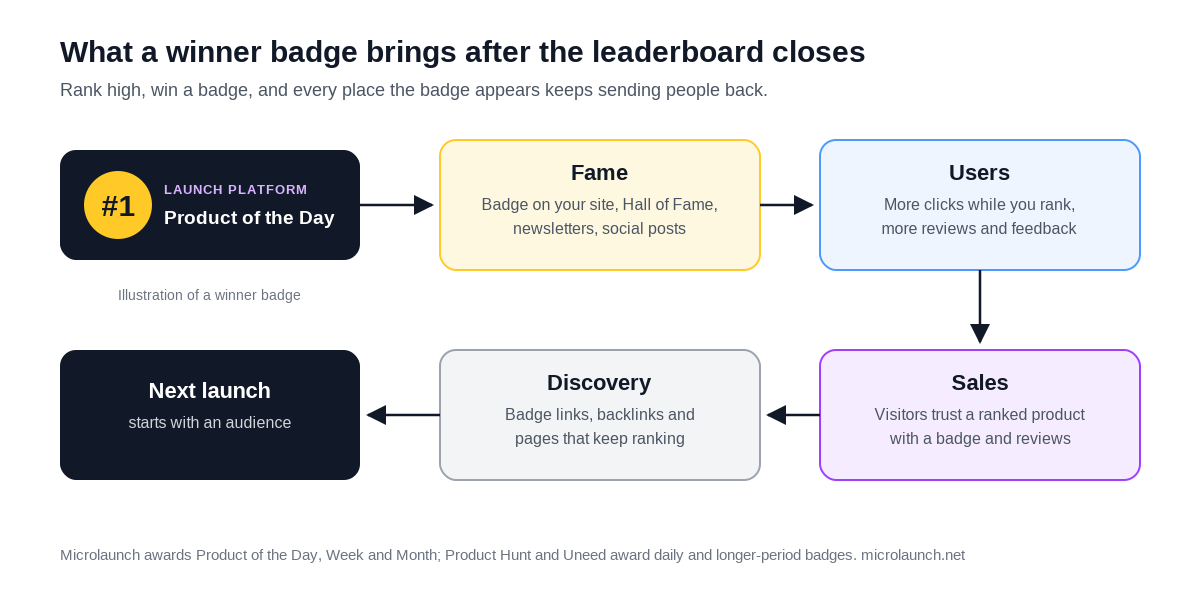
Ranking high, and staying visible longer, compounds:
- Fame: the badge goes on your homepage, your launch posts and your pitch deck. Microlaunch still shows its own Product Hunt #1 Product of the Day badge on its homepage.
- Users: the top spots get the most clicks while the leaderboard is live, and more visitors leave more reviews.
- Sales: a ranked product with a badge and reviews looks safer to buy. Travis Mathis, founder of SvelteLaunch, said Microlaunch gave them "our best couple days ever" and was "still driving sales" weeks later.
- Discovery: badge links, backlinks and product pages keep sending visitors from search after the day ends.
This is why combining platforms works. Product Hunt gives you a big day and a well-known badge. A 30-day launch keeps the product on weekly and monthly leaderboards, so you get more chances at Product of the Week or Month. The user acquisition guide explains how to turn that exposure into steady signups.
Tools that run the launch inside your team
Launch management tools help a team ship on time and explain the product well. Guideflow's 2026 roundup of product launch software lists Guideflow, Productboard, Asana, Monday.com, Notion, Airtable, Coda, Jira Product Discovery and Pendo, and groups them into four categories: project management, product analytics, feature flagging, and demo and enablement tools.
6. Guideflow
What it is: an interactive demo platform for capturing, editing, personalizing and sharing product demos, with sandbox, live demo, mobile demo and demo center formats and analytics on how people engage with each demo.
Who it suits: teams that want visitors to experience the product during a launch instead of reading about it. A demo link works well inside a launch platform listing.
Price: you can start for free.
Honest limit: a demo shows the product to people who already arrived. It doesn't bring an audience by itself.
How to choose product launch software
The right product launch software depends on your stage and team size more than on features.
| Your situation | What to use |
|---|---|
| Solo founder or a team of 2-5, product works | Microlaunch and Product Hunt. A shared doc or task board is enough to plan. |
| Pre-launch, collecting sign-ups or beta users | An early-access directory like BetaList, then a launch platform once the product is usable |
| You want backlinks and listings on many sites at once | A launch pack with directory submission, like Launch Everywhere |
| You want AI assistants to recommend your product | A platform with structured product data, like PeerPush |
| Several teams and a fixed GA date | A launch management tool (project management plus a demo tool), then launch platforms for reach |
Four questions narrow the choice:
- How long does the visibility last? A single launch day ends fast. Look for platforms that keep your product visible for weeks and let you re-launch for major updates.
- What happens after launch day? Badges, deals, reviews, SEO pages and backlinks keep sending traffic. Upvotes alone don't.
- Will you get feedback you can act on? Reviews, roasts and comments from real users are worth as much as traffic at the start.
- What does it cost per launch? Free listings often wait in a queue. Paid packs buy a launch date, featured spots and promotion.
A founder's launch campaign, step by step
A startup launch can run on two or three tools. This sequence adapts the enterprise launch checklist (test, prepare collateral, plan feedback, pick metrics) to a small team.
- Test with real users first. Run a beta with a handful of strangers who fit your customer. See our guide to beta testing websites for where to find them.
- Pick your goal and metric before launch. Users, feedback, fame, sales or discovery. Decide now, so the launch has a target.
- Prepare your assets. A clear one-line pitch, screenshots, and a short demo (a tool like Guideflow helps here).
- Pick a launch date and platforms. Choose a day you can be online all day to answer comments. Our product launch guide covers the timing.
- Launch on Microlaunch and Product Hunt. Each audience is different, and each listing is another way to be found.
- Collect feedback, reviews and testimonials while the launch is live. Reply to every comment and put the best reviews and any badge on your site.
- Keep going for 30 days. Share the launch on Reddit and in communities, publish a deal, and follow the user acquisition channels that fit your product.
- Re-launch for major updates. A new feature is a new reason for people to look.
FAQ
What is product launch software?
Product launch software is a tool that helps you plan, run or promote a product release. Launch management tools coordinate the work inside a team; launch platforms like Microlaunch, Product Hunt and PeerPush bring the product to an audience of early adopters.
Do I need product launch software as a solo founder?
A solo founder needs a launch platform more than a launch management tool. Planning fits in a simple checklist or doc, while getting first users takes an audience you don't have yet, which is what launch platforms provide.
What is the difference between a launch day and a launch campaign?
A launch day is a single 24-hour push on one platform, such as Product Hunt. A launch campaign covers the weeks before and after it: preparation, launches on several platforms and about 30 days of visibility, reviews and follow-up.
Is a Product of the Day badge worth it?
A Product of the Day badge is worth having because it keeps working after the launch. You can show it on your site and in your launch posts as social proof, and the ranking that earns it brings the most clicks and reviews while the leaderboard is live.
Can I launch on more than one platform?
Launching on several platforms is common and usually helps. Each platform has its own audience, and every listing adds another page where people and search engines can find your product. Spread launches over a few days so you can answer comments on each.
Do backlinks from launch platforms help SEO?
Do-follow backlinks from high-authority launch platforms can help a new site get discovered and indexed by search engines. Treat them as one signal among many: a useful product page and content people search for still matter most.