Product Feedback: How Founders Collect It
What product feedback is, where early-stage founders get it, which tools fit each stage, and how to turn feedback into roadmap decisions and testimonials.
Product feedback is what the people who use (or try) your product tell you about it: what works, what breaks, what confuses them, what they would pay for and what they want next. For an early-stage founder, product feedback decides what to build, what to fix before launch and what to say on your landing page. The hard part is rarely analysing it. The hard part is getting enough honest feedback from the right people while you still have few users.
The fastest way to get that feedback from strangers is a launch: on Microlaunch, every visitor who backs a product rates the idea and the product separately, leaves a written review, and can flag a critical one as a roast. This guide covers why feedback matters most at the early stage, the types of product feedback, where founders get it, how to read launch ratings and roasts, the tools worth knowing, and how to close the loop.
Why product feedback matters most at the early stage
Early feedback is cheap and late feedback is expensive. Before launch, a piece of feedback changes a sentence on your landing page or a screen in your onboarding. After months of building, the same feedback can mean throwing work away. CB Insights analysed 101 startup post-mortems and found that no market need was the No. 1 reason for failure, cited in 42% of cases. "Ignore customers" made its top 20 reasons too.
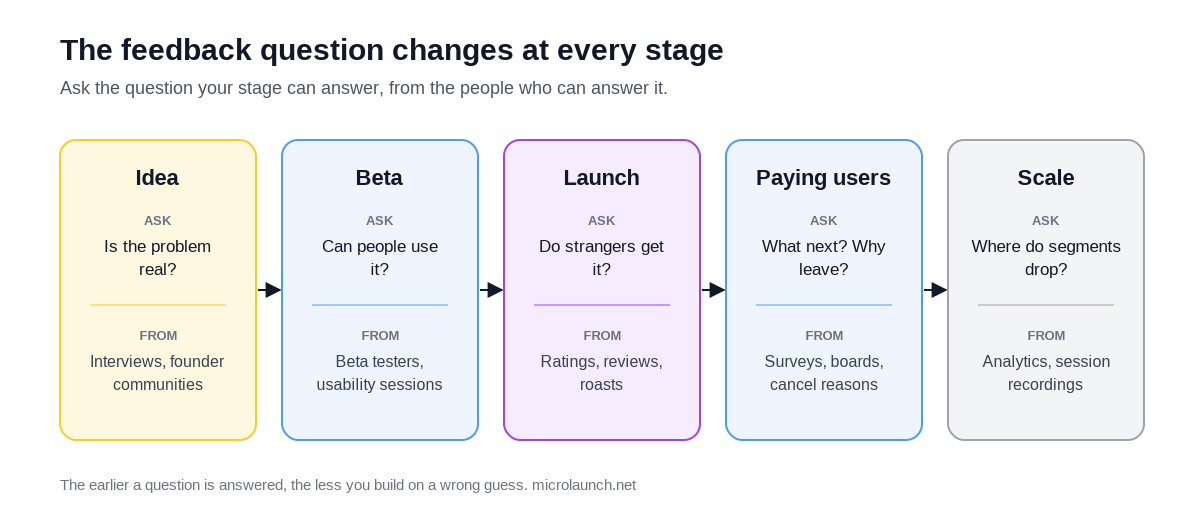
Feedback at the early stage answers three questions that decide everything else:
- Is the problem real? If nobody recognises it, no amount of features will help.
- Does the product solve it? People who try it should finish the core task without help.
- Do strangers get the pitch? If the one-line description doesn't land, nobody tries the product in the first place.
Each answer also feeds growth. Clear positioning makes every channel in our user acquisition guide convert better, and early reviews become the social proof your launch and landing page need.
What counts as product feedback
Product feedback covers any insight about a product from the people using it. The common types:
| Type | What it tells you | Typical source |
|---|---|---|
| Bug reports | What breaks, and where | Support emails, in-app widgets, beta testers |
| Feature requests | What users want next | Feedback boards, interviews, community threads |
| Usability feedback | Where people get stuck or confused | Usability tests, session recordings, first-run observation |
| Satisfaction scores | How happy users are overall | NPS, CSAT and micro-surveys |
| Pricing feedback | Whether the price feels fair and clear | Pricing surveys, sales calls, churn reasons |
| Positioning feedback | Whether people understand what the product is for | Landing page reviews, launch comments, roasts |
| Testimonials and reviews | What users value enough to say in public | Review requests after a good outcome, launch platforms |
Unsolicited feedback is mostly bug reports. Users who don't know you want their opinion rarely go out of their way to give it, so every other type has to be asked for.
Where founders get product feedback, by stage
Feedback sources change as a product grows. A team with 50,000 users has an analytics and survey problem; a founder with 12 users has a reach problem.
| Stage | Best feedback sources | What to ask |
|---|---|---|
| Idea, no product | Founder communities, problem interviews, a landing page | Is the problem real? How do people solve it today? |
| Prototype or beta | Beta testers, usability sessions, a small private group | Can people finish the core task without help? |
| Launch | Launch platforms, community threads, direct replies | Is the value clear in ten seconds? Would you pay? |
| Paying users | In-app surveys, feedback boards, support conversations | What should we build next? Why did you cancel? |
| Scale | Session recordings, NPS programmes, feedback analytics | Where do whole segments drop off? |
Before you have users
Talking to people who have the problem beats any tool at this stage. Five to ten conversations about how someone handles the problem today tell you more than a survey sent to strangers. Founder communities help too: on Microlaunch's own subreddit, r/microlaunch, makers share launches and ask for feedback.
During a beta
Beta testers give the most useful usability feedback because they use the product in their own environment, over time. Watch where they stall, ask what they expected to happen, and fix the first-run experience before anything else. For places to recruit them, see our list of beta testing websites.
At launch
A launch is the cheapest moment to get a lot of feedback at once, because strangers see the product for the first time and react to the pitch, not just the features. That first reaction is positioning feedback you can't get from friends. Our product launch guide covers how to prepare one, and our comparison of product launch software shows which platforms bring the most reviewers.
Getting launch feedback on Microlaunch
Microlaunch is a launch platform where founders get early users, honest feedback and social proof from a community of builders and early adopters. Feedback is built into the launch: the leaderboard shows an Idea rating, a Product rating and a Roasts count for every product, which separates "nice idea" from "I tried it and it works".
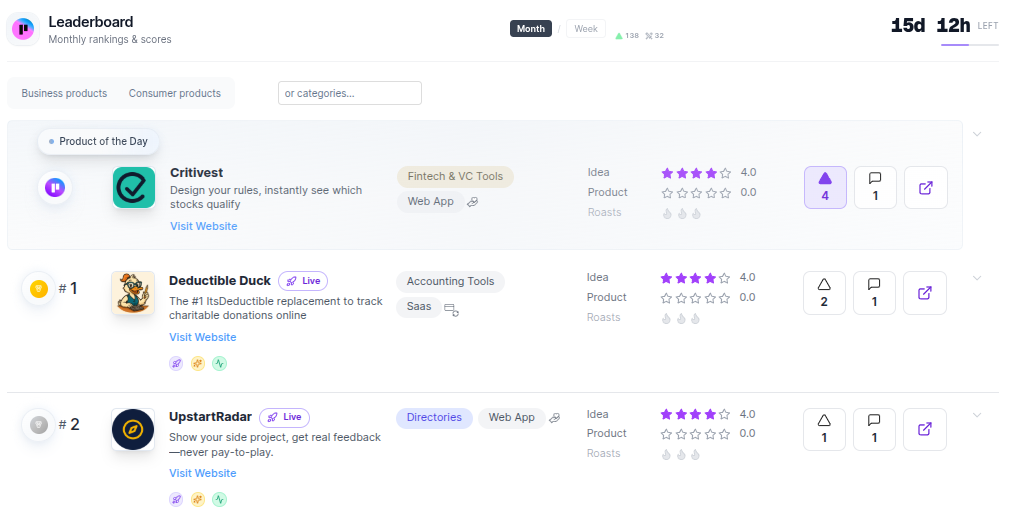
A sample product page: scores, reviews and a roast
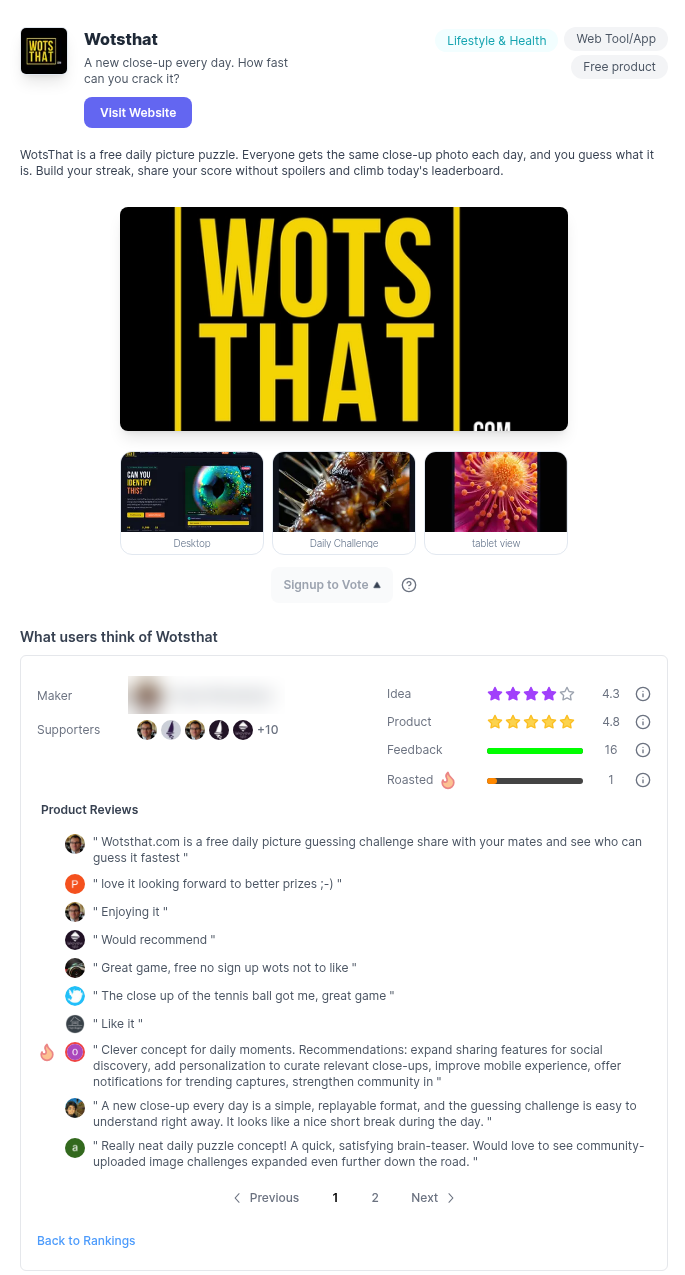
Here is what a founder gets back. Wotsthat, a free daily picture puzzle, launched on Microlaunch and its product page showed an Idea score of 4.3, a Product score of 4.8, 16 pieces of feedback and 1 roast. Each review is a short written reaction from someone who tried the game, from "Would recommend" to concrete suggestions.
The two scores answer different questions. The Idea score says whether people think the problem and the concept are worth it. The Product score says whether the product delivers once they try it. Read them together:
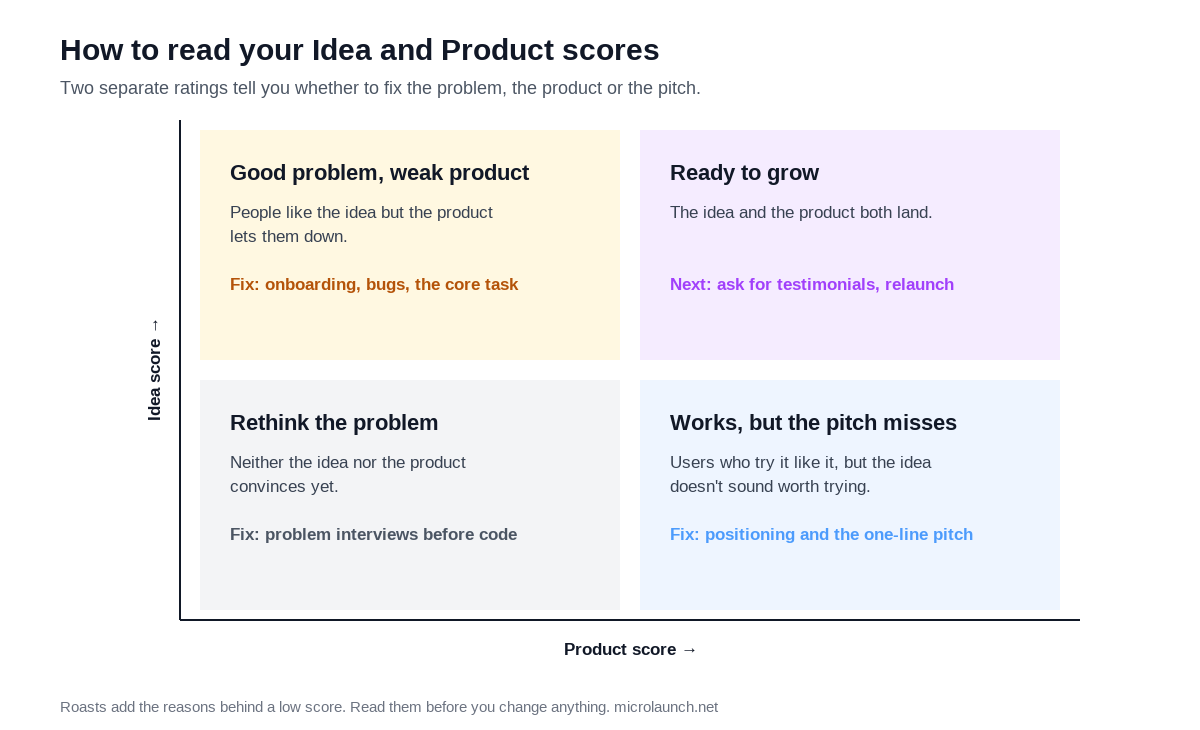
- High idea, low product: the problem is real but the product lets people down. Fix onboarding, bugs and the core task.
- Low idea, high product: people who try it like it, but the concept doesn't sound worth trying. Fix your positioning and one-line pitch.
- Both high: ask your best reviewers for testimonials and plan a re-launch.
- Both low: go back to problem interviews before writing more code.
The roast: critical feedback on purpose
A roast is feedback flagged as critical, marked with a flame on the product page. It exists because polite praise ("love it", "great idea") feels good and teaches you nothing. On Wotsthat, the roast was the most useful review on the page: it called the concept clever, then listed what to improve, from sharing features to the mobile experience and notifications.
How to use roasts well:
- Read them first. A roast usually names the thing your friends were too polite to mention.
- Look for repeats. One roast is an opinion. The same complaint in two roasts and a review is a priority.
- Reply in public. Thank the reviewer and say what you'll change. Other visitors see a founder who listens.
- Ship, then re-launch. Microlaunch includes re-launches for major feature releases, so you can go back to the same community with the fix.
What else Microlaunch gives a founder looking for feedback
- Honest feedback, roasts and testimonials from the community during a 30-day launch with continuous visibility.
- Verified reviews and a verification badge with Launch Pro ($49), so reviews can be reused as social proof.
- Reach: 2,561 daily visitors on the homepage and 168 products launched in November 2026, with 1,800+ startups and founders who have used it.
- A community: makers share launches and ask for feedback in r/microlaunch, with 6,000+ founders.
- Expert feedback: the Product Review & GTM Plan ($299 one-time, 2 slots per week) is an async review of your landing page and product, with 5–10 blockers ranked by ROI and a go-to-market plan.
One founder, Serg Karakhanyan of Larafast, put it this way: "Microlaunch helped me to get a lot of traffic and feedback about my products."
The honest limit: a launch community gives first impressions and early-adopter opinions. It won't replace interviews with your exact target customer, or ongoing in-app feedback once you have paying users.
Product feedback tools by job
Product feedback tools help you capture, organise and act on user insight once you have users to ask. Pick by the job, not by the longest feature list. The tools below are the ones recommended in Qualaroo's roundup of product feedback tools, with the prices it lists.
| Tool | Best for | Starting price |
|---|---|---|
| Qualaroo | In-app and website micro-surveys, NPS, AI sentiment analysis | $19.99/mo |
| ProProfs Survey Maker | AI-generated feedback surveys with templates and skip logic | $19.99 per 100 responses/mo |
| Canny | Public feedback boards, roadmaps and changelogs | $79/mo |
| SurveyMonkey | General survey creation with templates and analytics | $30/user/mo |
| Zonka Feedback | Omnichannel surveys with AI theme and sentiment analysis | Custom pricing |
Other tools in the same roundup, by job:
- Usability testing: UserTesting (remote usability tests).
- Behaviour analysis: Hotjar by Contentsquare (UX and behaviour analysis).
- Bug reporting: Marker.io (visual bug reports), Usersnap (user feedback and bug tracking).
- Feature requests and prioritisation: UserVoice, ProductLift (taking a request through to a shipped update).
- Forms and satisfaction surveys: Typeform (interactive forms), Delighted (customer satisfaction surveys).
A founder with fewer than a hundred users rarely needs more than one survey tool and one place to log requests. Feedback boards and AI analysis pay off once requests arrive faster than you can read them.
How to choose a product feedback method
The right method depends on what you need to learn next, not on what's popular. Use this as a decision path:
- You don't know if the problem is real: interviews and founder communities.
- You don't know if people can use the product: beta testers and usability sessions.
- You don't know if strangers get the pitch: a launch, a landing page review or a roast. Our list of Product Hunt alternatives covers where to launch.
- You don't know what to build next: a feedback board and short in-app surveys.
- You don't know why users leave: a cancellation survey and follow-up conversations.
Ask one question per survey where you can. Long, dull forms put people off and you lose the feedback you wanted most.
How to close the product feedback loop
A product feedback loop is the habit of collecting feedback, acting on it, and telling users what changed. Closing the loop is what makes people give feedback a second time.
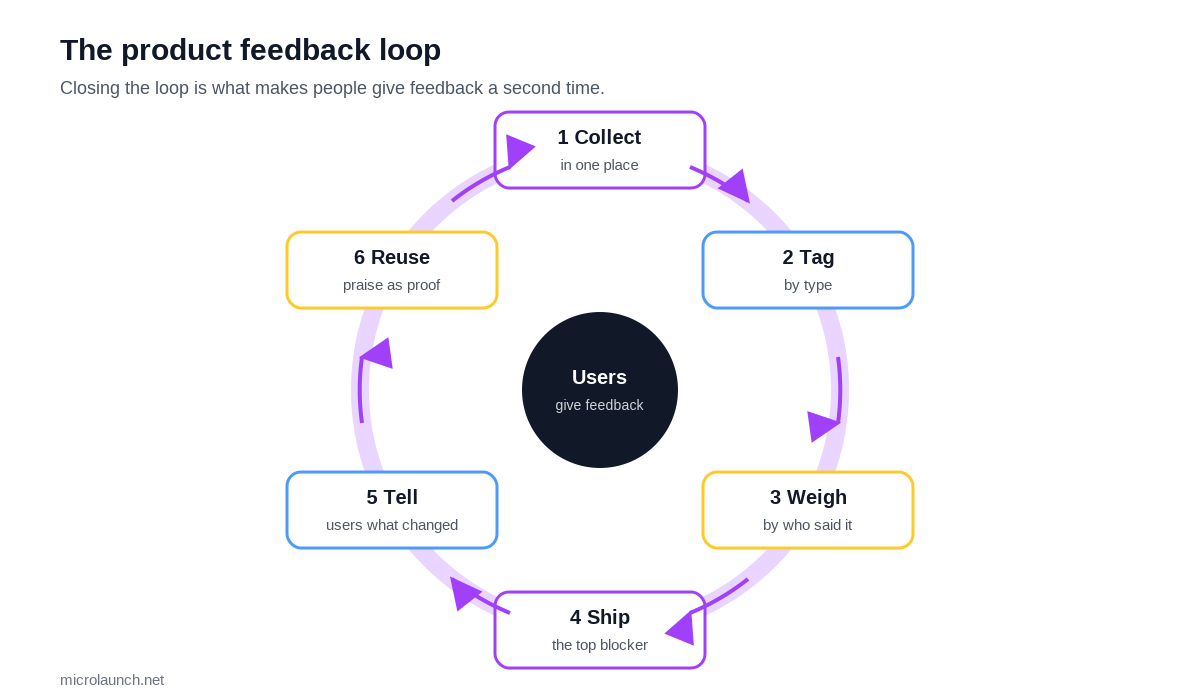
- Collect in one place. Feedback scattered across email, DMs and Slack threads gets lost. Log every piece with who said it and when.
- Tag by type. Bug, request, usability, pricing, positioning. Patterns show up when the same tag repeats from different people.
- Weigh by who said it. A request from your target customer counts more than one from someone who would never pay.
- Decide and ship small. Fix the most repeated blocker first, then the most requested feature that fits your direction.
- Tell people. Reply to whoever asked, post a changelog, or re-launch a major update to the community that gave the feedback.
- Turn praise into proof. When feedback is a compliment, ask permission to use it as a testimonial. Reviews on your launch page, a badge and testimonials on your site make every later visitor more likely to sign up, as the user acquisition guide explains.
FAQ
What is product feedback?
Product feedback is any insight users give about a product: bugs, feature requests, usability problems, satisfaction, pricing and how well they understand what it does. It comes from surveys, interviews, support conversations, reviews and launch comments, and it guides what a team builds and fixes next.
How do I get product feedback with no users yet?
Founders without users get feedback from people who have the problem, not from tools. Run five to ten problem interviews, share the idea in founder communities such as r/microlaunch, recruit a small group of beta testers, then launch to get first impressions from strangers at once.
What is the difference between product feedback and customer feedback?
Product feedback is about the product itself: features, bugs, usability and roadmap. Customer feedback is broader and covers the whole experience with a company, including support, billing and onboarding. Most product feedback is a subset of customer feedback.
What are the best product feedback tools?
The best product feedback tool depends on the job. Qualaroo suits in-app micro-surveys, Canny suits feedback boards and changelogs, UserTesting suits usability tests, and Hotjar suits behaviour analysis. Early-stage founders usually need one survey tool and one place to log requests.
How do I get honest product feedback instead of polite praise?
Honest product feedback comes from strangers who have no reason to be nice and from questions about behaviour, not opinions. Ask "what did you expect to happen?" rather than "do you like it?", watch people use the product, and use communities with ratings or roasts.
What is a roast in product feedback?
A roast is deliberately critical feedback on a product. On Microlaunch, reviewers can flag their feedback as a roast, shown with a flame on the product page, so founders can find the critical reviews that point to what to fix first.
Why is product feedback important for early-stage startups?
Early feedback is the cheapest way to avoid building something nobody wants. CB Insights found that no market need was the top reason in 42% of 101 startup post-mortems. Feedback before and at launch checks the problem, the product and the pitch while changes are still cheap.
How often should I ask for product feedback?
Ask for product feedback at moments that matter rather than on a fixed schedule: after onboarding, after a user completes the core task, after a major release and when someone cancels. Keep each request to one or two questions.