User Acquisition for Startups: A Founder's Guide
User acquisition explained for early-stage founders: the channels that bring first users, the metrics to track, and a 30-day plan you can run.
User acquisition is the process of attracting new people to a product and turning them into active users, through paid channels (ads), organic channels (search, AI answers, content, communities) and partner channels (referrals, directories, launch platforms). For an early-stage startup, user acquisition means one thing first: finding the first users who will try the product, give feedback and pay, before any budget for ads exists.
Most guides on user acquisition are written for mobile apps with ad budgets and attribution tools. This guide is for founders of SaaS and indie products who need their first 100 users. At that stage, the users usually come from a launch on a platform such as Microlaunch, from communities like Reddit and from directories, and later from search and AI answers.
What user acquisition means at the early stage
User acquisition at the early stage is about learning, not scale: each new user tells you whether the positioning lands, where people drop off and what they would pay. A founder with a new product has a different job than a large company buying installs:
- Reach the right people, not the most people. Ten users who match your ideal customer teach more than a thousand random visitors.
- Turn visitors into active users. A visitor who signs up and never comes back is not an acquired user.
- Collect proof. Reviews, testimonials and honest criticism make every later channel convert better.
Why positioning, pre-launch and launch decide your distribution
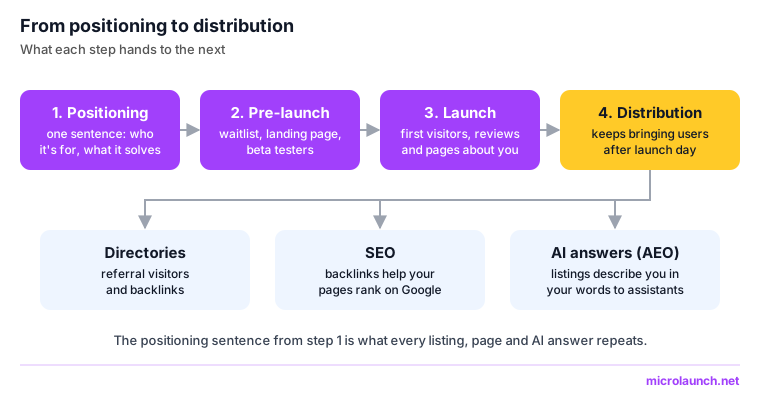
Positioning, pre-launch and the launch itself set how far every later channel can carry a product, because directories, search pages and AI answers all repeat what the first wave of listings and users said about it.
- Positioning comes first. Write one sentence naming who the product is for and the problem it solves, and use the same words on your landing page, your launch listing and every directory profile. Consistent descriptions are what search engines and AI assistants pick up when they decide what your product is and when to recommend it.
- Pre-launch builds the first audience. A waitlist, a landing page that converts (see these product landing page examples) and a round of testers from beta testing websites mean launch day starts with people ready to try, comment and review.
- The launch creates the first proof and links. A launch brings a burst of visitors, the first reviews and the first pages about your product on other sites. The product launch guide and this product launch plan checklist cover the preparation step by step.
- Distribution compounds after the launch. Directory listings keep sending referral visitors and backlinks, the backlinks help your pages rank on Google, and the pages and listings that describe your product are what AI assistants read when someone asks for a tool like yours.
User acquisition channels compared
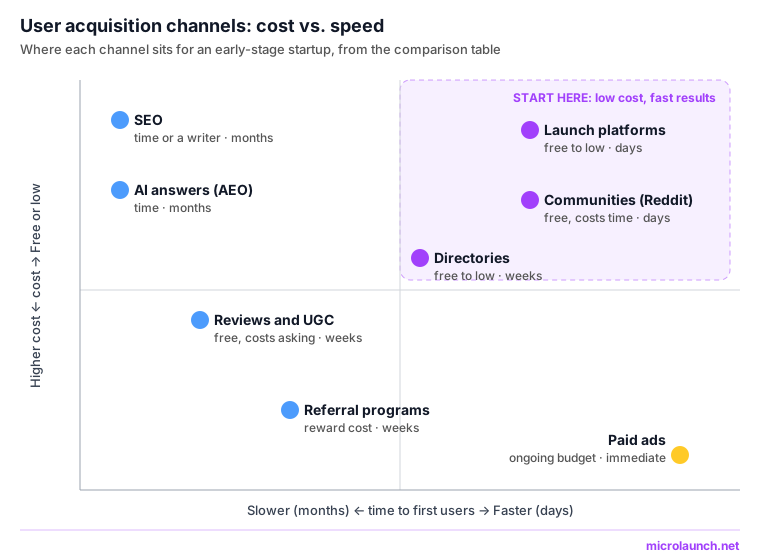
User acquisition channels differ most in cost and in how soon they bring users, and early-stage founders usually get their first users from the cheapest and fastest ones: launch platforms, communities and directories. The table gives one figure for each channel.
| Channel | Cost | First users in | One figure |
|---|---|---|---|
| Launch platforms | Free to low, one-time | Days | PeerPush lists 1,458,162 monthly visits; Uneed, 164,491 visits this month |
| Communities (Reddit) | Free, costs time | Days | r/SideProject has roughly 907K members |
| Directories | Free to low, one-time | Weeks | Each listing adds a referral source and a backlink |
| SEO | Time, or a writer | Months | Organic search brought 53% of trackable site traffic (BrightEdge, 2019) |
| AI answers (AEO) | Time | Months | ChatGPT has 800 million weekly users (OpenAI, October 2025) |
| Reviews and UGC | Free, costs asking | Weeks | 66% of people trust consumer opinions posted online (Nielsen, 2015) |
| Referral programs | Reward cost | Weeks | Dropbox's two-sided referral program raised signups by 60% |
| Paid ads | Ongoing budget | Immediate | Google Ads average $5.26 per click, $70.11 per lead (WordStream, 2025) |
Sources: PeerPush, Uneed, The Hive Index, Search Engine Land on BrightEdge, TechCrunch, Nielsen, Drew Houston's slides, WordStream.
Launch platforms for user acquisition
Launch platforms help with user acquisition because their visitors come specifically to find and try new products. The main options for SaaS and indie founders differ in how long they keep a product visible.
| Platform | What it offers | Price stated on its site | One honest limit |
|---|---|---|---|
| Microlaunch | 30 days of visibility, feedback and deals for new products | Launch Pro $49, Launch Plus $99 | Paid plans for the full 30-day program |
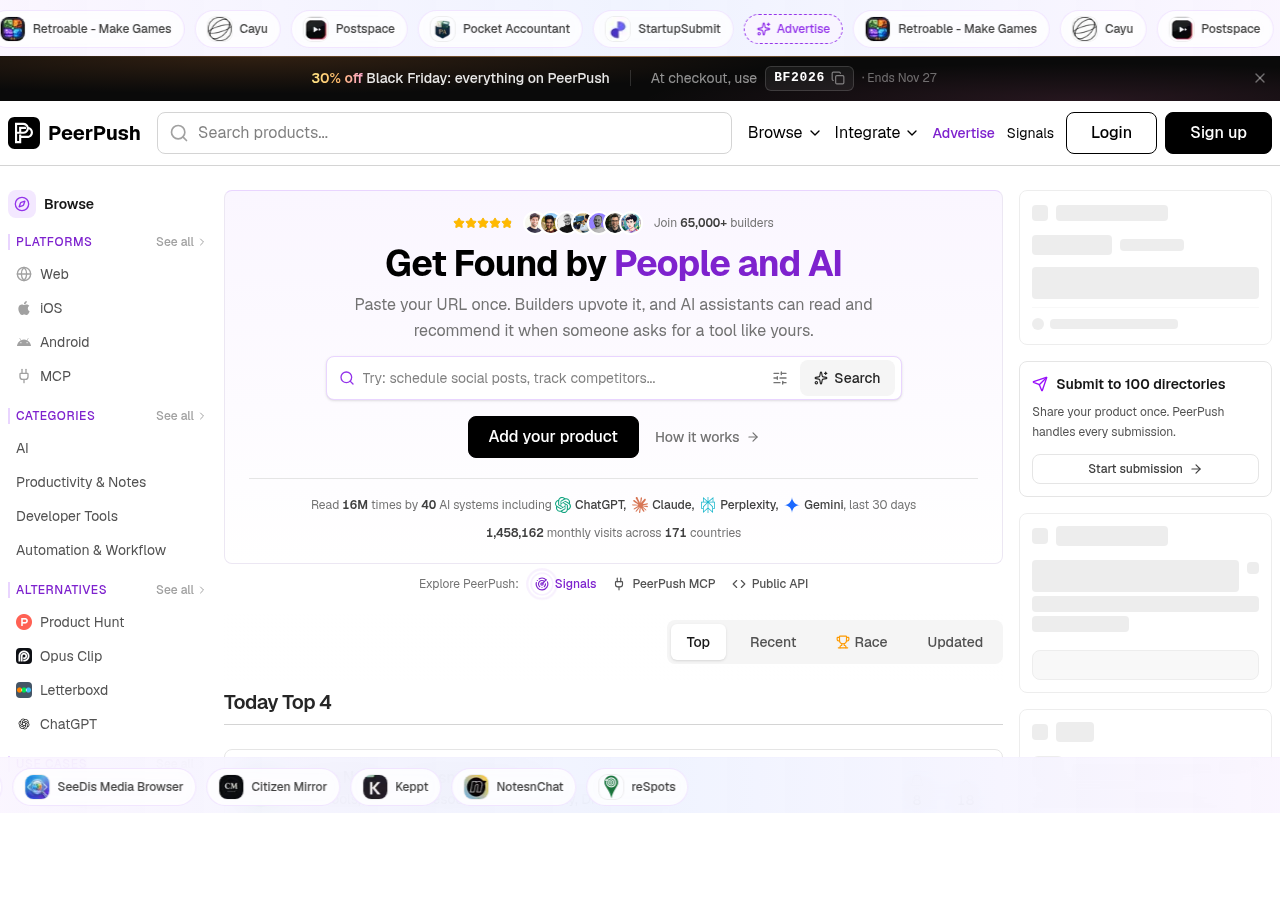
| PeerPush | Product discovery for people and AI assistants, with structured product data | Free submission, paid plans for instant publishing | Free submissions wait in a publishing queue |
| Uneed | Daily product launches with homepage visibility and a 75 DR backlink | Pro lifetime $149 once | Visibility centers on the daily launch ranking |
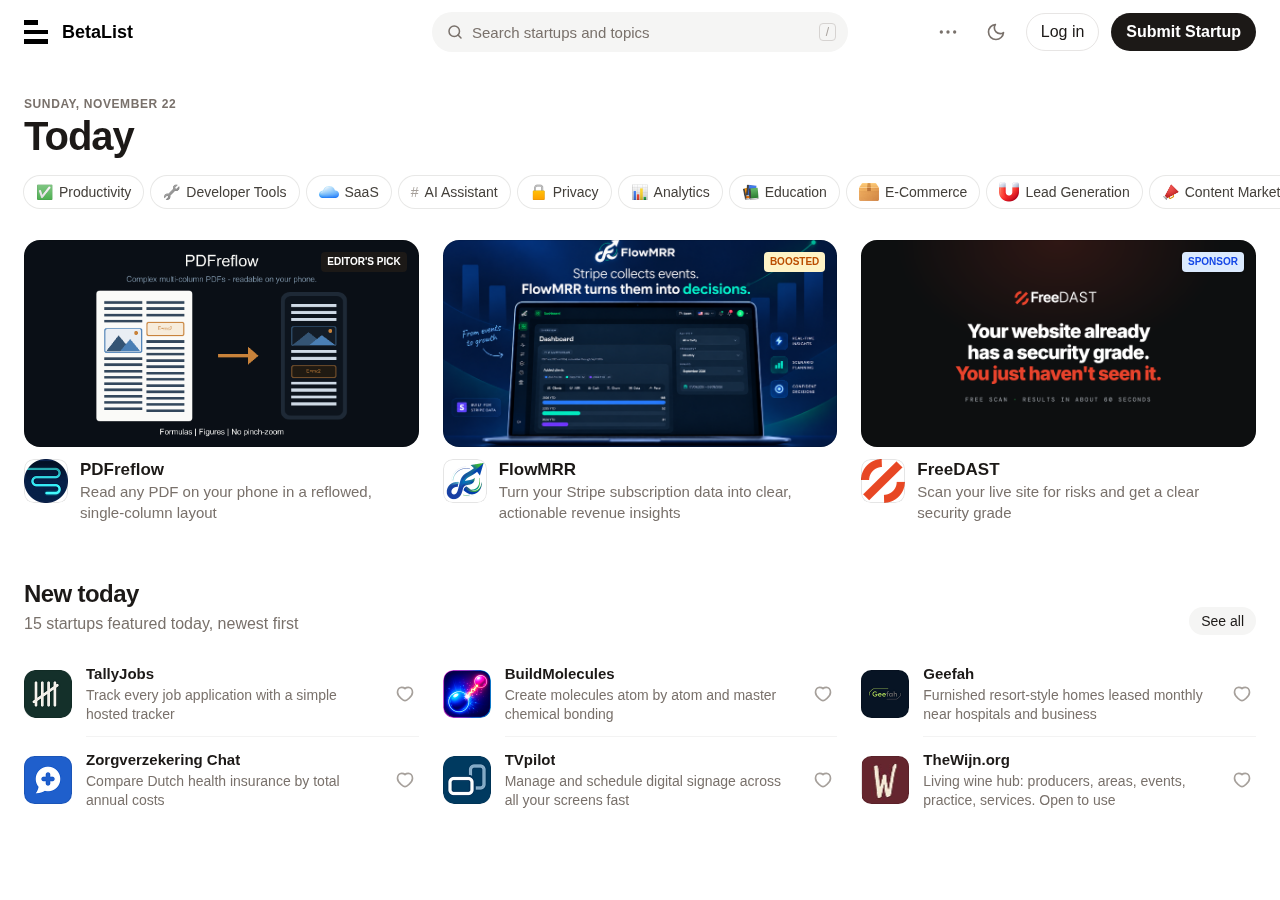
| BetaList | Early access to upcoming startups, with an editor's pick and boosted listings | Paid boosts for more visibility | Built around pre-launch and early-access products |
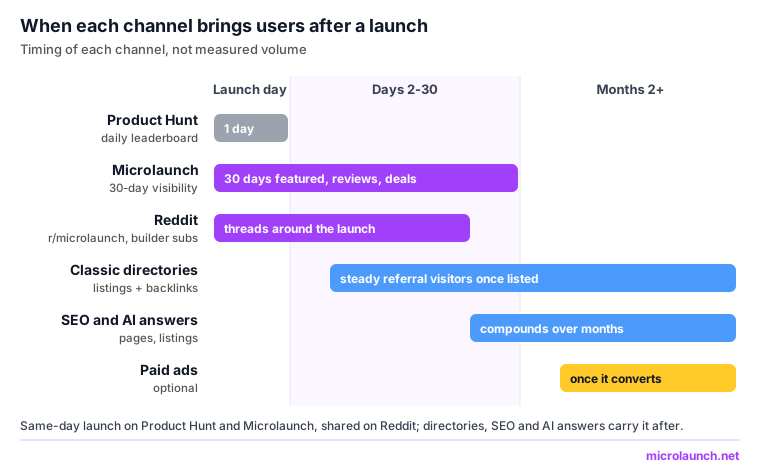
Product Hunt is the best-known launch platform, with daily, weekly, monthly and yearly leaderboards run on Pacific time. Launching on Product Hunt and Microlaunch the same day combines the two: Product Hunt's daily leaderboard concentrates attention on launch day, and Microlaunch keeps the product visible for the following 30 days. The Product Hunt alternatives guide compares the options in detail.
Microlaunch
Microlaunch is a launch platform where founders get reviews, exposure and first sales over 30 days, used by 1,800+ startups and founders. Its stats, last updated August 2026, list 650,000+ unique visitors in total, 30k+ unique visitors a month, 7.2M+ product impressions and 140,000+ product clicks sent to listed products. Its homepage counted 168 products launched in November 2026 and 2561 daily visitors.
- Launch Pro ($49, or $39 with code LAUNCH20): pick your launch date, featured spots, 2 boosts, Product of the Day eligibility, auto distribution, 4+ SEO-optimized pages, a marketplace spot to publish deals, verified reviews and badge, DR65+ do-follow backlinks and founder support.
- Launch Plus ($99, or $79 with code LAUNCH-PLUS-20): everything in Pro, plus 4 long-form SEO-optimized pages, 3 automated boosts, a mention on X (10.8k followers), a post on Reddit (4.2k builders) and premium category placement.
- Launch Everywhere ($199, or $149): Launch Pro plus submission to 50 launch and SaaS directories, with live status and a URL for every directory and a final report.
- Product Review & GTM Plan ($299): an async review of the landing page and product, 5-10 blockers ranked by ROI, and a go-to-market plan covering positioning, channels, pricing and a 30-day plan.
Founders who launched there report results such as "14.5% of my traffic came from there" (Nathan Chua, Snipowl). Microlaunch's marketplace also lets founders publish deals, a channel the AppSumo alternatives guide covers.
Reddit and Microlaunch together
Reddit and Microlaunch work best together because a launch gives founders something concrete to share, and Reddit's builder communities are where early adopters discuss new products every day.
- r/microlaunch, Microlaunch's own subreddit, has 6,000+ founders who share launches and ask for feedback. Posting your launch there puts it in front of builders already looking at new products.
- Builder subreddits reach further. Communities such as r/SideProject welcome show-your-project posts; read each subreddit's rules on self-promotion before posting.
- Each one feeds the other. A Reddit thread sends visitors to the launch page, where they can leave reviews and feedback, and the launch page gives the thread a place to point that stays live for 30 days. The Launch Plus plan's Reddit post adds one more push.
Answering every comment turns a one-time post into the first testimonials. The guide on getting your first 100 users without a marketing budget has more ways to work communities.
SEO and AI answers (AEO)
SEO and answer engine optimization (AEO) bring users for months after a page is written, which makes them the channels that compound once your positioning is settled. BrightEdge's 2019 study found organic search delivered 53% of all trackable website traffic, against about 15% for paid search.
- SEO: write pages that answer what your customers search: comparisons, alternatives, how-tos and problems your product solves. Backlinks from launch platforms and directories help a new domain's pages rank.
- AEO: AI assistants answer many questions that used to go to a search engine. Gartner predicted in 2024 that traditional search engine volume would drop 25% by 2026 as people turn to AI chatbots, and ChatGPT alone reports 800 million weekly users. AI search still sent less than 1% of referral traffic in BrightEdge's September 2025 data, so treat AEO as a channel you build alongside SEO, not instead of it.
- What helps both: the same one-sentence positioning everywhere, direct answers at the top of each page and section, and listings on launch platforms and directories that describe the product in your words. Directories and launch pages are often among the pages AI assistants read when someone asks for a tool like yours.
Reviews and user-generated content (UGC)
User-generated content, such as reviews, testimonials, roasts and community posts, acquires users because people trust other users more than a brand. Nielsen's 2015 global survey found 83% of people trust recommendations from friends and family, and 66% trust consumer opinions posted online.
- Ask during the launch. Launch visitors are the easiest people to ask for a review or a roast; reply to every one.
- Turn feedback into proof. Quote the best testimonials on your landing page and directory profiles. Why early feedback matters for SaaS startups explains how to use it.
Paid ads
Paid ads bring users the day they start, but at a cost per user that early-stage products rarely recover before they know what converts. WordStream's 2025 benchmarks put the average Google Ads cost at $5.26 per click and $70.11 per lead, across more than 16,000 search campaigns in 23 industries.
- Wait until the landing page converts. Use the free channels above to learn which message and audience sign up and activate.
- Start with small tests. A fixed budget on one audience and one message tells you your real cost per acquisition.
- Retarget warm visitors first. Visitors from your launch, Reddit or a directory are the warmest audience to test.
The user acquisition metrics to track
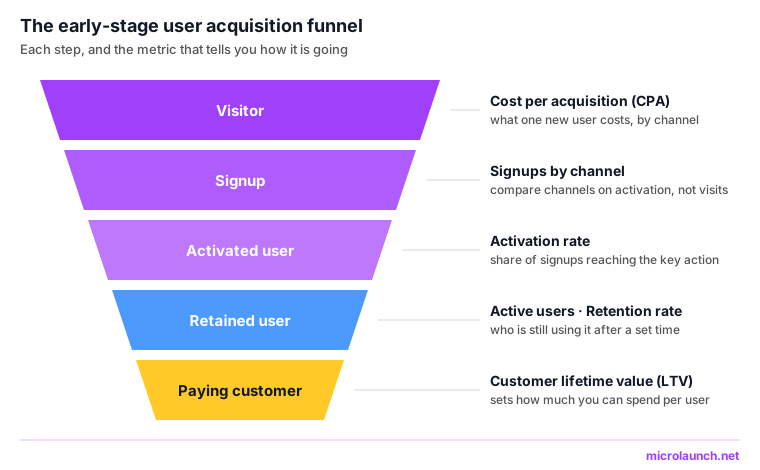
Five metrics cover user acquisition for an early-stage product: cost per acquisition, activation, active users, retention and lifetime value. Track them from the first user, even in a spreadsheet, and see tracking product launch metrics from day one for launch-specific numbers.
| Metric | What it measures | Why it matters early |
|---|---|---|
| Cost per acquisition (CPA) | The average cost of acquiring one new user | Shows which channel is worth more time or money |
| Activation rate | The share of signups who reach the product's key action | Shows whether the onboarding works |
| Active users | Users who interacted with the product in a period, such as the past 30 days | The real size of your user base |
| Retention rate | The share of users still active after a set time | Tells you whether to fix the product or get more users |
| Customer lifetime value (LTV) | The revenue you expect from a customer over the whole relationship | Sets how much you can spend to acquire one |
For apps, cost per install (CPI) replaces cost per acquisition. Return on ad spend (ROAS) only matters once you run ads.
How to get your first users: a 30-day plan
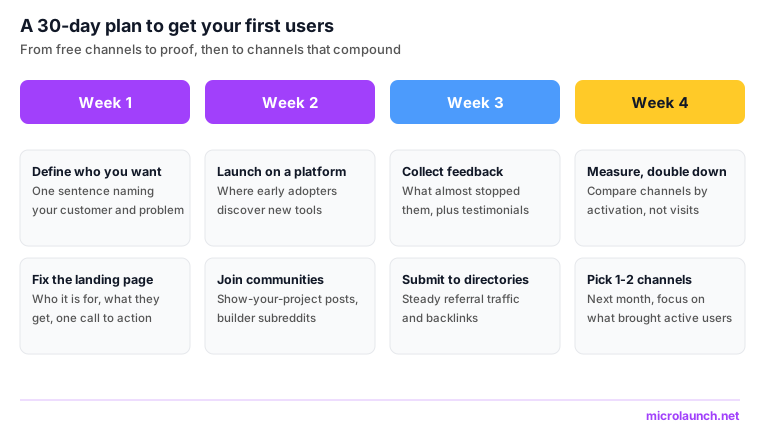
A 30-day user acquisition plan for a new product moves from positioning to a launch, then to proof and channels that compound. Each step feeds the next.
- Week 1: Define who you want. Write your one-sentence positioning. Every channel below repeats it.
- Week 1: Fix the landing page. Make the first screen say who it is for and what they get, with one clear call to action. Visitors from every channel land here.
- Week 2: Launch on a platform built for early adopters. Launch on Microlaunch, and on Product Hunt the same day if you want the extra day of attention, then answer every comment and question.
- Week 2: Join the communities your customers use. Share the launch in r/microlaunch and in builder subreddits where it is welcome, and help in threads where your product is relevant.
- Week 3: Collect feedback and testimonials. Ask early users what almost stopped them from signing up, and ask the happy ones for a quote you can show.
- Week 3: Submit to directories. Directory listings bring steady referral traffic and backlinks that help your pages rank and give AI assistants more pages that describe your product.
- Week 4: Measure and double down. Compare channels by activation, not visits. Put next month's time into the one or two channels that brought active users, and start the SEO pages that keep users coming.
Common user acquisition mistakes
The most common user acquisition mistake at the early stage is buying traffic before the product converts. A few others repeat across early-stage startups:
- Launching before the positioning is clear. A vague one-liner gets repeated by every directory and AI answer that describes the product.
- Counting visitors instead of active users. A spike of visits that never activate hides a product or onboarding problem.
- Launching once and stopping. A launch brings a burst; directories, communities and content keep users coming after it.
- Ignoring feedback from the first users. Early criticism is the cheapest research you will get.
FAQ
What is user acquisition?
User acquisition is the process of attracting new users to a product and converting them into active users. It covers paid channels such as ads, organic channels such as search, AI answers and communities, and partner channels such as referrals and launch platforms.
What is the difference between user acquisition and customer acquisition?
User acquisition counts everyone who starts using a product, including free users, while customer acquisition counts people who pay. For a freemium SaaS, user acquisition fills the top of the funnel and customer acquisition measures how many of those users convert.
How do startups get their first users with no budget?
Startups get their first users with no budget through a launch, communities and direct outreach. Launch the product where early adopters browse new tools, share it on Reddit and in communities your customers use, list it in directories, and talk to every early user to learn what to fix.
Why does positioning matter for user acquisition?
Positioning matters because every channel repeats it: launch listings, directory profiles, search results and AI answers all describe the product in the words you gave them. A clear one-sentence positioning makes each of those pages bring the right users.
Which user acquisition metrics matter most early on?
Activation rate and retention matter most early on, more than raw signups. They show whether the users you acquire stay, which tells you whether to work on the product or on getting more users.