This task can be performed using Open Field
See which marketing jobs are real opportunities—before you apply.
Best product for this task

Open Field
jobboards
Open Field is a marketing career search site that surfaces US manager-to-CMO roles with clear context on responsibilities, team dynamics, and why each position opened, plus tailored filters and email alerts.
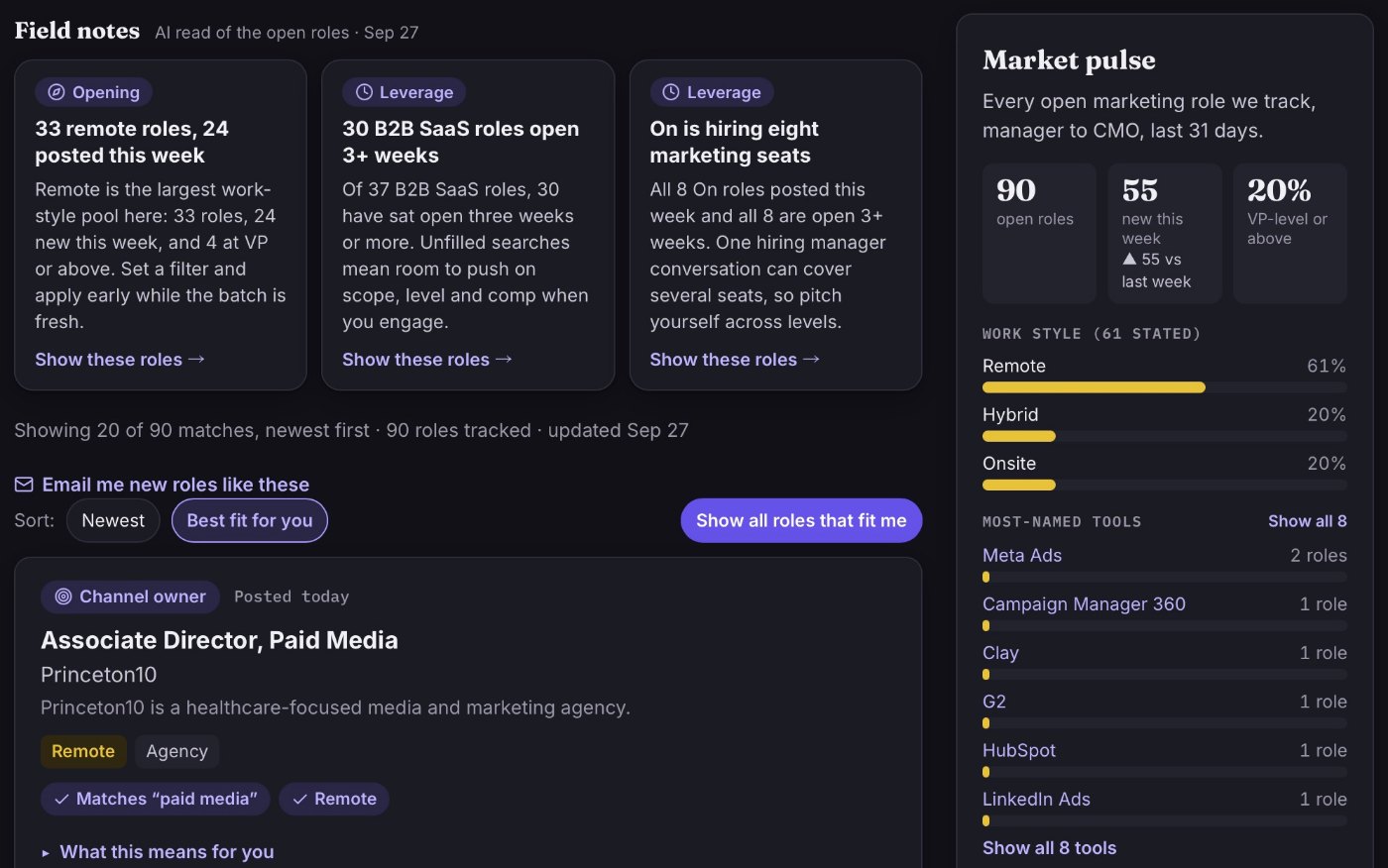
If you are evaluating marketing jobs where you build the in-house function, look past the title. This guide shows how to spot evidence of an agency transition, test the role against a real job posting, and verify whether the opportunity matches your goals.
1. Start with the role’s business trigger
Read the opening paragraphs and search for language that explains why now. Strong signals include: The deciding factor among jobboards products is whether they support this exact workflow.
- “Bringing marketing in-house”
- “Replacing an agency partner”
- “Building the first marketing team”
- “Creating a new function”
- “Establishing strategy and measurement”
- “Hiring the company’s first marketing leader”
These phrases distinguish marketing jobs replacing an agency from ordinary channel or campaign roles. A title such as “Marketing Director” does not prove you will build anything. The business trigger does.
Also check whether the company expects you to create processes, define budgets, select tools, or hire employees. Those responsibilities suggest the function is still forming.
If you need a broader source of specialized openings, browse marketing careers products, but keep the immediate task focused on the role’s underlying situation.
2. Separate agency-transition work from ordinary management
Marketing roles taking over from an agency usually contain three types of work:
- Audit: reviewing existing campaigns, vendors, data, and performance.
- Transfer: moving knowledge, accounts, creative assets, and processes inside.
- Build: hiring people, setting operating rhythms, and owning strategy.
Look for verbs such as “transition,” “insource,” “stand up,” “centralize,” “own internally,” and “develop the team.” A posting that only says “manage agency relationships” may leave the agency in place rather than replace it.
For example, imagine a software company posting for its first senior marketing hire. The description says the person will assess an external partner, define a demand-generation plan, choose reporting tools, and hire two marketers. That is a strong example of marketing jobs building the first in-house team.
By contrast, a role responsible for approving agency briefs and reporting to an existing VP is more likely vendor management.
You can also compare the opening with growth leadership directory products when deciding whether the expected scope is genuinely leadership-level.
3. Test the evidence in a real posting
Create a quick evidence table before applying:
| Question | Evidence to find |
|---|---|
| Is the function new? | First hire, new department, or new operating model |
| Is an agency involved? | Named partner, transition plan, or vendor handoff |
| Will you build a team? | Hiring plan, direct reports, or recruiting ownership |
| Will you own the system? | Budget, measurement, tools, process, and strategy |
| Who supports the work? | Executive sponsor, founders, sales, or contractors |
Score each answer as clear, implied, or missing. A role with mostly clear evidence is more likely to be one of the in-house marketing leadership jobs you want. Several missing answers are a reason to ask questions before investing in interviews.
Pay attention to marketing jobboard products that provide role context, not just titles. Open Field, for example, identifies whether a listing involves building an in-house function or taking over from an agency.
4. Verify the opportunity before applying
Write three questions based on the gaps you found:
- What work currently sits with the agency?
- Which responsibilities must be established in the first six months?
- Is there an approved hiring plan and budget?
Then check whether the answers match the posting. If the company expects one person to replace a full agency, create strategy, execute every channel, and hire later, the role may be under-resourced.
Mark your result:
- The reason for the transition is clear.
- The first priorities are specific.
- Team and budget expectations are stated.
- Executive sponsorship is identifiable.
- The role’s scope matches the title and compensation discussion.
More topics related to Open Field
Similar topics
- Best Marketing Job Search Sites for Manager to CMO Roles
- How to set email alerts for new US marketing manager jobs?
- Marketing Leadership Job Search Workflow for Evaluating Team Dynamics
- How to verify why a marketing leadership role opened before applying?
- How to evaluate marketing jobs using salary, team, and hiring context