This task can be performed using ZeroPulp AI
Describe process, get instant compliant workflow app—zero code.
Best product for this task

ZeroPulp AI
no-code
ZeroPulp.ai converts plain-English descriptions of business processes into live, compliant workflow automation in minutes, eliminating manual approvals, email chasing, and spreadsheet tracking without requiring any.
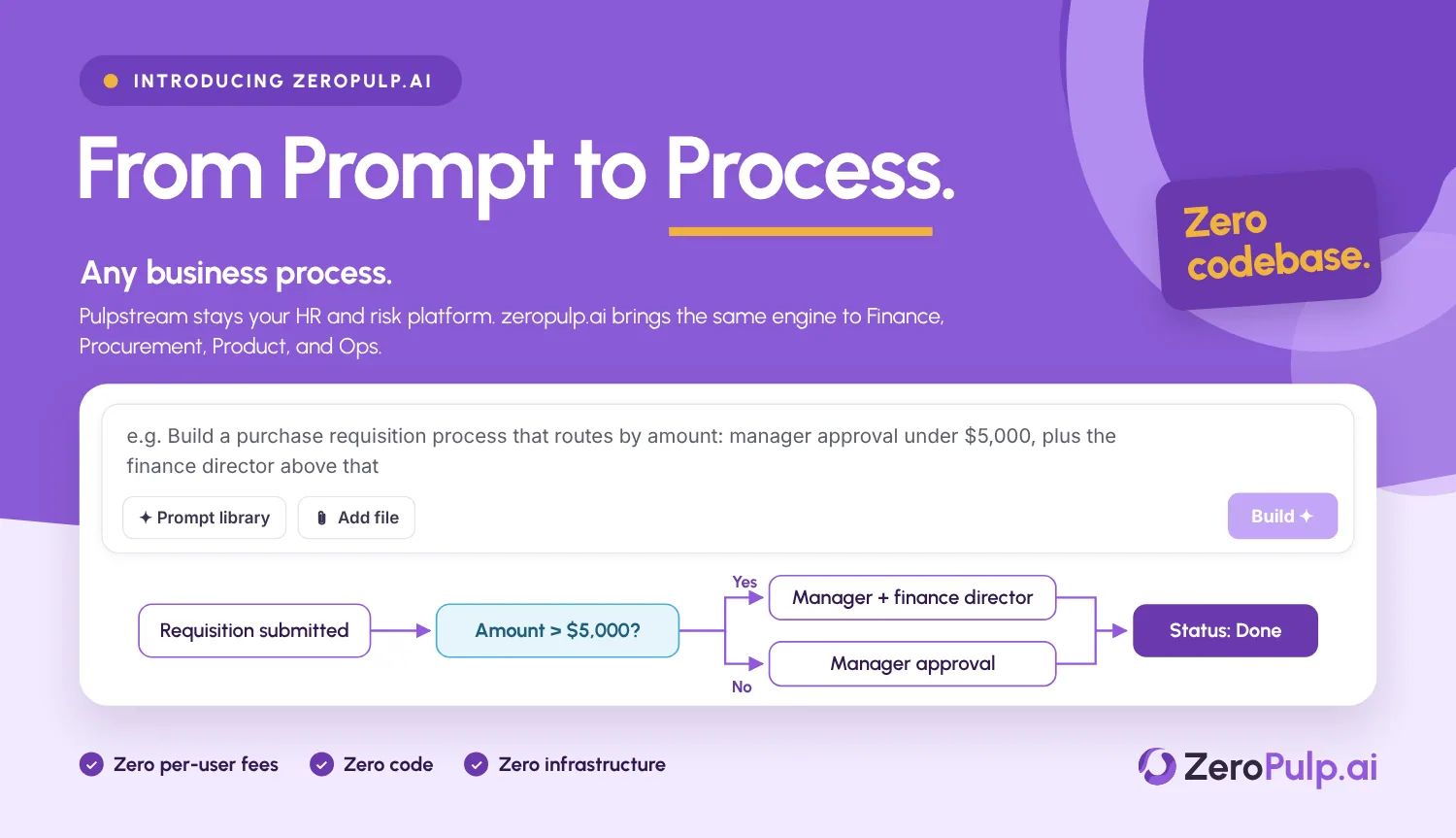
If approvals still live in email and spreadsheets, use this guide to create a governed workflow, test its controls, and verify that every decision can be reconstructed later. You will apply the steps to a purchase approval example and produce audit-ready business process automation without engineering support.
Before you build: define the control
Start with one process and write its compliance requirements in plain language.
For example:
Route every purchase request above $10,000 to the department head and finance. Require vendor documentation before approval. Record the requester, approvers, timestamps, decision, and supporting files.
List these prerequisites:
- The process owner and backup approver
- Approval thresholds and routing rules
- Required fields and supporting documents
- Separation-of-duties requirements
- Retention and access expectations
- The evidence an auditor must be able to review
This is the foundation of compliant workflow automation software. A workflow is not audit-ready merely because it moves work automatically. It must enforce the policy and preserve evidence.
For broader implementation choices, compare workflow automation products only after you have documented these controls.

1. Convert the policy into explicit workflow steps
Break the process into actions, decisions, and records.
For the purchase example:
- An employee submits the request through a form.
- The workflow validates amount, cost center, vendor, and attachments.
- Requests under $10,000 go to the department manager.
- Requests above $10,000 go to the department head and finance.
- Missing vendor insurance or tax documentation sends the request back.
- The final decision is recorded with the approver and timestamp.
- The requester receives the outcome.
Avoid vague instructions such as “finance reviews as needed.” Replace them with a condition, owner, and required result. This makes workflow automation for regulated organizations easier to test and maintain.
A no-code platform can help compliance teams express these rules directly. ZeroPulp AI turns a plain-English process description into a live workflow application, including routed approvals, parallel tasks, and external request forms. It is designed for no code workflow automation for compliance teams, not just simple reminders.
You can also review approval workflow engine products when routing complexity is the main decision.
2. Add governance before launch
Inspect the draft workflow as if you were an auditor. Confirm that:
- Every request has a unique record.
- Required fields cannot be skipped.
- Approvers are assigned by role or rule, not informal forwarding.
- A requester cannot approve their own submission when separation of duties applies.
- Rejections require a reason.
- Changes, approvals, and timestamps remain visible.
- Access is limited to appropriate participants.
For teams evaluating SOC 2 compliant workflow automation or HIPAA compliant workflow automation software, ask the vendor how compliance is supported and what evidence the platform retains. ZeroPulp AI states that it supports SOC 2 Type II and HIPAA compliance, but your organization must still configure access, data handling, and retention appropriately.
Use no-code process automation products when business owners need to change routing without creating an engineering backlog.
3. Test, verify, and fix the evidence trail
Run normal, boundary, and failure cases:
- Submit a request below and above the approval threshold.
- Omit a required document.
- Try an unauthorized approval.
- Reject a request and confirm the reason is captured.
- Reassign an unavailable approver.
- Export or inspect the complete history.
A useful audit record should show who acted, what they decided, when they acted, and which data or files informed the decision. Those details are the basis of audit-ready business process automation.
Before production, complete this checklist:
- Policy rules match the live routing
- Required fields and attachments are enforced
- Conflicting roles are blocked
- Test records show complete timestamps and decisions
- Owners review exceptions regularly
- A change process exists for future policy updates
Common mistakes and next step.
More topics related to ZeroPulp AI
Similar topics
- Best Zero-Code Compliance Workflow Use Cases for Operations Teams
- How to Turn a Business Process Description Into a Live Workflow
- How to build a compliant approval workflow from a plain English process?
- How to replace email approvals and spreadsheet tracking with one workflow app?
- Employee Onboarding Approval Workflow Template With Automated Compliance Tracking