This task can be performed using Boldrouter
Effortless routing, bold performance for modern networks
Best product for this task
Boldrouter
dev-tools
Boldrouter is a Swiss-developed unified AI gateway providing access to leading models from OpenAI, Anthropic, Google, xAI, DeepSeek, Mistral, and others through a single API. Built for developers and enterprises, it offers intelligent routing, automatic failover, multi-model intelligence, cost optimization, privacy protection, usage analytics, and consolidated billing. Build and scale AI applications, autonomous agents, and enterprise automation with one secure, provider-agnostic platform.
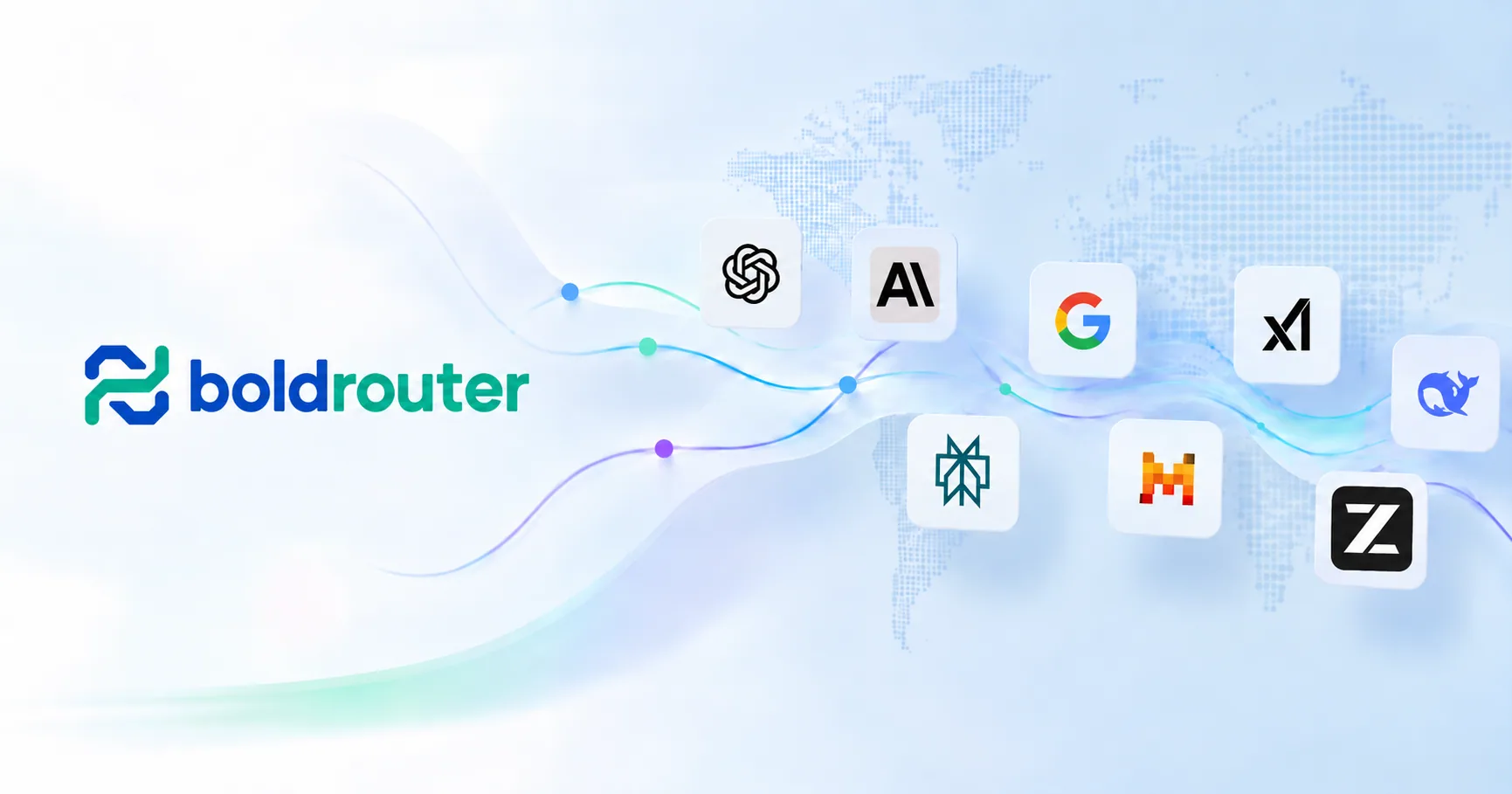
If your application calls OpenAI, Anthropic, Google AI, or other providers through separate integrations, you can replace that maintenance burden with a unified AI gateway. This guide shows how to centralize multiple LLM APIs, route requests through one endpoint, and verify that your application still behaves correctly.
Prepare your provider migration
Start by inventorying every existing integration. Record the provider, model, authentication method, request format, response fields, timeout, and fallback behavior. The deciding factor among dev-tools products is whether they support this exact workflow.
For example, a support assistant might currently use:
- OpenAI for general responses
- Anthropic for long-form reasoning
- Google AI for selected multimodal tasks
Create a small compatibility checklist before changing code:
- Identify every model your application calls
- Save representative prompts and expected outputs
- Note streaming, tool-calling, and token settings
- Define acceptable latency, cost, and failure behavior
- Remove provider keys from client-side code
This inventory helps you compare a multi model AI gateway with direct integrations. It also clarifies whether you need simple provider abstraction or intelligent routing and failover.
If routing rules currently live inside application code, first review this guide to centralize API routing without putting logic in application code. The goal is to keep provider decisions outside your business logic.
Choose a single gateway contract
Select an AI API gateway for multiple providers that exposes one stable request format. Your application should send a request to the gateway, specify a model or routing policy, and receive a predictable response.
A single API for multiple AI models should handle:
- Authentication with the gateway
- Model selection or policy-based routing
- Provider-specific translation
- Timeouts and retries
- Usage and billing visibility
For example, replace separate provider clients with one internal function:
const response = await aiGateway.chat({
  model: "support-default",
  messages,
  temperature: 0.2
});
Your application no longer needs separate branches for an OpenAI Anthropic gateway or an OpenAI Anthropic Google AI gateway. A provider agnostic AI infrastructure layer can map the logical model name to the selected provider.
When evaluating options, confirm that the gateway supports the capabilities you actually use. Streaming, structured output, tool calls, image input, and safety settings may not translate identically between providers.
Migrate one real workflow
Choose one contained workflow rather than changing every AI call at once. A support ticket classifier is a useful example because it has a clear input, output, and fallback.
First, route the workflow through the gateway in a staging environment. Keep the original integration available for comparison. Send the same test cases to both paths and compare:
- Output structure
- Classification accuracy
- Error handling
- Response time
- Token or usage reporting
A Swiss AI gateway such as boldrouter can provide one secure access layer for OpenAI, Anthropic, Google, xAI, DeepSeek, Mistral, and other leading models. Its routing, automatic failover, privacy controls, analytics, and consolidated billing are relevant when a development team wants to replace multiple LLM integrations with one API.
For teams treating this as an operational API product, keep the gateway configuration separate from application release cycles. If the workflow spans services, involve the team responsible for microservices products early.
Verify the migration and avoid common mistakes
Run the same test set through the old and new paths, then check logs and application behavior. A successful migration should show that the application can change providers without changing its core business logic.
Common mistakes include:
- Assuming every provider supports identical parameters
- Forgetting to test streaming and tool calls
- Exposing gateway credentials in browser code
- Retrying requests without an idempotency strategy
- Measuring only successful responses, not fallback events
- Switching models without checking output format
Use an enterprise AI gateway when governance, usage analytics, privacy, and consolidated billing matter across teams. After staging passes, release gradually and monitor errors, latency, cost, and real user outcomes.
More topics related to Boldrouter
Similar topics
- Best Boldrouter Use Cases for API and Backend Traffic Management
- How to centralize API routing without putting logic in application code
- How to configure API traffic routing with Boldrouter?
- How to reduce backend latency using Boldrouter routing rules?
- Boldrouter Alternatives for Centralized Service Routing and Configuration