This task can be performed using GrowthMap
The growth solution every indie developer struggles to solve
Best product for this task

GrowthMap
marketing
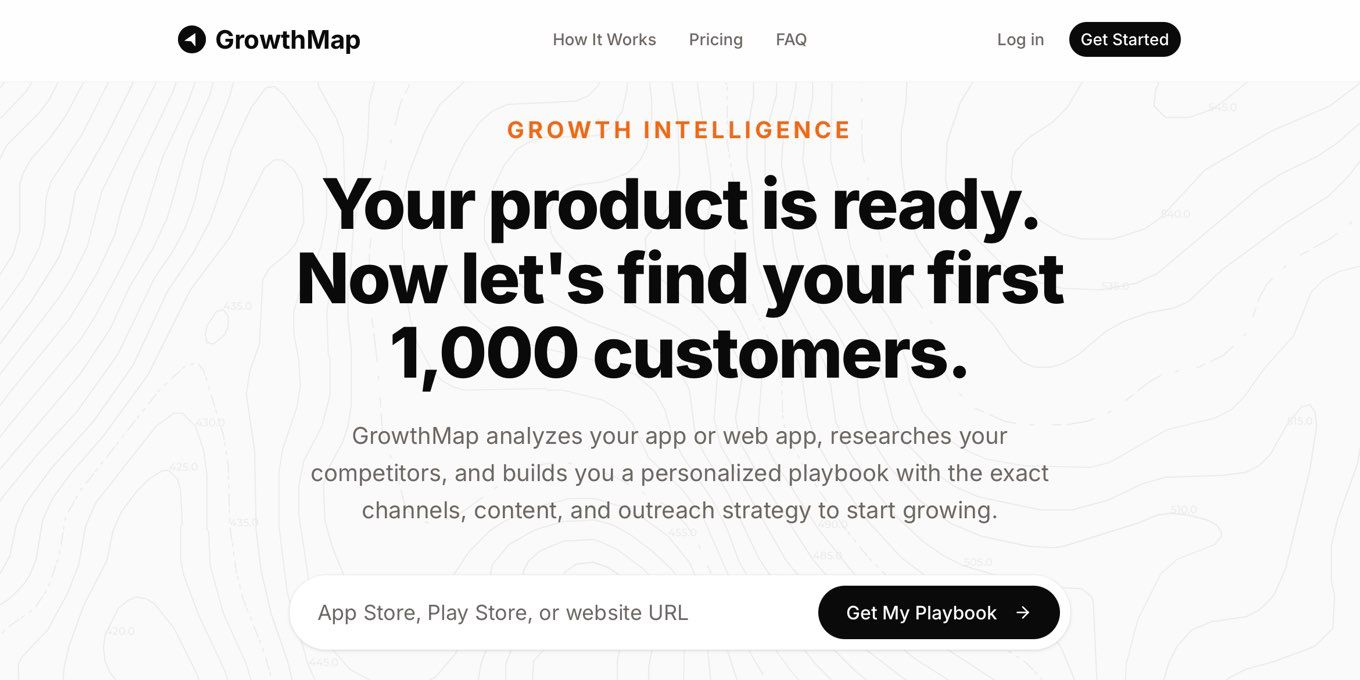
GrowthMap will help you find your first 1,000 customers. It analyzes your app or Saas, researches your competitors, and builds you a personalized playbook with the exact channels, content, and outreach strategy to start growing.
If your SaaS or app has early interest but no repeatable acquisition path, use this guide to find your first 1,000 customers or users. You will define a narrow audience, inspect competitors, test focused channels, and verify progress with real activation and retention data.
1. Define the customer you can actually reach
Before promoting your product, write a one-sentence customer profile:
“I help [specific audience] solve [specific problem] with [product outcome].”
For example, a budgeting app might target freelance designers who need to separate business and personal expenses. A broad audience makes it difficult to choose keywords, communities, or outreach targets. The deciding factor among marketing products is whether they support this exact workflow.
Prepare these items:
- Your product URL or App Store or Play Store listing
- The main problem your product solves
- Three competing products users might already consider
- One activation event, such as creating a project, inviting a teammate, or completing a first task
- A target for the next 30 days, such as 100 activated users
This is the foundation for deciding how to get your first 1,000 customers for SaaS without spreading effort across every channel.
2. Find the gap competitors leave open
Study competing products, not just their feature lists. Record their positioning, pricing, ratings, reviews, onboarding, and repeated complaints. Look for patterns such as:
- A user group they ignore
- A confusing setup step
- A feature people repeatedly request
- Content topics they rank for poorly
- Communities where users ask for alternatives
Prioritize gaps you can explain in one sentence. For example:
“Unlike general task managers, this app helps solo consultants turn client notes into follow-up tasks.”
A structured competitive analysis product can speed up this inspection, but verify every promising insight against real user behavior. Do not copy a competitor’s message before confirming that your product delivers the same outcome.
3. Choose one acquisition path and run a small test
To find your first 1,000 app users, select one primary path based on where your audience already seeks help:
- Search content for recurring questions
- Direct outreach to people with a clear use case
- Communities where the problem is actively discussed
- Partnerships with newsletters, podcasts, or niche websites
- Launch activity for collecting initial feedback
Create one useful asset for the chosen path. A SaaS founder might publish a comparison page. An app developer might post a practical workflow showing the product in use.
Set a test limit before starting:
- 20 personalized outreach messages
- Three helpful community contributions
- One landing page and one follow-up email
- Seven days of search or social content
Track visits, signups, activation, replies, and retained users. Avoid changing the product, audience, and channel at the same time. A focused customer acquisition product can help organize these experiments.
4. Turn early traction into a repeatable playbook
After the first test, inspect where users dropped out:
- Many visits but few signups: clarify the promise and call to action.
- Signups but few activations: shorten onboarding and show the first useful action.
- Activations but low retention: interview users about the moment the product stopped being valuable.
- Replies but no trials: address trust, timing, or a missing use case.
For a practical example, imagine your app gets 40 community visits, 12 signups, and five activated users in a week. Do not call that a winning channel yet. Repeat the same message with a similar audience, then compare activation and retention. If the result improves, turn the message into a reusable post, email, or landing page.
A SaaS marketing product may help you document the test, but the decision should come from your own funnel data.
Verify the path to 1,000
Use a simple weekly checklist:
- One audience and problem are clearly defined.
- One acquisition channel has a measurable test.
- Activation is tracked for every new user.
- Retention is reviewed after the first useful action.
- The best message is reused and improved.
- Real conversion data is monitored before scaling.
More topics related to GrowthMap
Similar topics
- GrowthMap Alternatives for Building a SaaS Customer Acquisition Plan
- How to Build a Personalized Growth Plan for an Indie SaaS or App
- How to Use Competitor Research to Find SaaS and App Growth Opportunities
- How to Find Competitor SEO and App Store Keywords for Early Growth
- From Zero Users to 1,000 Paying Customers: A Competitor-Driven Growth Workflow for Indie Apps