This task can be performed using CaptainCode AI
CaptainCode: One prompt, always the best AI model.
Best product for this task
CaptainCode AI
dev-tools
Captain Code is a local TUI crew chief that routes each developer task to the best mix of coding and reasoning models across your existing subscriptions and open-source deployments.
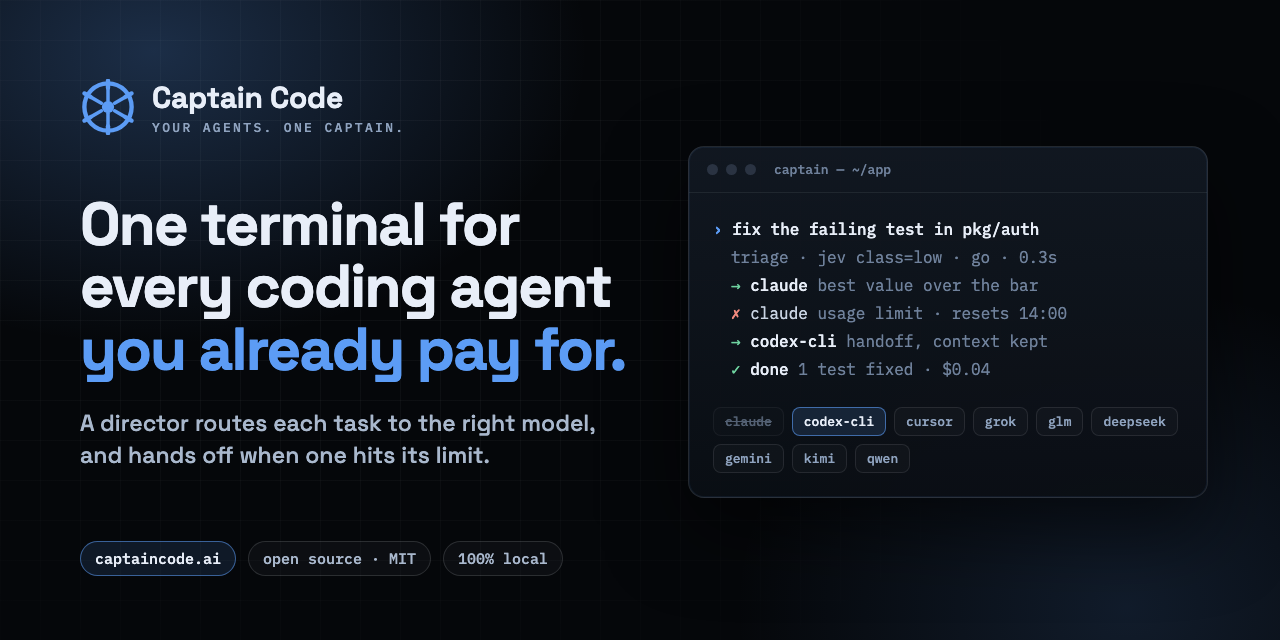
If your team sends every coding request to the most powerful model available, costs can rise without improving results. This guide shows how to classify tasks, route routine work to cheaper models, reserve frontier models for difficult reasoning, and verify the outcome on a real debugging example.
1. Classify the task before choosing a model
Start by labeling each request according to risk and reasoning depth:
- Routine: formatting, boilerplate, simple documentation, and small syntax fixes
- Verification: unit tests, test updates, lint fixes, and straightforward bug reproduction
- Transformation: refactoring across several files or changing an established pattern
- Complex: architecture changes, concurrency bugs, security-sensitive logic, and unfamiliar codebases
This prevents the common mistake of using a frontier model for every prompt. A cheap AI model for routine coding tasks is often sufficient when the required change is narrow and easy to verify. The deciding factor among dev-tools products is whether they support this exact workflow.
For example, “Add tests for this pure function” may need the best AI model for writing tests, but not the most expensive reasoning model. “Find why these requests occasionally deadlock” belongs in the complex category.
You can also compare routing approaches in this guide to routing every coding task to the right AI model.
2. Set a task-based routing policy
Create a simple policy before running the task:
- Send routine edits and boilerplate to a low-cost coding model.
- Send test generation and small debugging tasks to a capable coding model.
- Send broad refactors to the best AI model for refactoring code, especially when many files share dependencies.
- Use the best AI model for complex coding problems only when the issue requires deep reasoning, ambiguous diagnosis, or architectural judgment.
- Use frontier AI models only for hard coding tasks, not as a default.
The best AI model for debugging code depends on the failure. A reproducible typo or failing assertion can use a less expensive model. A nondeterministic production failure may justify a frontier model.
With Captain Code, you can define this routing through commands such as /cheap, /frontier, /team, and /workflow. Captain Code runs locally, uses configured subscriptions or open-weight deployments, and can explain a decision with captain why. This makes AI routing products relevant when you need inspectable task selection rather than manual model switching.
3. Apply the policy to a real debugging task
Suppose a checkout test fails because a discount is applied twice.
Use this sequence:
- Ask a lower-cost coding model to reproduce the failure and identify the relevant files.
- Route test creation to a suitable testing model. Request one failing regression test before changing implementation code.
- If the cause is a small conditional error, keep the fix on the lower-cost model.
- If the discount logic crosses services or depends on event ordering, escalate to a frontier reasoning model.
- Ask a second model to review the patch, then run the test suite locally.
Captain Code can assemble the right crew while keeping the workflow in one terminal. Its unified memory and ledger help preserve context, while commands such as /repeat and /interrupt support controlled reruns. For teams comparing orchestration patterns, dev orchestration products cover this exact operational concern.
4. Measure savings without weakening quality
Track each task in a small table:
- Task category
- Selected model
- Estimated or recorded usage
- Tests passed
- Escalations or retries
- Final review result
Then check whether cheaper routing caused more failed attempts or rework. Cost control is successful only when the total effort remains acceptable.
Common mistakes include routing by habit, skipping a regression test, and escalating too late on high-risk changes. Use captain why to inspect unexpected choices, and apply open-weight-only policies when governance requires them.