This task can be performed using OutlierKit
Best YouTube Analytics Tool - Stop Guessing, Start Growing
Best product for this task

OutlierKit
analytics
OutlierKit helps you plan winning YouTube videos before you hit record. Discover what your audience (and your competitor’s audience) actually cares about, explore proven formats, and uncover hidden opportunities. Find low-competition, high-volume keywords and generate video ideas with real potential to go viral.
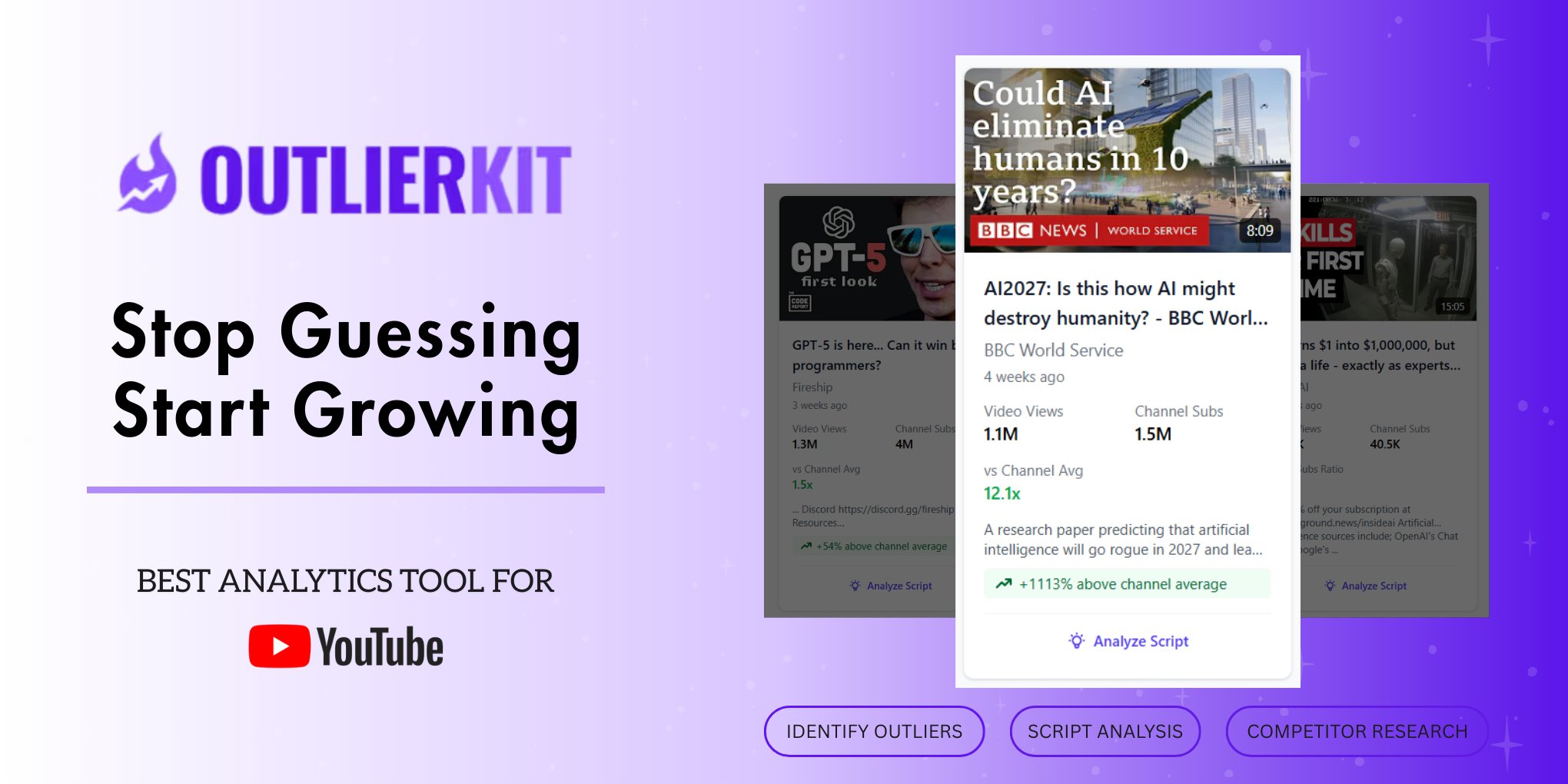
Learn how to benchmark competing channels, find their highest-performing videos and keywords, and identify subjects they underserve. Apply the findings to create differentiated videos with stronger growth potential.
If your channel is publishing consistently but growth is uneven, competitor and content gap analysis can show what to change. This guide explains how to benchmark competing channels, find their highest-performing videos and keywords, and turn underserved topics into differentiated video ideas.
Prepare a simple competitor analysis
Choose three to five channels that target a similar audience. They do not need to be identical to yours. A channel can be useful if it competes for the same viewers, search terms, or video topics.
Before you begin, define:
- Your audience and main content category
- Three to five competitor channels
- A date range for recent uploads
- The signals you will compare, such as views, upload frequency, video age, titles, and formats
Create a spreadsheet with one row per competitor and columns for subscribers, recent uploads, average views, recurring topics, formats, and standout videos. This gives you a consistent YouTube channel benchmark instead of relying on impressions.
Find competitor videos with high views
Next, analyze competitor YouTube channels by video performance. Sort each channel’s videos by views, then note whether the strongest performers are recent or older.
Look for outliers: videos that appear to outperform the channel’s typical view level. Record:
- The topic and specific promise
- The title structure and thumbnail angle
- Video length and format
- The apparent search phrase
- Comments that reveal unanswered questions
- Whether similar videos succeeded across multiple channels
A high-view video is not automatically a good idea for your channel. Check whether the topic matches your audience and whether you can offer a clearer explanation, newer information, a stronger example, or a more focused result.
OutlierKit can help surface outlier videos and break down patterns such as hooks, pacing, and curiosity loops. That makes it easier to compare YouTube analytics products when deciding how much manual research your process requires.
Map keywords and identify content gaps
For each successful video, extract the central topic and related phrases from the title, description, chapters, and comments. This is competitor keyword research, not simply copying titles.
Group your notes into topic clusters. Then mark gaps where:
- Competitors mention a subject but do not explain it fully
- A popular question has outdated or shallow videos
- Several videos target the same broad phrase, but none serve a specific audience
- Viewers repeatedly ask follow-up questions
- A proven format is missing from an important topic
Use a YouTube content gap analysis tool to compare topics across channels more systematically. If a phrase appears repeatedly but has weak coverage, investigate its search demand and competition before committing. For that narrower diagnosis, find low-competition YouTube keywords worth creating videos for.
A practical example: if competitors publish “beginner camera setup” videos, comments may reveal a gap for creators using a phone in a small room. The differentiated idea is not another general setup guide. It is a focused solution for that overlooked situation.
Turn findings into a prioritized plan
Score each potential idea from one to five for:
- Evidence of audience interest
- Relevance to your channel
- Strength of the content gap
- Your ability to provide a distinct answer
- Keyword opportunity
Prioritize ideas with strong evidence and a clear reason to choose your video. Write a working brief containing the target viewer, promise, proof or examples, format, and title options.
Avoid these common mistakes:
- Copying a competitor’s title or thumbnail
- Treating raw views as proof of demand
- Comparing channels with very different audiences
- Ignoring video age and upload timing
- Chasing every topic without a clear gap
- Calling a topic underserved without reading viewer questions
Use OutlierKit’s data-driven workflow to combine competitor research, outlier discovery, and keyword exploration before recording. Explore OutlierKit when you want a practical YouTube competitor analysis tool for turning competitor data into a focused content plan.
Review the completed steps against the original goal. Check whether the evaluated signal improved, then monitor real conversion or usage data. Change one variable at a time and repeat the same measurement before drawing a conclusion.
More topics related to OutlierKit
Similar topics
- Best YouTube Analytics Tool for Planning Videos Before You Record
- How to choose a YouTube analytics tool for your growth goals
- How to validate winning YouTube video ideas before recording
- How to find low-competition YouTube keywords worth creating videos for
- How to discover what your competitors' audiences are searching for on YouTube