This task can be performed using Episode
From idea to tested landing pages and ads, automatically
Best product for this task

Episode
marketing
Episode is an AI-driven marketing workspace that turns your designs or URLs into on-brand landing pages, matching ads, and search-focused content while you test, personalize, and optimize everything with built-in.
Choosing an AI landing page builder for growth teams means checking more than templates. Use this guide to compare tools for brand consistency, fast campaign launches, scalable testing, and minimal developer support. By the end, you can shortlist a landing page builder for startup growth teams, founders, or indie hackers and verify whether it fits your workflow.
1. Define the campaign before comparing tools
Start with one campaign and write down its requirements:
- Audience and traffic source
- Primary conversion, such as signup, demo request, or lead capture
- Required brand assets
- Launch deadline
- Number of variants you expect to test
- Developer availability
For example, a SaaS team launching paid search may need five audience-specific pages, matching ads, CRM-ready lead capture, and page-level analytics. An indie hacker may need one credible page built from a written prompt with no developer involvement.
This distinction matters. A landing page builder for indie hackers should reduce setup work. A landing page builder for founders should make iteration simple. A larger growth team needs campaign scale, controlled experiments, and clear reporting.
If you are comparing the broader marketing product category, keep the evaluation tied to this campaign rather than general feature counts.
2. Check how the builder preserves your brand
Ask how the tool creates a page from existing inputs. Useful options may include a URL, Figma file, design export, or prompt. The key question is whether the result keeps your visual system and message consistent without requiring manual reconstruction.
Run this test:
- Provide an existing brand page or design
- Review typography, colors, spacing, and imagery
- Check mobile layouts
- Confirm that forms and calls to action remain editable
- Compare the result with your approved brand guidelines
The [best landing page builder from Figma] should also support practical changes after import. If every copy edit requires engineering help, the initial speed advantage quickly disappears.
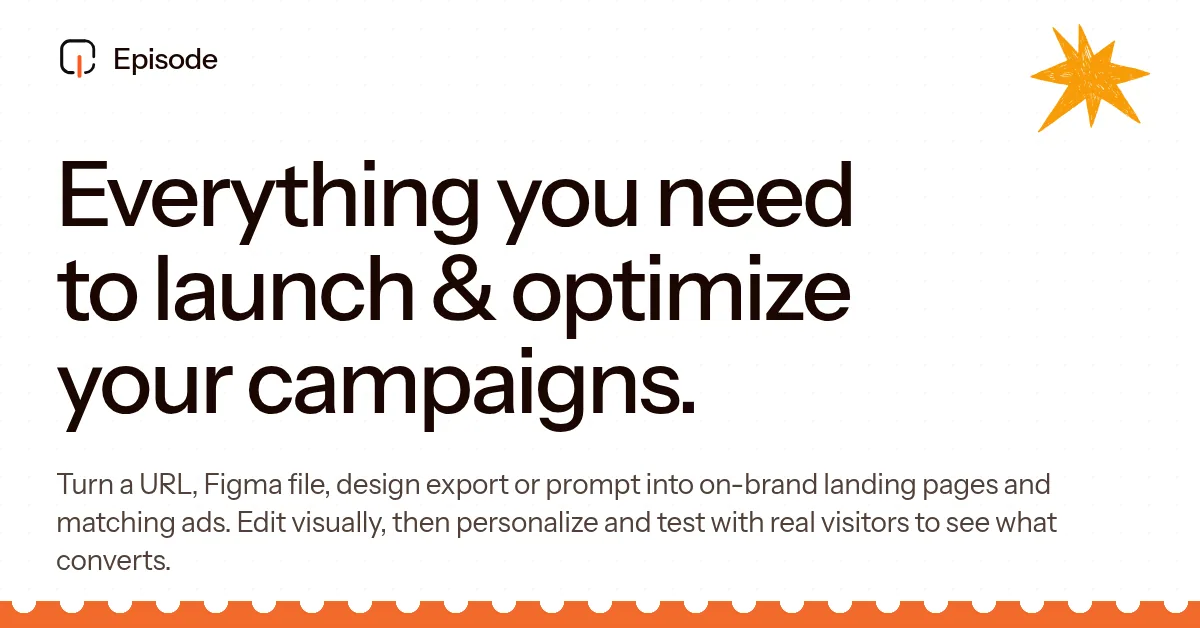
Episode can turn URLs, Figma files, design exports, or written prompts into on-brand landing pages. It also creates matching ad creatives, which is useful when campaign consistency extends beyond the page itself. See the landing page generator products category when comparing this specific capability.
3. Verify testing, personalization, and measurement
A fast launch is only valuable if your team can learn from it. Look for tools that let you create variants, target audience groups, and evaluate performance using real visitor traffic.
Before choosing, confirm that you can:
- Create multiple page versions without duplicating a disconnected workflow.
- Personalize experiences by audience.
- Run controlled or multivariate experiments.
- See page-level conversion and visitor data.
- Capture leads in a workflow your team can use.
Treat any automated evaluation or rescan as a signal, not proof of improved conversion. Monitor real conversion data after launch and compare variants against the same success metric.
This is where conversion optimization products become relevant. For paid campaigns, also check whether the tool supports the relationship between landing pages and ads, rather than optimizing each asset in isolation.
4. Test the workflow with a real campaign
Do not select the best AI landing page builder for founders from a feature list alone. Build a small test campaign and record:
- Time from brief to first usable page
- Number of developer requests
- Brand corrections required
- Time to publish a variant
- Clarity of analytics
- Ease of stopping or promoting a test
Common mistakes include choosing a tool that produces attractive but uneditable pages, ignoring mobile review, and testing without a defined conversion event. Another mistake is buying for one page when your roadmap requires repeated campaign launches.
Episode connects page creation, matching ads, experimentation, personalization, analytics, and search-focused content in one workspace. If that matches your campaign needs, review Episode and test it with your own assets.
More topics related to Episode
Similar topics
- How to turn a design into landing pages and matching ads with Episode?
- Create On-Brand Landing Pages and Ads From Any URL
- Best AI Marketing Workspace for Campaign Testing and Search Content
- How to build search-focused campaign pages from a URL with Episode?
- How to turn URLs, Figma files, and prompts into landing pages