Wire Reviews — Discover what people think of this product.

Wire
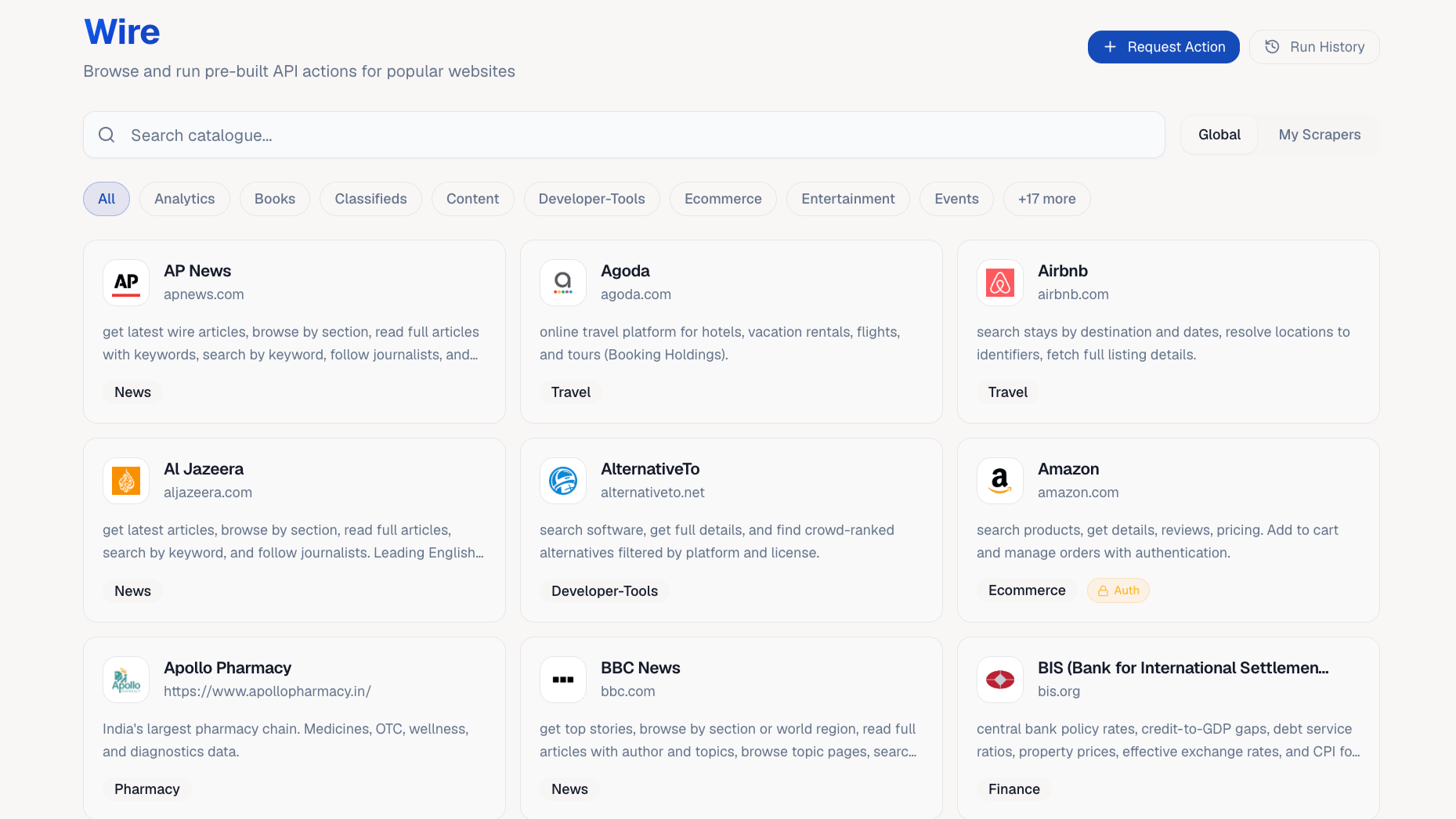
Browse and run pre-built API actions for any website.
- supporters
What does Wire help with?
Wire turns any website into managed APIs. Pre-built API actions for hundreds of popular websites: scrape, browse, extract structured data, and run automation tasks. Each action handles browser rendering, authentication, and structured data extraction. Jobs are processed asynchronously: submit a task and poll for results. Pick an API from our catalog, or request one and we'll build it for you. Replace fragile workarounds with clean API calls.
Key Features:
- Pre-built actions across hundreds of popular websites. Catalog covers travel, commerce, real estate, analytics, and many more categories, with new sites added regularly.
- Up to 1000x cheaper than scraping. Calls the underlying API directly. Kilobytes instead of megabytes, no proxy spend, no browser overhead, no LLM parsing costs.
- Skip the reverse engineering. No network inspection, auth tracing, or schema mapping. Wire handles the complexity for you.
- Discover and execute in one system. Search available services, inspect schemas, and run actions instantly through a single REST API with Python and Node.js SDKs.
- Identity-based authentication. An identity is a named account on a website. Each identity holds one or more credentials, the encrypted auth data needed to run tasks as that account.
- Automate systems that were never built for it. Portals, dashboards, legacy tools, and marketplaces. Wire turns them into callable APIs.
How It Works:
- Discover an action through the catalog or search to find an action_id and parameter schema.
- Submit a task to /v1/holocron/task with the action_id and your params.
- Poll for results using the returned job_id at /v1/holocron/jobs/{id}.
Use Cases:
- Web data extraction at scale. Pull structured data from sites without building or maintaining custom scrapers.
- Authenticated workflow automation. Run actions on platforms under stored user identities for order management, account operations, and listing changes.
- Legacy system integration. Turn portals, dashboards, and SaaS tools that lack public APIs into callable endpoints.
- Data ingestion for LLM and RAG pipelines. Feed real-time structured data into vector databases, retrieval layers, and context windows.
Featured Today

tiun
Payments backend for indie hackers
All-in-one: Auth, payments & DB
Single command: MCP, Skills
Built for developers.
Merchant of Record. Better fees.
Join the Microlaunch builder community
Get product updates, weekly standouts, and founder deals.