OpenClaw Launch Reviews — Discover what people think of this product.

OpenClaw Launch
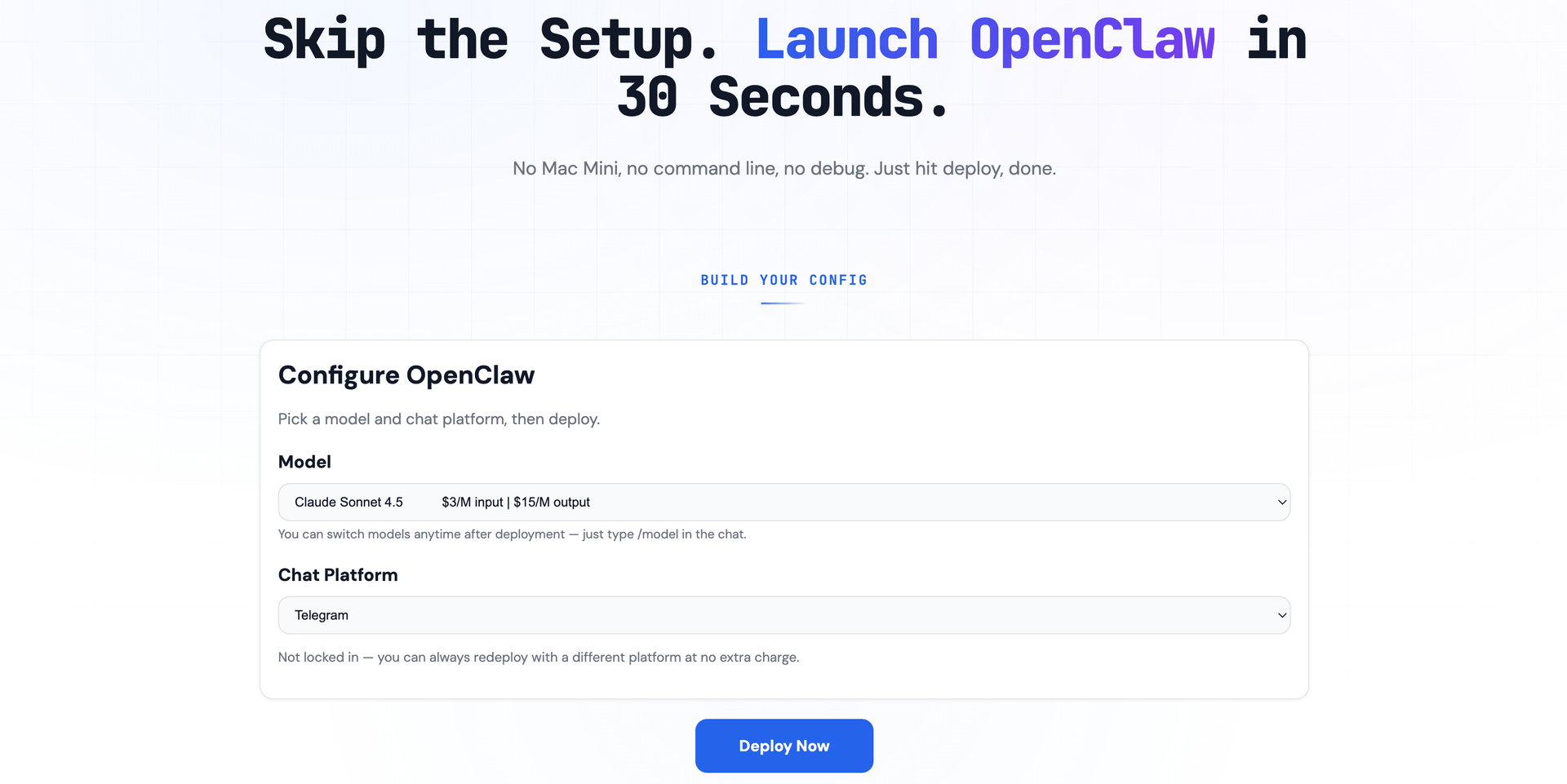
Deploy OpenClaw in 30 seconds. No code.
- supporters
What does OpenClaw Launch help with?
OpenClaw Launch is a fully managed deployment platform for OpenClaw, the open-source AI chatbot framework. It replaces the entire self-hosting workflow — servers, Docker, CLI, config files — with a visual browser-based editor and one-click deployment.
How it works
- Configure — Pick your AI model and chat platform from a visual form. No YAML, no JSON, no terminal. Supported models include GPT-5.2, Claude Opus 4.6, Claude Sonnet 4.5, Gemini 3 Pro, Gemini 3 Flash, DeepSeek V3.2, Kimi K2.5, and a free tier (Trinity Large Preview).
- Deploy — One click. Your bot is live in under 30 seconds. OpenClaw Launch handles Docker containers, networking, SSL/HTTPS, and monitoring automatically.
- Connect — Your bot is instantly reachable on Telegram, Discord, or the built-in Web UI. Manage everything — logs, start/stop/restart, configuration changes — from the dashboard.
What makes it different from self-hosting
- No hardware required — no Mac Mini, no VPS, no cloud VM
- No setup — no Docker install, no port configuration, no firewall rules
- No config files — visual editor replaces YAML/JSON editing and syntax debugging
- No deployment headaches — no SSH, no docker-compose, no praying
- No SSL management — HTTPS is included out of the box
- No monitoring scripts — built-in dashboard with real-time logs
- Time to launch: under 30 seconds vs. 2–6 hours for a manual setup
What people use it for
- WhatsApp and Telegram bots
- Email management
- Morning briefings
- Smart home control
- Web research
- Voice commands, calendar scheduling, meal planning, price tracking, competitor monitoring, and more
OpenClaw has access to over 5,700 community skills on ClawHub, covering everything from flight check-in and file management to Discord moderation and code review.
Security
- Each bot runs in an isolated Docker container with its own storage
- Gateway tokens are auto-generated and never shared
- Configurations are encrypted at rest
- All connections use SSL/HTTPS
- Your conversations, API keys, and data are never accessed or used for AI training
Featured Today

tiun
Payments backend for indie hackers
All-in-one: Auth, payments & DB
Single command: MCP, Skills
Built for developers.
Merchant of Record. Better fees.
Join the Microlaunch builder community
Get product updates, weekly standouts, and founder deals.