This task can be performed using GoldMine
Autonomous AI marketing agent for solopreneurs and small teams
Best product for this task

GoldMine
ai
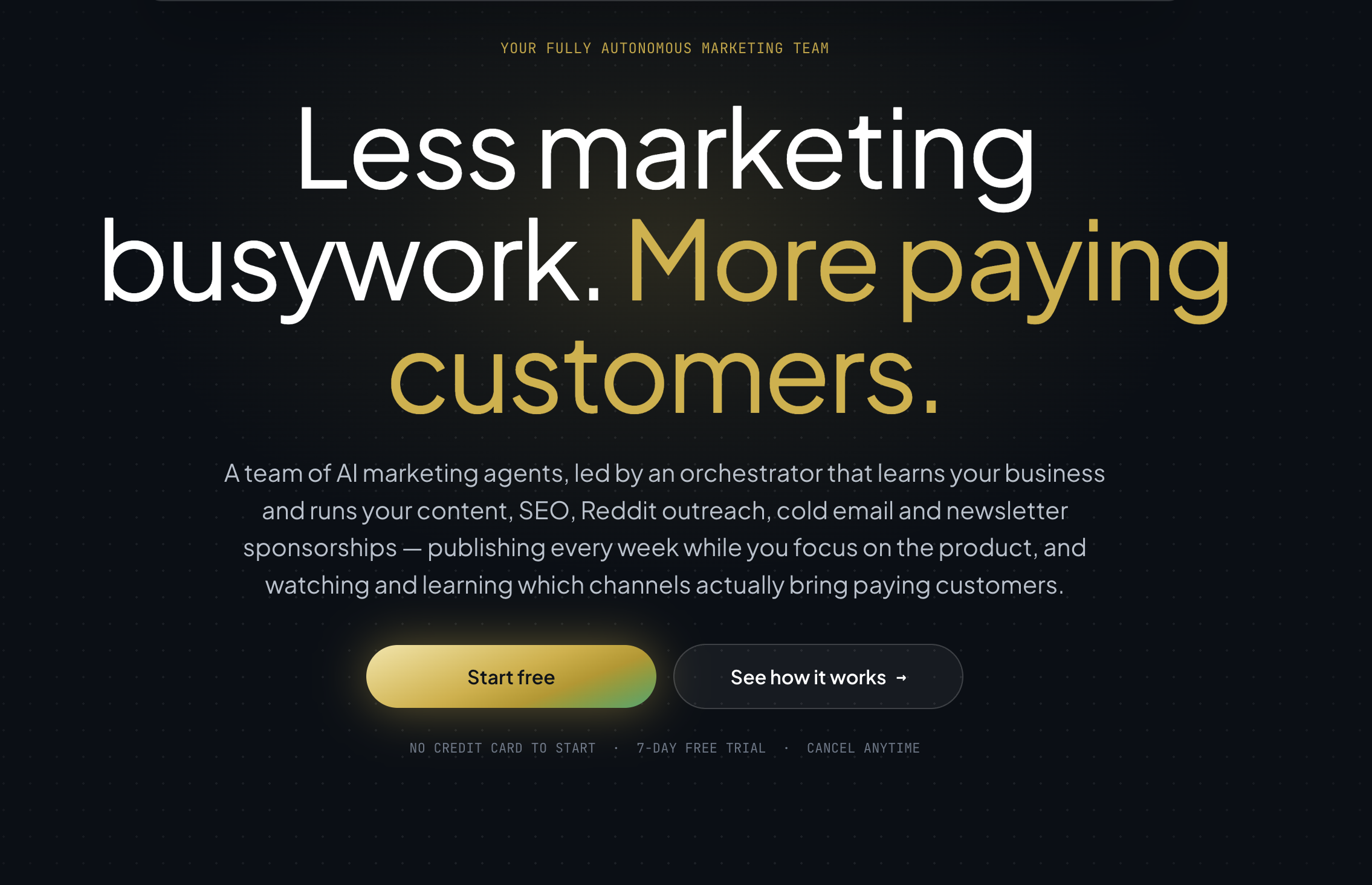
GoldMine AI is an autonomous online marketing agent designed for solopreneurs and small teams. It acts as a dedicated business brain—your "Cortex"—that learns and adapts to your marketing needs over time. Rather than managing every detail manually, you focus on high-level decisions: approving recommendations, providing feedback, and making strategic choices. The AI handles the execution of campaigns, optimization, and ongoing learning from results. Ideal for founders and lean teams looking to scale their marketing without hiring a full in-house team.
Choosing autonomous marketing software for founders comes down to one question: do you need another tool to operate, or an agent that can learn, recommend, and execute with limited supervision? This guide compares practical options for startup, SaaS, and indie hacker marketing automation, then shows how to choose a setup that fits your stage.
1. Define the level of autonomy you actually need
Before comparing tools, list the marketing work you want to delegate:
- Researching audiences and opportunities
- Recommending campaigns or content
- Launching marketing activities
- Optimizing based on results
- Learning from your feedback over time
A conventional automation platform usually follows rules you configure. It can be useful when your process is stable and your team has time to maintain it. AI marketing automation for startups is more suitable when you need help making decisions as well as carrying out repetitive work.
For example, a bootstrapped SaaS founder may want to approve a campaign direction while an agent handles execution and ongoing adjustments. An indie hacker may prefer a smaller system that reduces daily marketing decisions without requiring a full operations team.
If you are comparing the broader AI products category, focus on whether each option supports your desired level of founder involvement.
2. Compare the main approaches
Use this simple comparison before committing:
| Approach | Best fit | Founder workload | Main trade-off |
|---|---|---|---|
| Manual marketing | Early validation and highly personal outreach | High | Slow to repeat |
| Rule-based automation | Repeatable campaigns and established processes | Medium | Requires ongoing setup |
| Autonomous AI marketing | Lean teams managing changing priorities | Lower after direction is set | Requires review and feedback |
Manual work can be the right choice when you are still discovering your audience. Rule-based marketing automation for early stage startups works better when you already know the exact trigger, message, and action.
An autonomous AI marketing agent for SaaS startups is worth considering when your priorities change often and you need a system that can adapt. GoldMine AI is designed for solopreneurs and small teams, acting as a business “Cortex” that learns from your marketing needs over time.
The important distinction is not whether a tool uses AI. It is whether the tool helps with strategy, execution, optimization, and learning, rather than only generating copy.
3. Evaluate a tool with a founder-focused checklist
Ask these questions during evaluation:
- Can I set high-level goals without defining every task?
- Can I approve recommendations before important actions?
- Can I provide feedback that shapes future work?
- Does the system handle execution and optimization?
- Can I see what it is doing and why?
- Does it fit a solopreneur or small-team workflow?
Also check whether the tool matches your marketing maturity. For early-stage SaaS, an AI marketing tool for makers should reduce operational friction without hiding strategic decisions. For a larger startup, you may need more control, ownership, and review processes.
Do not choose based only on a polished demo. Test one meaningful marketing objective, define what approval looks like, and observe whether the system saves time without weakening your judgment. A useful AI marketing evaluation should be treated as an evaluated signal, not proof of improved conversions. Monitor real conversion data separately.
4. Choose, test, and verify the fit
Start with a limited evaluation:
- Write down one marketing goal and its audience.
- Define which decisions require your approval.
- Give the system relevant context about your product and priorities.
- Review its recommendations and execution.
- Provide specific feedback.
- Check whether later recommendations reflect that feedback.
- Monitor qualified traffic, leads, and conversions using your existing measurement process.
More topics related to GoldMine
Similar topics
- Best Autonomous AI Marketing Software for Solopreneurs and Small Teams
- Best Autonomous AI Marketing Software for Solopreneurs and Small Teams
- AI Marketing Agent vs. Hiring a Freelancer, Marketer, or Agency
- How to scale solopreneur marketing without hiring a full team?
- How to automate marketing campaigns with AI for a small business?