VirtuProbe Studio Review (2026) - Let Your AI Agent Test the Entire Stack
Combine 11 protocols, reusable workflows, scripting, and supervised MCP execution inside one local workbench.

SaidAitmbarek
September 25, 2026
When one test starts with an API call, continues through email, and ends in a database, a normal HTTP client stops being enough.
Most integration tests don't stay inside HTTP. A signup flow creates a user through an API, sends a verification email, and writes a row to a database. Testing it usually means Postman for the request, a mail client or IMAP script for the email, the terminal for DNS, and a database client at the end, all glued together with a one-off script.
VirtuProbe Studio is built to replace that tool sprawl. It's a local-first cross-protocol testing workbench: think Postman for workflows that don't end with HTTP. It covers 11 protocols, from SMTP and LDAP to PostgreSQL and MongoDB, lets you chain them into one reusable test, and ships a local MCP server so an AI coding agent can run those tests under your supervision.
This review walks through how it works: setup, probes, cross-protocol chains, scripting, the MITM proxy, agent-driven testing, how it compares to Postman, and what's free versus paid.
Quick take: VirtuProbe is most convincing when one test crosses several systems. If you only send REST requests, much of its depth will be unnecessary.
Disclosure: VirtuProbe Studio launched on Microlaunch, the platform I run. Links marked ?ref=microlaunch are referral links.
What Is VirtuProbe Studio?
VirtuProbe Studio started four years ago as a Burp Suite Pro plugin. Its maker needed a reusable request manager, and the plugin kept growing until it became a standalone app.
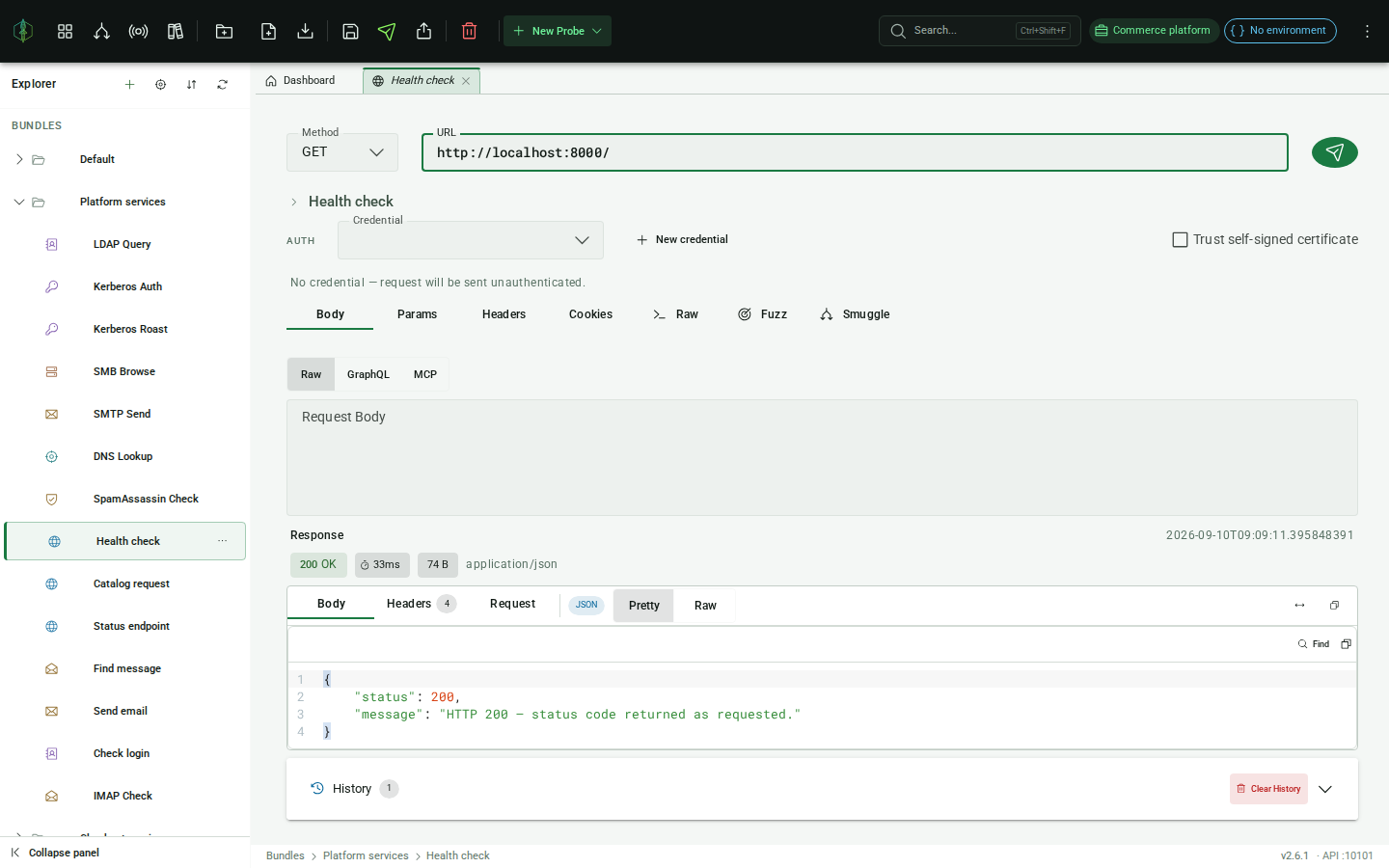
The probe library supports HTTP/HTTPS, SMTP, IMAP, DNS, LDAP, SpamAssassin, SMB, Kerberos, MySQL, PostgreSQL, and MongoDB.
Each saved interaction is a probe: a target, request, optional credentials, extractors, and assertions. Run it alone, place it in a chain, or follow the first-probe walkthrough.
That is the difference from a normal API client: every protocol can join the same test.
Installation and First Setup
VirtuProbe is a desktop application for macOS, Windows, and Linux. The official installation guide is short: macOS uses a DMG, Windows an installer, and Linux an AppImage that must be launched with --no-sandbox on most distributions.
How I reviewed it: I tried the Linux AppImage on Ubuntu 20.10, an old non-LTS release, and it wouldn't start even with the documented flag. That says more about my machine than about Linux support in general, but it means this review is based on the product's interface, workflows, and documentation rather than a full local test run.
There is no mandatory account. Projects, requests, environments, and credentials use local workspace storage by default.
On first launch, VirtuProbe creates a local database, project, and development environment. The interface looks more like an IDE than a SaaS dashboard:
- Project Explorer on the left
- Editor tabs across the workspace
- Projects and environments in the top bar
- Probes, chains, scripts, suites, and skills organized into bundles
Creating the First Probe
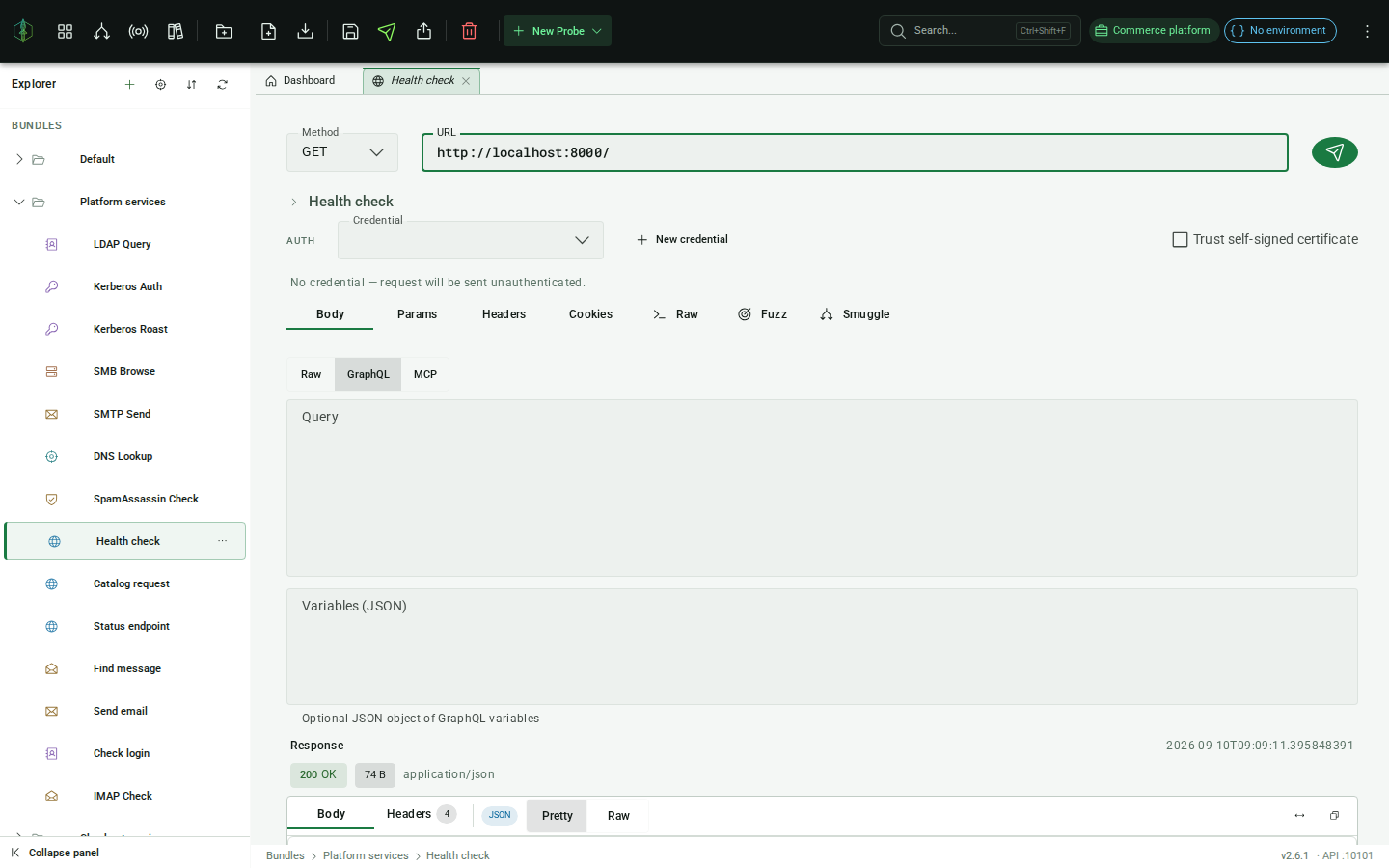
The easiest place to begin is an HTTP probe. Add the method, URL, headers, authentication, and body, then run it. Results stay in history, turning the request into a reusable test.
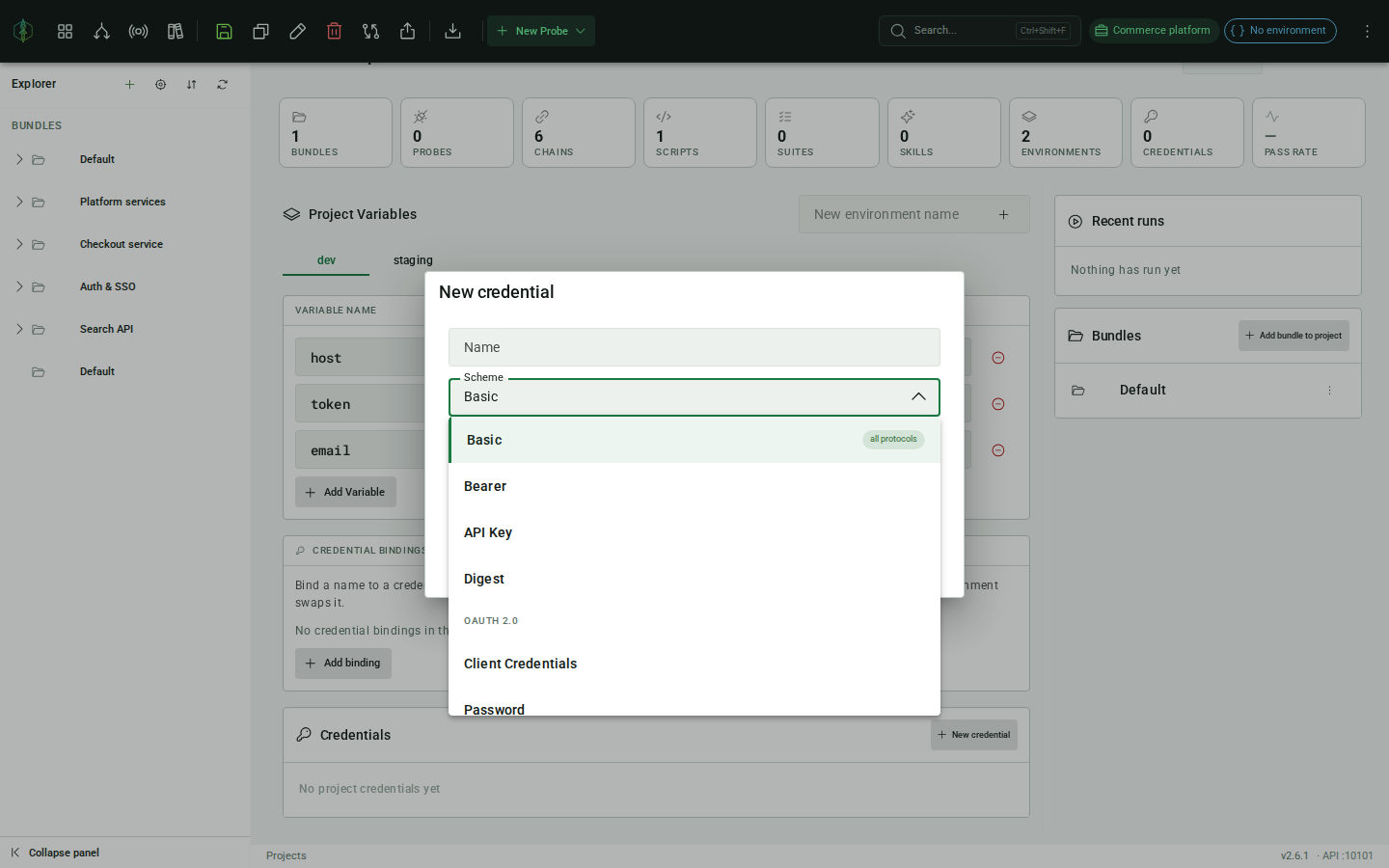
HTTP authentication covers Basic, Bearer, API keys, Digest, and OAuth 2.0. The paid tiers add NTLM, pass-the-hash, SPNEGO/Kerberos, AWS SigV4, and scripted authentication.
Environments work as expected: define variables for development, staging, or production, reference them with {{variable}}, and switch targets without editing the probe itself. Credentials are stored separately and can be scoped globally or to one project.
The editor keeps request and response side by side, including status, latency, headers, and raw data. Variables resolve when sent, so secrets stay outside the probe.
Cross-Protocol Chains Are the Main Differentiator
This is where VirtuProbe justifies another testing app.
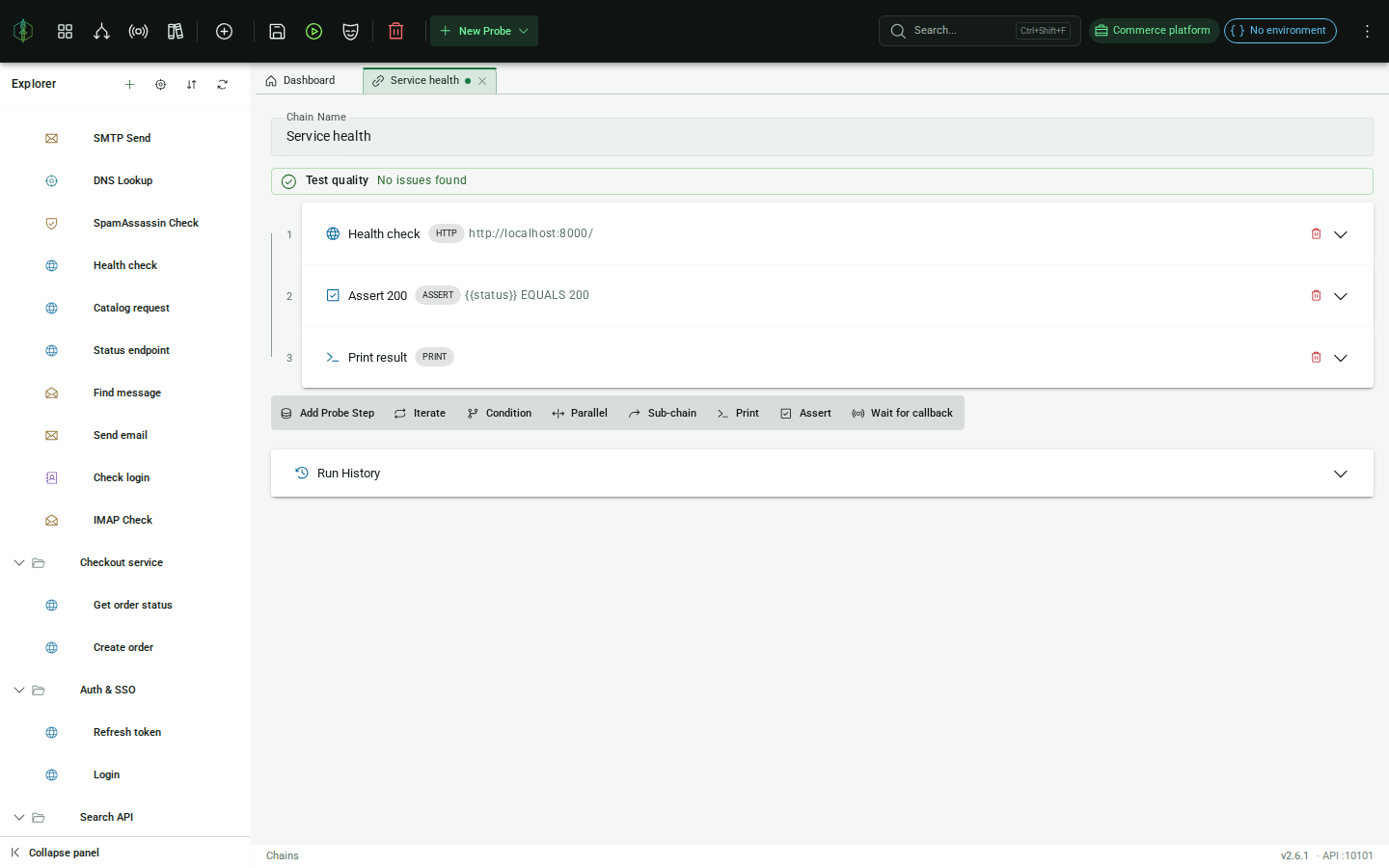
A chain is an ordered workflow made from saved probes. You can extract a result into a variable and pass it to the next step. A signup test could look like this:
- HTTP: create the user through the API
- IMAP: fetch the verification email
- Extractor: pull the verification token from the email body
- HTTP: call the verification endpoint with that token
- PostgreSQL: confirm the account is marked as verified
Chains also support assertions, delays, conditions, and iteration. That covers reusable integration-test workflows, mail delivery checks, identity flows, and security work that crosses several systems.
Because every step is a saved, named probe, the whole flow stays inspectable in a way a long notebook or one-off script rarely is.
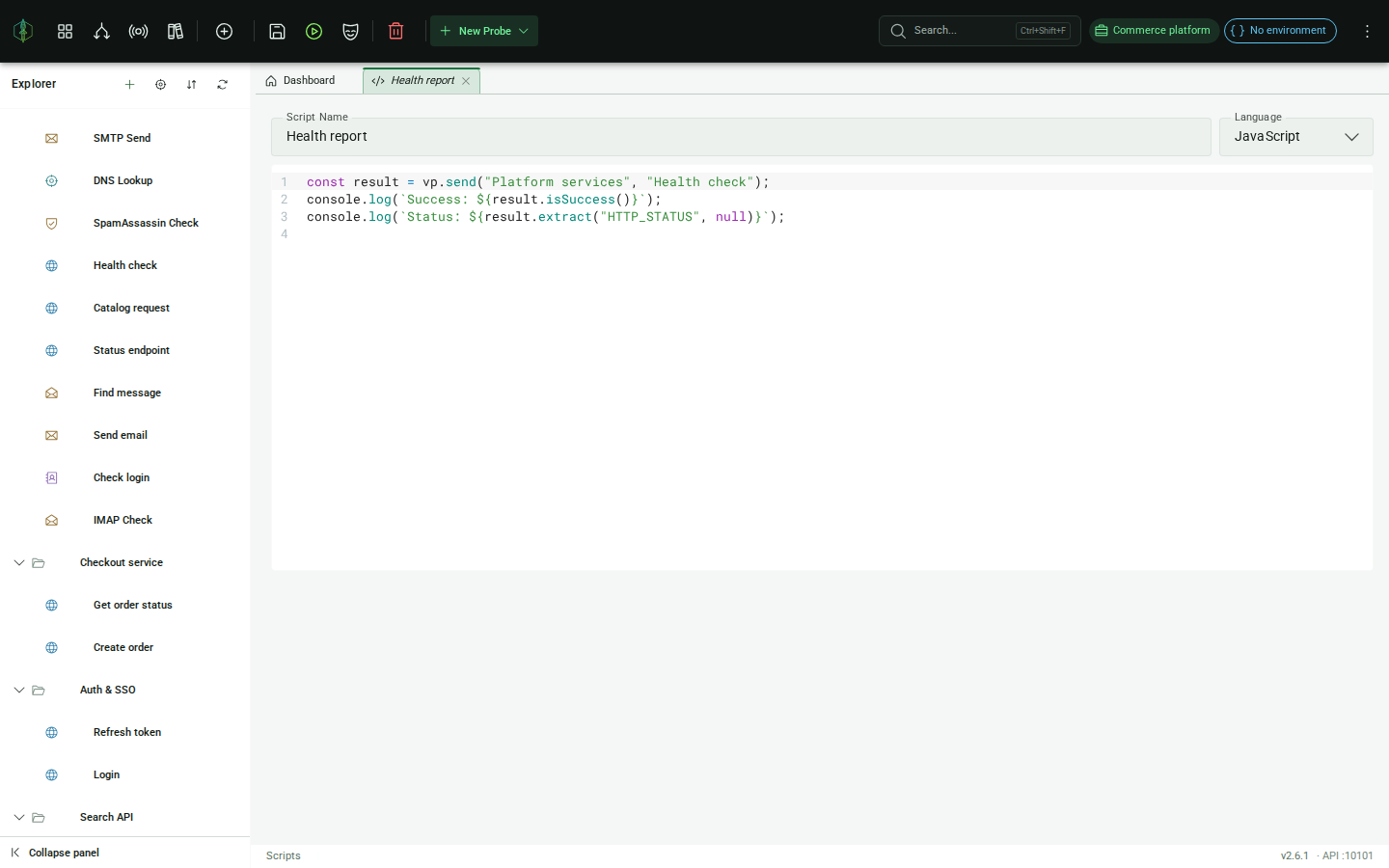
JavaScript and Groovy Scripting
For branching, loops, or custom output, the script editor supports JavaScript and Groovy through an injected vp API.
In practice, scripting adds:
- Conditional logic and dynamic iteration
- Variable overrides at runtime
- Access to response status, headers, and body
- Protocol-specific extractors
- Reusable JavaScript and Groovy automation without external glue code
The engines cannot load third-party packages, so JavaScript require/import and Groovy @Grab are unavailable.
MITM Proxy and Service Virtualization
The paid tier also includes a built-in MITM proxy. Point a client at it, inspect the captured traffic, filter the noise, and turn a useful exchange into a reusable probe.
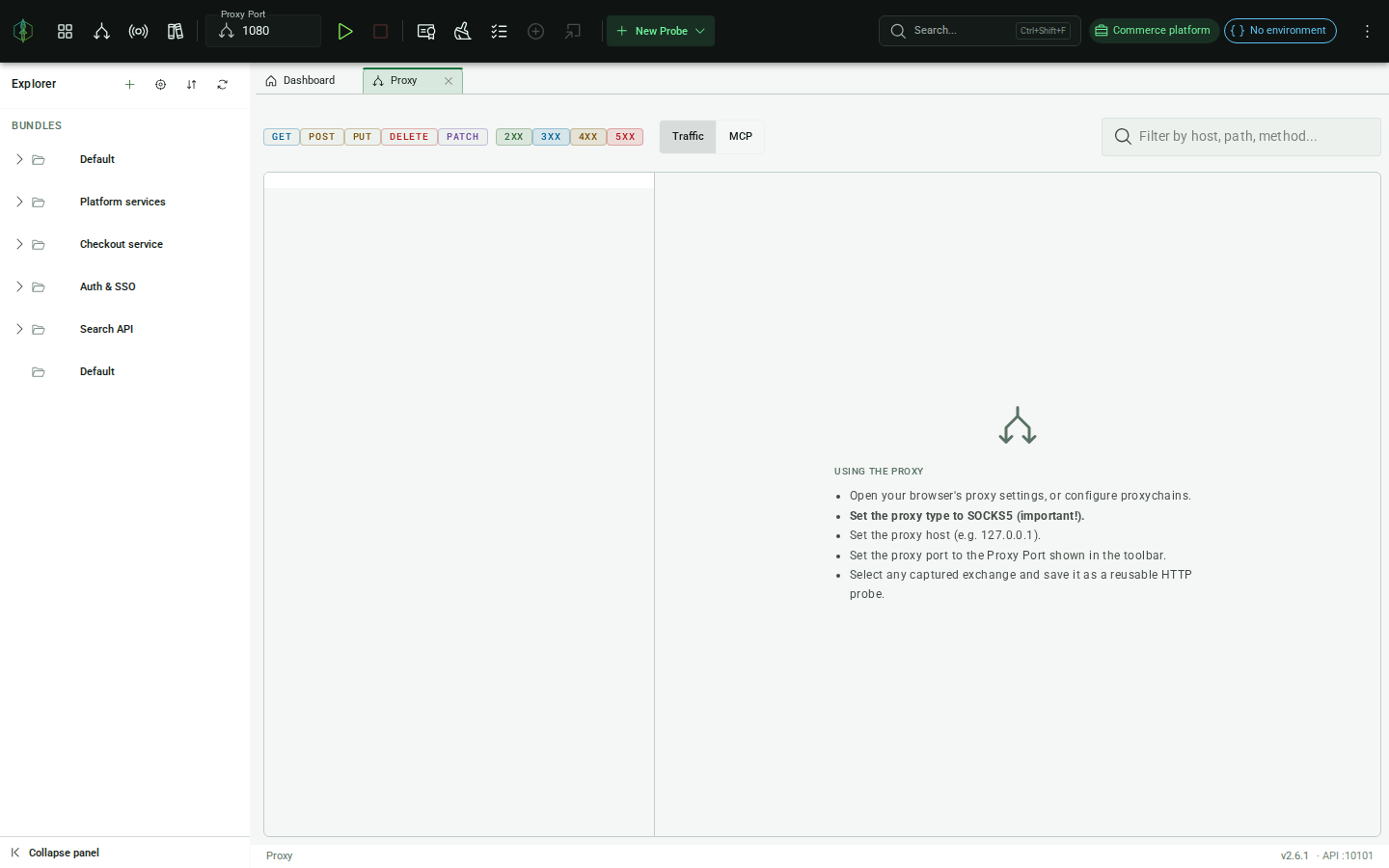
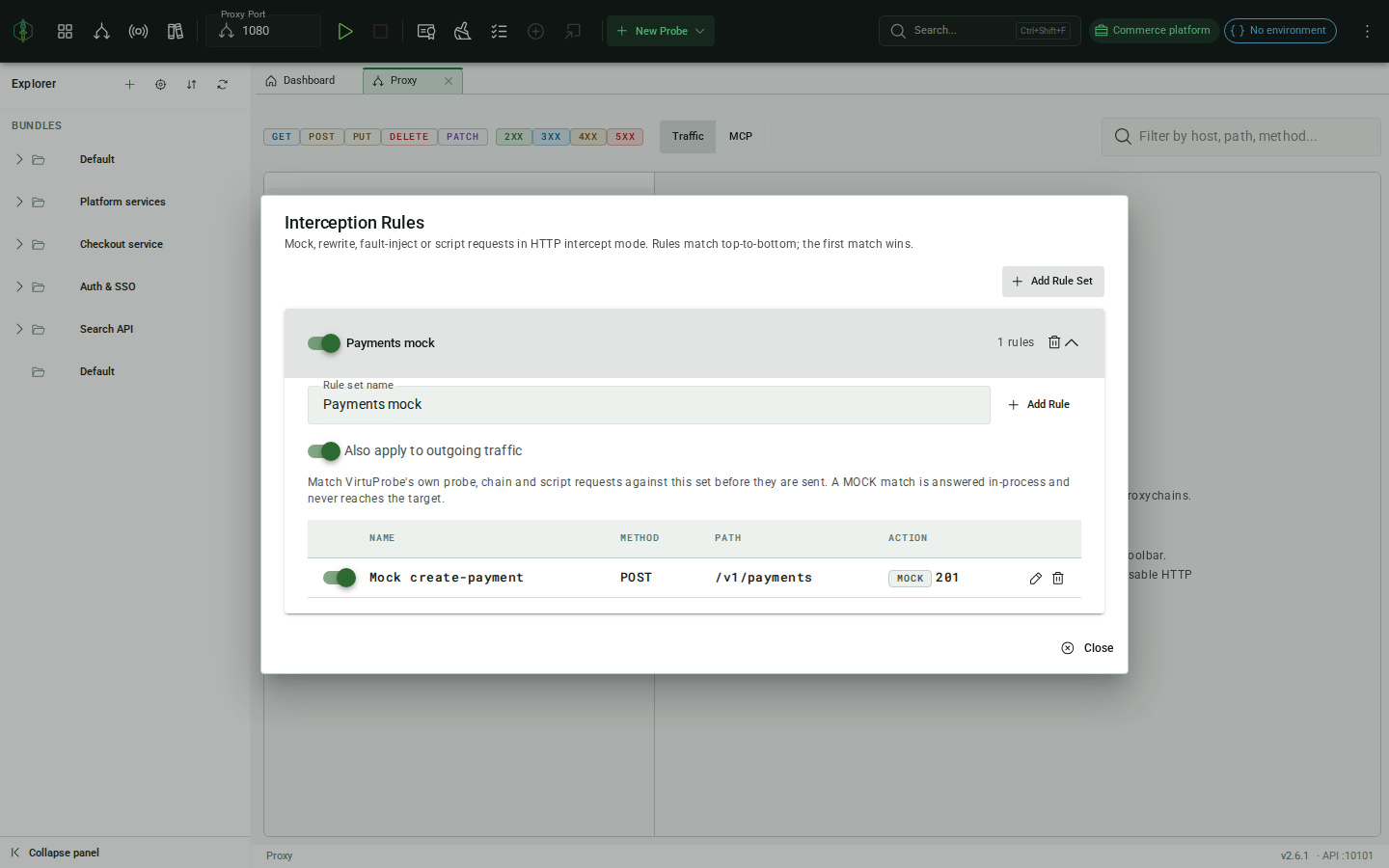
Proxy rules can mock or rewrite responses, forward requests, inject errors or latency, and run scripts against live traffic. That's enough to simulate a dependency failure without a separate mock server.
MCP and Agent-Driven Testing
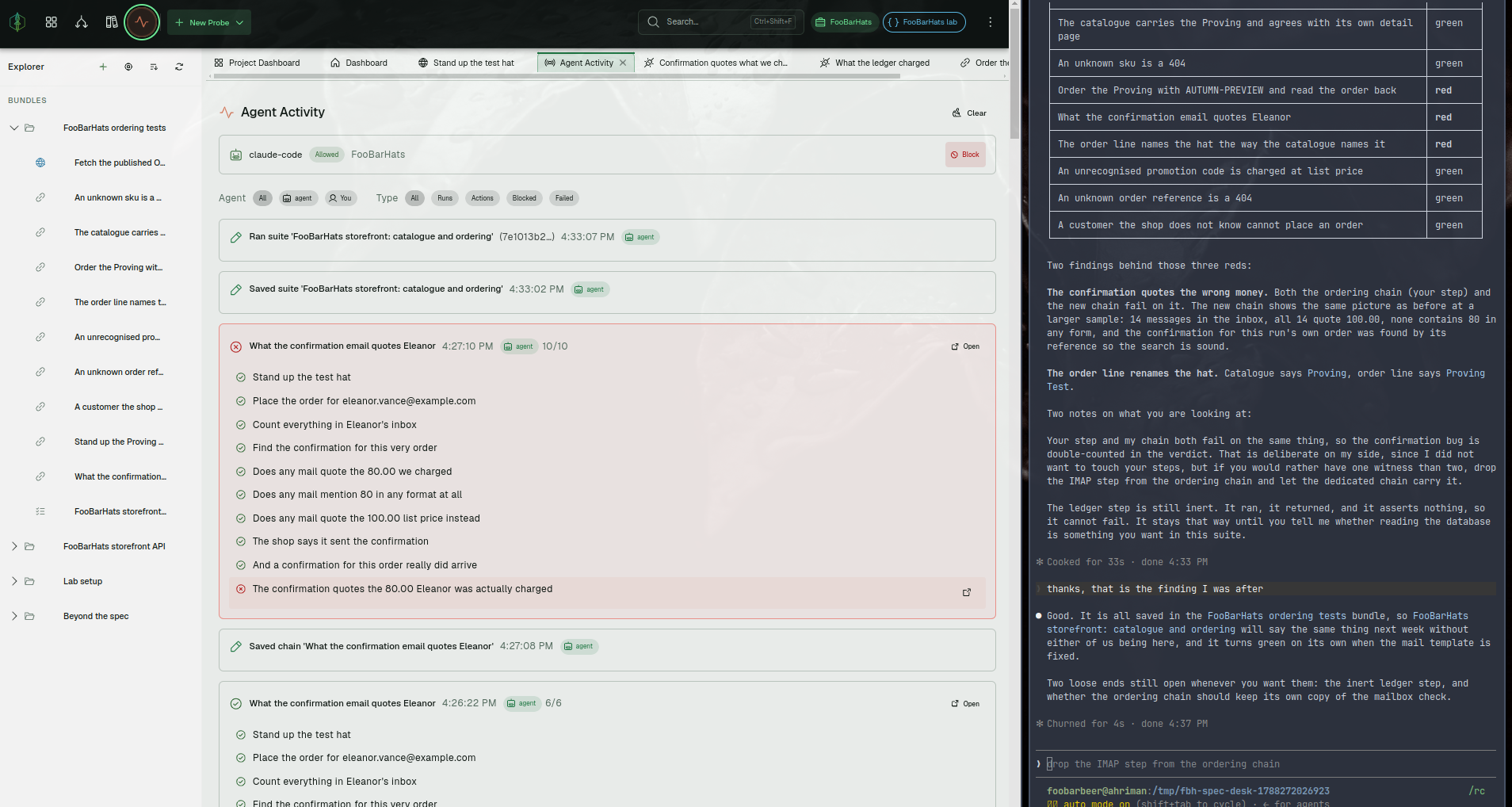
VirtuProbe also includes a local MCP server. A coding agent can connect, discover the available tools, create or run tests, and return the evidence.
The split is straightforward:
- The agent decides what should be tested
- VirtuProbe executes the test consistently
- The user approves write or execution access
- Agent-triggered runs remain visible in the activity stream
Credential bindings cannot be chosen freely by the agent. They are resolved through the environment, reducing the risk of an agent sending a stored secret to an arbitrary host.
There is also a BYOK assistant that works with any OpenAI-compatible API. It can explain responses and help build or run chains and scripts.
The agent event stream shows which agent connected, what it changed or ran, and how each step ended. You choose which projects it can access and can block it mid-session.
VirtuProbe vs Postman: When a REST Client Isn't Enough
Postman is the default for API work, and for REST, GraphQL, and other HTTP-style APIs it remains the easier choice, with a far larger ecosystem and team collaboration built around its cloud workspace.
VirtuProbe starts where those tests leave HTTP:
| Postman | VirtuProbe Studio | |
|---|---|---|
| Core focus | HTTP-style APIs | Workflows across HTTP, email, DNS, LDAP, databases, and Windows protocols |
| Storage | Cloud workspace, account-based | Local by default, no account required |
| Email, DNS, and database steps | External tools or scripts | Native probes inside the same chain |
| Ecosystem | Large and mature | Small and young |
Stay with Postman if your tests begin and end with API calls and your team relies on shared cloud collections. Try VirtuProbe if your tests keep spilling into mail servers, directories, and databases, or if credentials must stay on your machine. There's a longer breakdown in the Postman alternative for local cross-protocol testing guide.
Free and Paid Capabilities
| Tier | What it covers |
|---|---|
| Free | HTTP, DNS, and SMTP testing, chains, extractors, assertions, and MCP/BYOK support. No account and no monthly request allowance. |
| Paid | More protocols, JavaScript/Groovy, advanced authentication, suites, proxying, and service virtualization. |
| Security | Out-of-band detection, fuzzing, raw TCP/UDP probes, SMB, and Kerberos. |
Check the VirtuProbe website for current pricing.
Pros and Limitations
Pros
- Tests 11 protocols in one workspace
- Local-first, with no mandatory account
- Cross-protocol chains solve real integration-testing problems
- Reusable probes, environments, credentials, extractors, and assertions
- JavaScript and Groovy for complex scenarios
- MCP server and supervised agent execution
- Useful free tier for HTTP, DNS, and SMTP
Limitations
- More complex than a basic REST client
- Full value appears only when your tests cross protocols
- Advanced protocols and scripting require a paid license
- Script runtimes cannot import third-party libraries
- Smaller ecosystem and community than Postman or Burp Suite
- Agent access still requires careful credential and approval setup
Who Is VirtuProbe Best For?
VirtuProbe makes the most sense for:
- Integration engineers testing complete workflows
- QA teams working across APIs, email, identity, and databases
- Security testers who need protocol depth and local control
- Backend developers replacing a mix of request tools, notebooks, and glue scripts
- Technical teams that want agent-assisted testing through MCP
It may be excessive for someone who only sends occasional REST requests and does not need chaining, scripting, or additional protocols.
FAQ
Is VirtuProbe Studio free?
Yes. The free tier covers HTTP, DNS, and SMTP testing, along with chains, extractors, assertions, and MCP/BYOK support. It needs no account and has no monthly request limit. More protocols, scripting, and the proxy require a paid tier.
Does VirtuProbe store my data in the cloud?
Not by default. Projects, requests, environments, and credentials live in local workspace storage. The optional BYOK assistant talks to whichever OpenAI-compatible API you configure.
Which operating systems does it support?
macOS (DMG), Windows (installer), and Linux (AppImage, usually launched with --no-sandbox).
Can AI coding agents use VirtuProbe?
Yes. Its local MCP server lets an agent discover tools and create or run tests, while you approve write and execution access. Credentials are resolved through the environment instead of being chosen by the agent. See how to connect an MCP agent to a testing workbench.
Can VirtuProbe replace Postman?
For tests that cross protocols, it can replace Postman plus the extra tools you'd need around it. For pure REST work with shared team collections, Postman is still simpler.
Final Verdict
VirtuProbe is built around a problem I recognize: a real integration test rarely stays inside HTTP. Its answer is to turn the API call, email, DNS lookup, database check, and whatever follows into one reusable workflow.
The local-first model is not a minor detail either. Projects and credentials do not have to be pushed into a cloud workspace just to send a request.
The tradeoff is obvious once you look at the interface: there is more to learn. Projects, probes, bundles, environments, chains, and scripts are a lot if all you need is the occasional REST request.
My verdict: broad and unusually capable, and valuable because the pieces work together, not because the feature list is long.
If your testing already involves several apps, terminal commands, and glue scripts, VirtuProbe Studio on Microlaunch is worth a look. The free HTTP, DNS, and SMTP workbench is enough to understand the model before paying for the wider protocol and scripting stack. For more tools in this space, browse the developer tools on Microlaunch.
Sources: VirtuProbe Studio · Official documentation · VirtuProbe Studio on Microlaunch